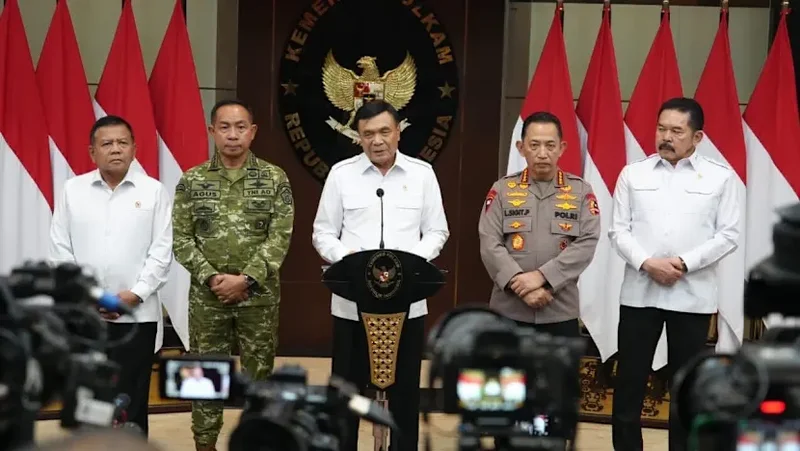
Indonesia’s security minister Djamari says country remains ‘secure’ amid unrest speculation, misinformation online
Coordinating Minister for Political and Security Affairs Djamari Chaniago’s call for calm came on the heels of a study by Monash University Indonesia on a possible disinformation campaign where videos of past demonstrations in the country had been recirculated online.
JAKARTA: Indonesia’s domestic security situation remains stable and under control ahead of next week’s Independence Day celebrations, said its Coordinating Minister for Political and Security Affairs Djamari Chaniago, urging the public not to be influenced by “disinformation” circulating online about possible unrest.
“The domestic situation remains secure and fully under control. We are not being complacent, we continue to monitor all developments,” Djamari was quoted as saying by local news outlet Jakarta Post at a press conference on Wednesday (Aug 5).
The minister’s call for calm came on the heels of a study conducted by researchers from Monash University Indonesia that found that videos of past demonstrations in the country had been recirculated online in a possible disinformation campaign.
According to Jakarta Post, Djamari said on Wednesday that there has been a rise in social media posts containing allegedly unverified claims that large-scale protests would erupt this month on specific dates, raising concerns of a repeat of the violent unrest seen across Indonesia last year driven by economic grievances among others.
The security minister said that the videos - which included recycled clips of protests in 2025 - did not reflect the current situation in Indonesia.
Local media further reported that these videos had been presented as current events, amid unverified claims online that the country’s mainstream media organisations have deliberately ignored the protests.
Over the past week, shopping malls and office buildings in several Indonesian cities have installed metal barriers in a move deemed to be in anticipation of possible protests, with Jakarta Governor Pramono Anung later reassuring businesses and the public that the Indonesian capital remains safe.
Echoing this, Djamari said that daily life across the country continues as normal, with business activities, public services and shopping centres operating without any disruption.
He added that global uncertainty continues to affect countries around the world, including Indonesia, but that the government is working to reduce its impact on the public and ensure that its programmes can continue without disruption.
At the press conference that was also attended by Indonesian military commander Agus Subiyanto and national police chief Listyo Sigit Prabowo, Djamari said that the government has been monitoring the spread of hoaxes and disinformation on social media, including posts and videos falsely depicting violent protests in the country.
"We will identify the accounts involved. If there are indications that their actions constitute a criminal offence, we will take firm legal action," he said.
Djamari warned that the police would enforce the law “without compromise”, as he urged the public to not be distracted by unverified information ahead of the Independence Day celebrations on Aug 17.
Listyo said that security preparations are being stepped up ahead of the celebrations and the police are working with related ministries and regional administrations to maintain security and stability.
“We are continuously coordinating to ensure that all events leading up to the Aug 17 celebrations, including a series of programmes already organised by the government, can run safely and smoothly,” Listyo said, as quoted by Jakarta Post.
Over the past week, shopping malls and office buildings in Jakarta, Surabaya, Yogyakarta and Surakarta, erected tall metal fences around their premises amid the speculation about possible demonstrations, with some barriers reaching between 2m and 5m high and topped with pointed spikes, news outlet Kompas reported.
Some of these fences have since been removed.
The protests in August 2025 had forced some shopping malls to temporarily close after demonstrations escalated into violence in several Indonesian cities.
The unrest had intensified after a motorcycle taxi driver was fatally struck by a police vehicle during a protest in Jakarta. Several people were killed and others injured, with losses estimated to run into billions of rupiah.
POSSIBLE DISINFORMATION CAMPAIGN
Separately, an analysis by Monash University Indonesia researchers and cited by various local media outlets found that the spread of recycled posts about past demonstrations being presented as current events was a coordinated move and unlikely to have been carried out organically.
The study had analysed about 197,000 social media posts between Jul 26 and Aug 1 containing keywords including “demonstration”, “action”, “students”, “video” and “coverage” and found unusual reposting patterns.
Some accounts were also found to have reposted content at speeds that the study claimed to be difficult for humans to achieve manually, suggesting the possible use of automated tools, scripts or bulk reposting systems meant to increase engagement.
The researchers also identified some recurring patterns in these social media posts - including what they describe to be a sense of urgency and an inflation of the scale of the protests.
For example, most of these posts began with phrases such as “PROTEST TODAY”, “IN THE PAST FEW DAYS”, “EMERGENCY”, written in capital letters, Detik reported the study as saying.
The purported protests were also presented as being “massive”, “happening everywhere” or “taking place simultaneously across Indonesia”.
Ika Idris, one of the researchers, warned that the spread of misleading online posts about street protests risks blurring the line between authentic information and manipulated content. She noted that this could potentially delegitimise genuine protest movements while reinforcing claims that the demonstrations were being orchestrated.
"In this situation, the biggest casualty is not any particular political group, but the public's ability to distinguish what is real from what is not," she said, as quoted by Detik.