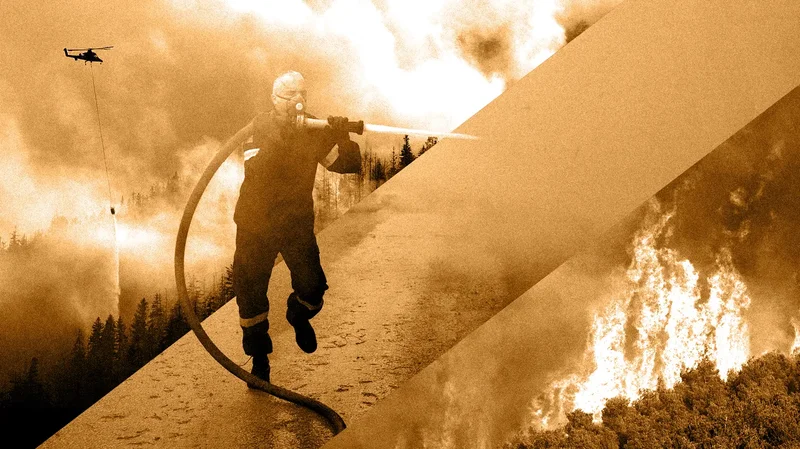
SEATTLE — Wildfire smoke blanketing this coastal city and much of the West is bringing an ominous reminder that the reach of destructive fires is growing. Why it matters: Climate scientists study how global warming increases the odds of wildfire. People living through it are confronting a more immediate question: where is truly safe anymore?The big picture: Wildfires intensified by climate change are like an unforgiving spotlight sweeping across the world. No one really knows where it will stop next.Driving the news: Right now, that spotlight is on Spokane, Washington, where a historic wildfire has destroyed neighborhoods and remains uncontrolled. Fires are also burning in the Bordeaux region in France, outside Madrid and in British Columbia."I don't think we've had one single year in the past decade where there hasn't been at least one catastrophic fire event of some magnitude that looks just like this," said climate scientist Daniel Swain, in a virtual presentation Monday showing Spokane neighborhoods burned to the ground.Catch up quick: Catastrophic fires have repeatedly destroyed populated communities:Fort McMurray, Alberta (2016); Santa Rosa, California (2017); Paradise, California (2018); Australia's "Black Summer" (2019-20); Oregon Labor Day fires that reached the edge of Portland (2020); Denver suburbs of Louisville and Superior, Colorado (2021); Lahaina, Hawaii (2023); Pacific Palisades, California (2025).My thought bubble: Tragically, we must add Spokane to that list. The fires were a wake-up call for my parents, who live in another part of the city near forested land.We didn't talk about climate change. We talked about evacuation plans and how quickly they could get their cats into carriers.Reality check: Climate change doesn't cause wildfires, which have always been part of nature. Spokane itself suffered a devastating wildfire in 1991.But climate change is creating hotter weather and drier vegetation that make wildfires larger and more intense.Meanwhile, population growth into fire-prone landscapes is also increasing exposure.Threat level: When those latent trends intersect with highly variable factors — high winds, lightning or even a suspected arsonist, such as in Spokane — devastating fires are ignited.What they're saying: "Wildfires may look random on a map, but they're rarely random from a risk perspective," said Firas Saleh, who directs wildfire models at Moody's.Places as varied as Spokane, France and Hawaii share hotter temperatures, longer fire seasons, more burnable vegetation and growing development in fire-prone landscapes, Saleh said.Between the lines: Climate change is only one factor behind destructive fires, making direct attribution difficult — and often beside the point for people living through them.Susan Prichard, a forest ecologist at the University of Washington, said she wonders if the scientific community made a mistake assuming people would become more concerned about climate change as extreme weather — made worse due to climate change — becomes more common."I'm not a social scientist, but I do know through lived experience that saying 'it's getting so bad, are you now going to be part of the solution?' doesn't seem to work," said Prichard, who has evacuated from the small town where she lives in the Cascade foothills in Washington, five times in the last 20 years due to wildfires.Zoom in: A few days after Saturday's onslaught of fires, I asked my parents if they had thought about climate change. Not really, they said, as they were still focused on the crisis at hand, though they added they also see the climate connection. "I just want summer to be over," my mother said.That is an increasingly common refrain in these parts, unfortunately."That's a form of coping: How do we manage the terror and dread of it all?" said Claire Rapp, a Colorado State University scientist specializing in behavior science and wildfires.Once the immediate crisis passes, Rapp recommends developing an evacuation plan and improving household preparedness while recognizing that climate change is increasing overall wildfire risk.Zoom out: More Americans say they've personally experienced climate change as heat, wildfire smoke and floods become more common, according to Yale University research. But recognizing climate change and thinking about it in the middle of a disaster are two very different things.What we're watching: That disconnect helps explain why two conversations increasingly happen in parallel: One about near-term adaptation and another about long-term climate mitigation. Cutting greenhouse gas emissions matters over decades, but it doesn't help someone deciding whether to evacuate tonight.What's next: More wildfires, I'm afraid.The bottom line: "It's just early August," said Prichard. "Some fires that are burning will not be put out until rain and snow hits them, and it's just a long way to go until then."
Climate change is fueling wildfire risk — and anxiety