See more DutchNews articles in your Google search results
See more DutchNews articles in your Google search results
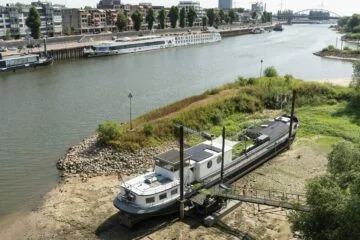
Add as a favourite source on Google Add DutchNews as a favourite source on GoogleLow water levels in the Rhine delta are causing problems for owners of Dutch houseboats, with no sign of an imminent end to the drought.
Some houseboats and static barges have been standing dry for over a month, resting on platforms that are not designed to support them out of the water or the exposed riverbed.
The Rhine sank to its lowest recorded level last week of 6.46 metres at Lobith, where it enters the Netherlands from Germany, while the flow in the river is one-third of its normal level for July because of low rainfall further upstream.
“We’ve seen these water levels more often in recent years, but usually not until September, and then it gets better after a few days’ rain,” Peter Broekmeulen, board member of the houseboat owners’ association LWO told broadcaster NOS.
The problems for dried-up houseboat owners go further than being stuck above dry land. Several homes have tilted, causing doors and windows to jam and cracks to appear in walls.
Power cables become strained and water pipes crack as they are stretched by the sinking houseboats.
But the biggest challenge is drainage, as residents have had to create improvised systems to deal with waste water that usually flows into the river.
“Open septic tank”
“When the water is there it flows away, but now they’re standing dry it ends up on the land and you get a kind of open septic tank, which is unacceptable from a public health point of view,” Broekmeulen told DutchNews.
Paul van de Veen, who has lived on Rosandepolder in Arnhem, for 40 years, told NOS: “In the early years our boat once had to be towed away by a sailing boat because the water was too high. Now we’re seeing the other side of the coin.”
Van de Veen’s house is still floating after the council dredged his side of the river in February. “We still have a margin,” he said. “The water around us is around a metre deep.”
His neighbours across the water are less fortunate. Marloes Kraal, whose houseboat is in the neighbouring municipality of Renkum, is on a section of river that dried up months ago. “We have cracks in the wall and the roof and there are more appearing,” she said.
The LWO is calling for councils to be more consistent in their policies for houseboats to avoid postcode lotteries arising. Arnhem paid the dredging of the river bank in February from public funds, but in Renkum owners have been told that removing the clay from the riverbed is their own responsibility.
“They are paying the same rent but get much less value for money,” Broekmeulen said. “Legally the council are in the right, but if one council dredges and the other doesn’t, that leads to inequalities.”
Wild west situation
“That’s the wild west situation that we’re up against. We want it to be better regulated nationally for everyone who has to deal with low water levels.”
Owners also face problems when the river levels rise again, as exposed houses can become stuck to their bases, causing them to flood rather than float.
Gert Schols, shipping expert at insurance company EOC, said: “We advise houseboat owners not to go on holiday in periods of extreme drought or arrange a housesitter. You need to keep an eye on what’s happening when the water rises.”
Without action from the government, living on Dutch houseboats risks becoming unappealing in the long term as droughts become more frequent, Broekmeulen warned: “If your house is lying off centre for six months, you’re going to start thinking about moving into one that stands upright.”
Thank you for donating to DutchNews.nl.
We could not provide the Dutch News service, and keep it free of charge, without the generous support of our readers. Your donations allow us to report on issues you tell us matter, and provide you with a summary of the most important Dutch news each day.
Make a donation