It’s a time of transition for big tech’s original voice assistants. Google has already rolled out its Gemini for Home to existing smart speakers and displays, while Apple is planning a new generative AI Siri for later this year. This week it’s Amazon’s turn, with the e-commerce giant announcing Alexa+ is launching in Australia.
However, with a new breed of AI assistants from OpenAI, Anthropic and others already on all our devices, is it too late for the previous generation of chatty helpers?
What is Alexa+?
Supplanting the original Alexa that has been active in Australia for eight years, the new generative AI version is being promoted as more conversational, deeply personalised, and capable of completing real-world tasks. Built on Amazon’s own Bedrock cloud infrastructure, the new Alexa can choose between dozens of AI models including from Anthropic, Meta and others depending on the query, meaning it should adapt to give fast, efficient answers or complete longer tasks.
As with the new Google and Apple assistants, Alexa+ promises to go beyond the precisely worded, transactional interactions we’ve generally had with smart speakers to hear the weather or set kitchen timers. Amazon says the new system can intuit your meaning, parse rambling language and use context to help understand what you want. It remembers things you tell it about your preferences and your family, and you can even connect your calendar or upload documents to it. It will get to know the different members of your household by their voice or face.
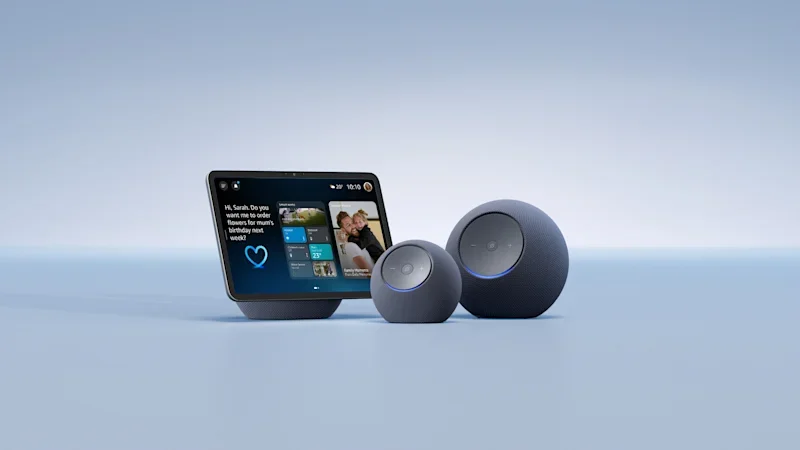
Alexa+ is initially rolling out to Australia as a preview. It works on most existing Echo devices, and users who want to test it out can sign up at the website and may be invited in the coming weeks. Anybody who buys one of the most recent devices (Echo Show 8, Echo Show 11, Echo Dot Max, Echo Studio), which have been custom-built for AI, will be invited automatically. Users will be able to decline the upgrade and stick with classic Alexa, at least for now. Alexa+ will be free during the preview, but afterwards it will be available via a $30-per-month standalone subscription, or included with Amazon Prime. And given Prime is $10 per month, it’s clear Amazon sees more value in using Alexa+ to pull people into the ecosystem than charging for it separately.
Alexa in the time of ChatGPT
So why choose a dedicated home assistant when Claude, Gemini, or ChatGPT already live on our phones and laptops? Amazon’s Michele Butti, vice president of Alexa international, argues the advantage comes down to ambient, hands-free availability and shared household context.
“The ability to manage your smart home, the ability to play your entertainment, with great devices that have really phenomenal sound, or basically a TV on your Echo Show, no one else has offered those capabilities. It is the best ambient experience,” he said.
If you don’t want to rely on your phone or computer, or you can’t because you’re cooking or doing something else, “then nothing like Alexa and now Alexa+ [will] allow you to use your voice to control your entertainment, your smart home, to have simple questions or simple tasks”.
Some examples Butti gave of specific features enabled by Alexa+ involved the system using its new contextual capabilities. You could ask it to remind your son to do his homework the next time it saw him, and the message would trigger when he walked into range of your device’s camera. Or you could describe what you wanted your lights or air-conditioning to do, even if you didn’t know the names and settings of each device.
“You can explicitly tell Alexa what you want her to remember about you and your family – ‘I don’t like mushrooms, and my friends Daniela and Ricardo that always come over for dinner, they are vegetarians’ – so that Alexa knows what to recommend. She learns through the interactions to get to know you and your family so that she becomes a better assistant,” he said.
“And [for smart home control] she can understand your intention, so you don’t need to remember the exact name. You can say, ‘take down all the blinds, but not the one in the office because I still want to see the sun there’. Something like that could have never happened before.”
How the home genAI battle is shaping up
Generative AI models and smart home ecosystems are on an inevitable collision course. As Google, Apple, and Amazon revamp their assistants, they are racing against OpenAI and Anthropic to control the central interface between consumers and their purchases, appliances and communications. But while chatbots focus on information retrieval, with Google and OpenAI building infrastructure to go shopping on your behalf, Amazon’s retail dominance and hardware presence give it a distinct advantage in turning conversational AI into actual real-world commerce.
For consumers, this tug-of-war marks the end of the simple smart speaker that plays your music and sets kitchen timers, and the rise of the paid digital concierge. The promise is a home that finally understands natural language and handles chores on your behalf without rigid commands.
The catch is that convenience now comes with tighter ecosystem lock-in, encouraging you to choose whether your daily life is run by Amazon, Apple, or Google, and meaning that even controlling your blinds becomes part of another monthly subscription.
Meanwhile, as Amazon, Google and Apple move their assistants closer to the chatty, all-knowing design of a ChatGPT, the native generative AI companies will begin moving further into homes.
Either way, the bot that offers to reword your emails and plan your trip itineraries will eventually be the same one that watches over your home, if for no other reason because you don’t want to pay for two ecosystems.
Get news and reviews on technology, gadgets and gaming in our Technology newsletter every Friday. Sign up here.