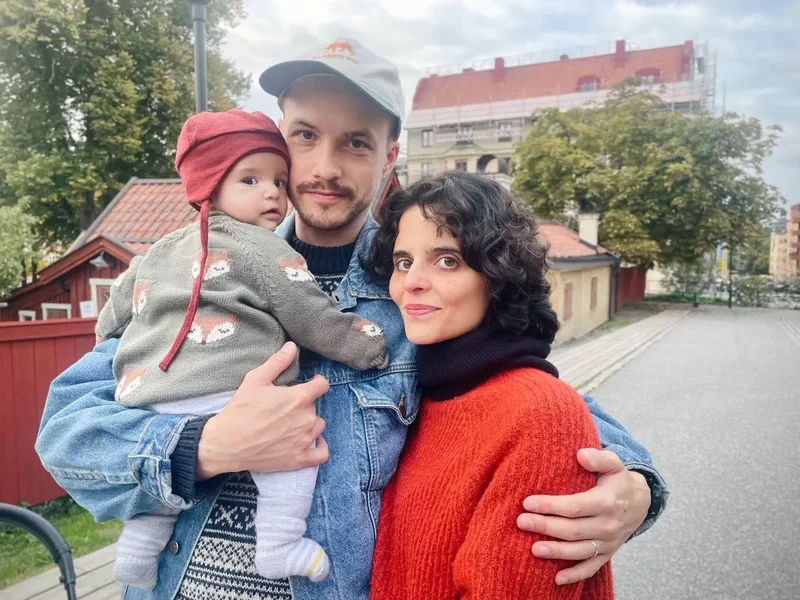
Growing up in the well-to-do Stockholm suburb of Täby, Gustav Magnusson never imagined he would find himself making contingency plans in the event he felt forced out of Sweden.
He himself – a lifelong Swedish citizen – is not directly at risk of being told to leave the country. Nor, currently, is his wife Luisa Fernandez, whom he met while on a cycling trip in Costa Rica in 2018.
But after the Swedish Migration Agency (Migrationsverket) rejected Luisa's permanent residency application this past January and the couple sees increasingly harsh laws for foreign-born people in Sweden being enacted, they feel on uncertain ground.
Luisa makes good money – more than enough, on an annual level, to satisfy the independent income requirement for permanent residency – but, as a screenwriter and script consultant, her work is freelance. Despite her having regular clients and meeting the income requirements on an annual level, Migrationsverket denied Luisa permanent residency on the grounds that her future income was not sufficiently stable.
Since neither the agency nor the law specifies what counts as sufficiently stable future income and the industry in which Luisa works operates on a freelance basis, Luisa and Gustav don't see how she will, under the current rules, ever qualify for permanent residency status in Sweden.
This means that, despite the fact that she has been living in Sweden for over four years, speaks fluent Swedish, is married to one Swedish citizen and is a mother to another, Luisa's status in the country is "temporary" – indefinitely.
It’s a situation that, they say, leaves them in an indefinite state of anxiety.
'I feel desperation just imagining being away from my child'
Being on temporary permits – which need to be renewed every two years and mean not being allowed to leave Sweden while waiting on renewal – leaves the family in a tricky place when it comes to planning travel back to Luisa's family in Costa Rica.
But worse, Luisa says, is the daily anxiety of being on insecure temporary footing in the country where her husband and one-year-old son are citizens.
"If they are unable to understand the way that I work, I am on a very flimsy basis here in Sweden," she tells The Local. "And, you know, it just makes your whole world upside down. Having temporary residency is not enough for me as a mother of a child that is Swedish."
The couple has started talking about what to do if Luisa loses the right to live in Sweden. Although there is no immediate danger of that happening, both say the political climate in Sweden combined with the sweeping immigration law changes they've seen passed recently make them fear that the laws will shift yet again – and that, as a temporary resident with a good income but no regular 9-5 employment contract, Luisa will not be allowed to stay.
"I feel just honestly scared because of the way the politics are going, with this government at least," Luisa says.
"The most terrible thing that I can imagine is having to be away from my child," she continues. "I feel desperation just imagining that situation. And Gustav tells me, if they kick you out, they kick us all out, which I feel very grateful for because of course there's no question we will stay together as a family."
Her husband says that while for him there is indeed no question of him and their son leaving the country with Luisa, if it became necessary for her to go, it has been painful for him to even have to consider the possibility.
“You know, my name is Gustav,” he tells The Local,”I feel like I'm just this very Swedish guy. And now [I have to think about the] possibility that I'm being, you know, moved out of my country."
“I feel ashamed [of Sweden]," he continues. When it was the national day [this year], I just felt like, what would I celebrate?”
"I cycle to work and I get this...I feel rage sometimes. I feel like, how is this even possible?”
'I was just shocked."
Gustav also works in film and his income is structured similarly to Luisa's. So after her permanent residency application was denied because of insufficient stability, the couple has now also begun to worry that if at some point Luisa's right to stay in Sweden depends on Gustav's income, he too will not be able to prove "income stability" to Migrationsverket.
Both say that there is a troubling lack of clarity on what would constitute proof of income stability – short of both of them completely changing their lines of work.
"My income is not necessarily the same every month," Luisa says. "Because of the way that the branch of the business works, sometimes I get paid for what I'm doing in two months’ time or sometimes I get paid in advance. So if you see the yearly income and divide it by twelve, it works, fulfills the requirements. But the problem is, they are very square."
Gustav agrees, and says it seems that the agency expected standard monthly paycheques.
"It's a fundamental misunderstanding of how people in my business work," Luisa said.
When the decision came through, both Gustav and Luisa were shocked.
"I thought that I had a solid case," Luisa told The Local. "In the world of freelancers, I have a good situation. And I also have integrated very successfully. I went to university to study Swedish. I have studied Swedish linguistics on the university level in the last few years while I was also working. I have a Swedish husband, a Swedish-born child who's also Swedish. Really, I was just shocked."
Gustav says he was particularly surprised by what seemed to him a quite old-fashioned way of thinking about work and income.
"I'm surprised that there's not [been] an evolution in the way of thinking about things like this. It's very like, it's [still] the 60s, people work in the factory, you get one job when you're 18 and you have that until you're 65," he says.
"But it's not like freelancing is a new thing... everybody knows that this is how people work. But when it comes down to these core authorities, myndigheterna, you have Migrationsverket, Skatteverket, where it's just like, has nothing happened? Do they live in the same society as we do?"
"The way we're living, it's not extreme," he adds. "We're not making money in an unknown way. You know, we're not Bitcoin miners or something fishy; we're very normal."
"It's a misunderstanding that is so fundamental that I don't see how I'm going to break through to them," says Luisa.
' Why are they putting so many people through this?'
Luisa speaks fluent Swedish – in fact, she was a step away from getting a degree in Swedish linguistics, out of sheer interest in the language, when the permanent residency denial zapped her motivation.
"I was in love with the Swedish language. I don't even want to see a Swedish book now. I am so upset that I can't even delve into what I wanted," she says of her Swedish language studies, which she did on her own time as distance courses through the University of Umeå.
She adds that she no longer plans to apply to the University of Stockholm to complete the courses so she can get her degree it because it reminds her of the permanent residency rejection.
But she says she will fight to stay in the country where they've built their home.
"I will do everything I can to stay because this is our home, this is where our child was born. I have spent so many years with this project that we have together. So, I'm going do whatever it takes, but I just see it as such an unnecessary burden. And I know that there's people that have it way worse than me."
It is an overall climate of hostility to immigrants, Luisa says, that adds to the weight she and Gustav feel.
"It makes me incredibly sad to know that all of these different changes that have happened in the last six years have put so much pressure on so many people that are here for perfectly normal reasons. Like love. What is more normal and understandable than love? Or family. So this is how I feel: I feel incredibly burdened. I feel a very intense pressure. I feel scared. I feel disillusioned, disappointed, like everything that I've done is worth nothing."
Although she and Gustav, like the other split-nationality couple The Local interviewed last month, speak about the particular unpleasantness of doing 'everything right' and still being slapped down by the Swedish immigration system, Luisa also points out that she thinks it's troubling that foreign-born people in Sweden feel they have to be "perfect."
"That's been a phrase that's been a lot in the headlines – ‘We've done everything right, we're still getting kicked out.’ And I know exactly how that feels," Luisa said. "I also think it shouldn't even have to be said, that phrase, ‘we've done everything right.’ Why do people have to defend how good they've been? Seriously, do you have to show that you're perfect to be able to stay in Sweden? Why are they putting so many people through this?"
'The image of Sweden that I had is actually not true.'
As with Chris and Anna-Karin, Gustav and Luisa say Swedish friends, family, and co-workers all assume Luisa has secure status in Sweden and that harsh immigration politics and policies do not affect them.
"All of them usually have hard time understanding," Gustav says. "They always say the same thing: 'but you're married, but you have a child."
"Yeah, the amount of times people tell me that," Luisa adds. "'But Gustav is Swedish and you just had a child. And I am like, yeah, it's it doesn't mean anything. It means literally null, zero."
Gustav says he understands the lack of comprehension the couple encounters when telling Swedes about their situation – because he's been through that internal process himself.
"You have to pass that step with people, then it takes almost a few weeks for them to understand that, wait, Sweden maybe is not perfect. Because that's also the self-image of Sweden abroad, and that's what we tell ourselves. It takes time for people [to dissolve that image] – it takes time for me."
"In this whole process since we moved here," Gustav says, "I've always told myself and Luisa 'but it's not us they're after. You're a working person and you're educated, so you should be clear. I told myself that for many years until I realised that, wait, if that's not true, that they do actually go after people like Luisa, that means that the image of Sweden that I had is actually not true."
What Swedish voters should know
The Local asked Luisa and Gustav what they want Swedish voters to know about families like theirs.
"I would like to say that unfortunately in Sweden after these laws have been passed, it has come to the point where we are not all equal under the law," Luisa says. "People that live here in Sweden, that have made their lives here in Sweden, that have Swedish children, that have Swedish husbands like me, that work making Swedish movies, that have learned the language because they actually believed in the beauty of the language, etc.– these people are not equal to you voters under the law."
"So like I would really like them to think about that."
Gustav says he would like his fellow Swedes to be less complacent.
"Politics isn't just changing how much you pay in tax every now and then or raises the food prices a little bit," he says. "It actually has a monumental effect on people's lives and it is possible to do something about it. You have to talk about this. That's the only thing that we can do as civilians. We have to really talk to the people we know, our friends and coworkers, so that people understand what's going on."
"The politics that are happening is not just affecting this little bubble of gang criminals or asylum seekers. It's seeping in everywhere into people that are here for normal reasons and are doing absolutely what they should be doing," Gustav says.
"I think It is harder for [people] to understand when on a fundamental level it's something that would never happen to them. But it's happening to me."