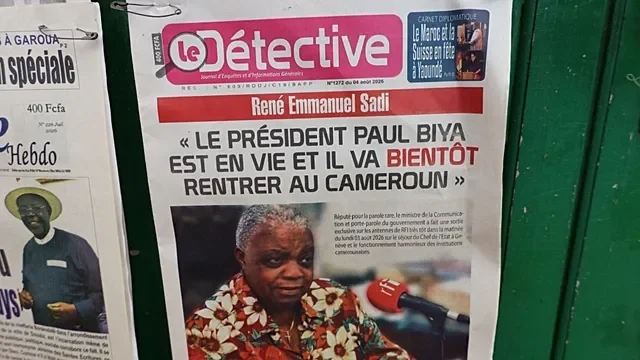
In Yaoundé, Cameroon’s capital, the president’s absence has dominated newspaper headlines and public conversations in recent weeks. Paul Biya has been out of public view for 58 days, but for some residents like Mr. Njoya, who is trying to remain reassured, the silence does not pose a major threat to the country.
“If he is away, there is certainly a good reason. We trusted him to manage the country, and we remain confident in that. We hope everything is fine and that his absence will bring us good news,” said Abdou Salam Njoya, a Yaoundé resident.
But for many residents of Yaoundé, Paul Biya’s prolonged and unprecedented absence is now becoming a source of concern.
“The children took their exams and had very poor results. He should have been there to guide us and guide this young generation, to ask why these results were so weak, but unfortunately he is not here. I feel that these are the holidays he has been waiting for. Maybe it is time, I don’t know, maybe he has gone to rest as he said,” said Tchoffo Jule, a Yaoundé resident.
“It has been almost two months now. We don’t know whether our president is alive or not, and this makes us even more uncomfortable,” said Majesté Arouna, a Yaoundé resident.
For this political analyst, the country is heading toward difficult institutional challenges. The absence of a new government since the October 2025 presidential election, along with growing confusion within the administration, has led him to argue that discussions about the post-Biya era can no longer be avoided.
“It is normal that, as we are now talking about 58 days of his absence from the country, Cameroonians are asking what this absence really means, especially because the government has shown signs of confusion. There is a heavy silence among Cameroonians when it comes to thinking about what comes after Biya. Today, we must acknowledge and address this,” said Cyrille Tchamba, a political analyst.
As the two-month mark of Paul Biya’s absence approaches, there has been no announcement of his return. Recent military appointments have raised concerns among observers about what lies ahead.
For now, the situation remains increasingly unclear.