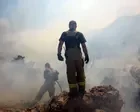
As France and Spain battle historic wildfires, comparisons to the second world war abound. “One of the continent’s biggest evacuation efforts since World War II,” reports the Associated Press. The French president, Emmanuel Macron, has called the wildfires his country’s “most difficult situation since the second world war”.
The images crossing all our screens certainly feel war-like – emergency aircraft and black smoke fill the skies, frantic civilians seeking shelter, historic towns lying in ruins, charred forests and burned-out vehicles, exhausted and sweat-soaked emergency responders.
Of course, brutal fires such as these are not restricted to France and Spain. They are hitting much of Europe. Australia has wrestled with escalating heat and devastating wildfires for years; during the fires of early 2020, the Australian government was forced to deploy the most military assets since the second world war. The US has lost entire towns to these climate-induced infernos. Brazil, Greece, Portugal, Chile, Russia, Turkey, Indonesia … all know the terror and loss of the fiery new world in which we reside.
And in my own country, nearly a thousand wildfires are currently burning across Canada.
In Europe, many leaders, including Macron and the Spanish prime minister, Pedro Sánchez, have made a point of linking these fires to the climate emergency; in Canada and the US, decidedly less so. Less common still are leaders and media who connect these events to their primary source – our continued combustion of oil, gas and coal (with the Guardian and a few others being notably exceptions).
Yet these extreme events leave no doubt: the climate emergency is upon us. The impacts of burning fossil fuels that climate scientists have warned of for years are now here.
The province of British Columbia, where I live, seems to go through this every summer now. A few years ago, I recall arriving at a holiday spot my family has visited for many summers, and coming upon a scene unlike any we had ever experienced. Residents in the area had been put on evacuation alert.
All afternoon, a fleet of four water-bomber float planes scooped up water from the lake directly in front of our rental house, flying in low over the homes in formation, collecting water in their pontoons and then doubling back to the fire on the mountain ridge behind us to dump their loads.
Right up until sundown, four helicopters likewise circled back to the lake in five-minute rotations, dropping enormous buckets on long cords to collect water, and then racing back to the mountain to release their cargo. This continued all week. The noise was deafening.
Our peaceful family time suddenly felt more like a scene from Apocalypse Now, as we huddled together and shouted to communicate. As darkness fell, the hills behind us were dotted with flames, and the sky glowed ominously red.
This is what people now nervously call “the new normal”, although it is, in truth, not normal and but a taste of things to come. These extreme weather events we are increasingly experiencing – and the warlike mood they create – represent attacks on our soil. They are a call to mobilize.
Sadly, however, the emergency-level responses we have seen to date are purely defensive, rearguard actions. Our governments have not yet seen fit to adopt a wartime-scale response that pre-emptively tackles the climate crisis. Beneath the urgency of the present lies a confounding paradox: we mobilize to put fires out, but not yet to prevent them.
Sure, every time events like this occur, opinions flow freely about how we need to better prepare for fires, to make our communities and forests more resilient, and to adapt to this new reality. All true.
But far too absent from the public debate is a more foundational truth: until we actually mobilize to dramatically expedite the transition off fossil fuels, we will never get ahead of the curve. No amount of fire preparation and planning will save us from an escalation in the horrors we are now experiencing.
If the crisis before us is indeed akin to a war – and it is; an existential peril to the people and places we love – then we must genuinely adopt a wartime-scale approach, a new mindset to mobilize all of society, galvanize our politics, fundamentally remake our economy and end our dependence on fossil fuels.
The good news: the second world war experience shared by many countries can be embraced as an instructive story, a helpful – and indeed hopeful – reminder that we have done this before. We have mobilized in common cause across society to confront a civilizational threat. And in doing so, we have retooled our entire economy in the space of a few short years.
How does one know when a government is in actual emergency mode? From my studies of past mobilizations, real emergency action has certain distinct markers. Governments in genuine emergency mode:
- Tell the truth about the severity of the crisis and communicate a sense of urgency about the measures necessary to combat it.
- Spend what it takes to win.
- Create new economic institutions (state enterprises and public programs) to get the job done.
- Shift from voluntary and incentive-based policies to mandatory measures.
- Commit to leave no one behind.
None of our governments are yet confronting the climate emergency in this manner. That time, however, will come.
All emergencies start were a period of denial, or with a “phoney war” phase of half-hearted engagement (sound familiar?). But then, some sort of alchemy occurs. A combination of events (that’s what these extreme weather emergencies are) and leadership comes together to shift the zeitgeist and move us into genuine emergency mode.
We need a “wartime” mindset and political and policy agenda to tackle the climate emergency.
- Seth Klein is a Canadian climate writer and activist, author of the book A Good War: Mobilizing Canada for the Climate Emergency, and former team lead of the Climate Emergency Unit. His newsletter can be found here