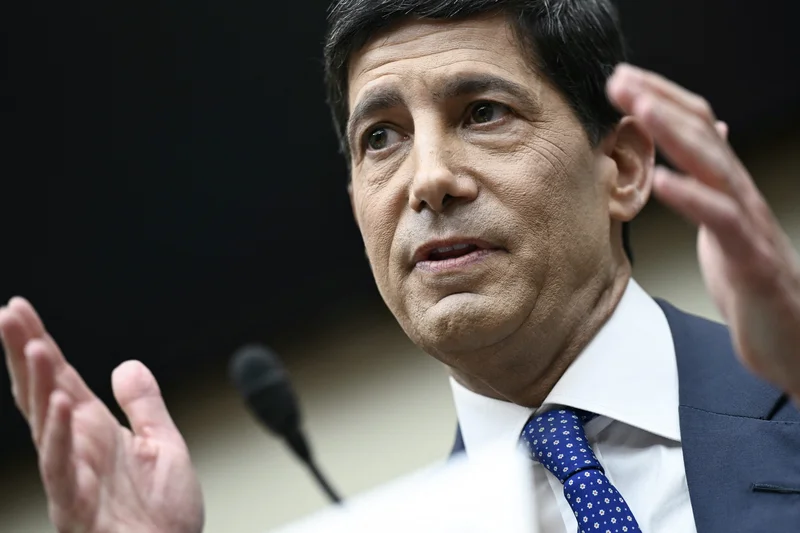
US Federal Reserve Chair Kevin Warsh testifies during a House Financial Services Committee hearing titled "The Federal Reserve's Semi-Annual Monetary Policy Report" on Capitol Hill in Washington, DC, on July 14, 2026.
Brendan Smialowski \| Afp \| Getty Images
He's not quite at the level of obscurity of former Federal Reserve Chairman Alan Greenspan, but new Fed chief Kevin Warsh has settled on a few phrases that are notable for their repetition and lack of clarity.
In five public appearances, starting with his nomination hearing in April, through his first press conference, roundtable in Portugal and two congressional testimonies, Warsh has used the phrase "family fight" 13 times, returning to "first principles" 11 times and "inflation is a choice" for the Fed six times.
But what those phrases mean for monetary policy is more challenging than counting their usage. Yet, with a chairman who has decided to say less than his predecessors, there's a premium on understanding the words he does choose.
CNBC asked five close Fed watchers their views on what these three phrases mean to them.
'A good family fight'
Dan Greenhaus, strategist, Solus Alternative Asset Management:
"If Chair Warsh encourages more open debate around policy and creates an environment where prevailing assumptions can be challenged rather than simply accepted, that should ultimately lead to better policymaking. The benefit is less about changing the outcome of any individual meeting and more about improving the quality of the decision-making process over time."
Loretta Mester, former Cleveland Fed president:
"Ensuring the environment at the FOMC meeting allows for all views/arguments to be heard. I note that this was already the atmosphere when I was on the FOMC. I never felt constrained in what I said or the policy case I argued. In reality, it is 19 people around the table so there has to be some order or else maybe it is only the loudest voice in the room that gets heard and you will actually have fewer views expressed since it will be hard to jump in."
Claudia Sahm, chief economist at New Century Advisors:
"FOMC meetings tend to be highly scripted affairs, with prepared remarks read aloud and limited conversation. Warsh wants a livelier back-and-forth — a style he is more comfortable with. The format is unlikely to affect the policy decision, and 19 participants is a large group for a free-for-all conversation. "
Mark Spindel, Fed author and Potomac River Capital CIO:
"To Kevin, this is his aphorism for the natural debate going on inside the FOMC and the Board. It implies obvious disagreements, but like all 'family fights' is best kept to members of the family and not revealed too much to the public. I think it's the second part that his committee colleagues (and market participants) are finding problematic, and doesn't fit the priors. Members of the committee are clearly willing to disagree in public, or at least state their opinions much more openly (than Chairman Warsh). It's also a way of deflecting his responsibility from external pressure (POTUS, CONGRESS, MARKETS)."
Michael Feroli, chief U.S. economist at JPMorgan:
"I guess the family fight is him trying to be folksy, but it doesn't depart from the tradition under Bernanke of (publicly) welcoming dissenting opinions."
'First principles'
Spindel:
"This is vague enough to mean whatever Warsh wants it to mean, but in context, it appears to be the basis for the decision making and structural reform he is manifesting. Over the summer (in Sintra) he said his Central Banking leadership colleagues shared a 'willingness to go back to first principles' as he questioned the whole process of monetary policy making. I'd think his re-introduction of the monetary aggregates, his cute "monetary policy should have something to do with money," is cut from the same general cloth as 'first principles.' Sadly, the science of monetary policy and other workhorses of monetary policy (The Phillips Curve), economic forecasting even appear to be unhelpful in Warsh's first principled approach. He's not been shy about slamming the year-after-year misses in inflation and blaming Powell and company. The low level of interest rates, the balance sheet, the failure to tighten sooner, FAIT and so on, all of that (to Warsh) was a departure from 'first principles.'"
Sahm:
"'First principles' is code for 'question everything.' Warsh has said repeatedly that he wants "regime change" at the Fed and questioning the basic assumptions of how monetary policy is done fits that agenda. I am skeptical that Warsh will be able to rewrite first principles. Showing that an assumption is flawed is not enough; it requires offering a better replacement. Even with his task forces, Warsh is likely to come up short on new first principles — no regime change in monetary policy, but some incremental improvements to how it's done."
Mester:
"Rethink the way the Fed goes about achieving its dual mandate goals of price stability and maximum employment without preconceived notions or assumptions, or precluding approaches because they may differ from the current approach. Think first about what the best approach is for communications, inflation and labor market assessment, balance sheet and operating framework, and data sources. Then consider how to transition to these new approaches."
"Note that the Committee has tended not to want to make major changes – consider the number of times the statement changed only by one or two words. This rethinking from first principles frees the committee to consider new approaches rather than minor tweaks. They will then have to think about how best to transition there."
Feroli:
"The 'first principles' line feels like it has the same spirit as his remark about PhDs from elite institutions not keeping money in monetary policy. Both seem to suggest the institution has let the academically driven types distract the Fed from focusing on a few basic economic principles. (Powell also didn't have a PhD but he certainly seemed less defensive about it!)"
Greenhaus:
"Getting back to first principles could have significant implications for policymaking. What is the Fed's mandate, and how should it go about fulfilling that mandate? Whether one agrees with this more 'originalist' approach or not, it appears to be the direction in which Warsh wants to take the institution. It suggests a more limited role for the Fed beyond monetary policy, including greater skepticism toward its involvement in areas such as regulatory policy and climate-related issues. More broadly, it implies a willingness to reassess how much the Fed's role has expanded since the Global Financial Crisis and whether that expansion has gone too far."
'Inflation is a choice, and the Fed must take responsibility for it.'
Mester:
"This harkens back to Milton Friedman's line that "Inflation is always and everywhere a monetary phenomenon, in the sense that it is and can be produced only by a more rapid increase in the quantity of money than in output."
"Over the longer run, to achieve price stability the Fed has to ensure that aggregate demand is not growing more strongly than aggregate supply. Otherwise. there will be price pressures and sustained inflation."
"Note that over the shorter run there can be times when supply is temporarily disrupted and prices rise for certain goods and/or services. The Fed would want to look through that because by the time a monetary policy action would affect the economy, the supply disruption would be over – this is because of the long and variable lags of the effects of monetary policy. But when supply disruptions are longer lasting or there is a series of multiple disruptions (like after the pandemic and now), the Fed needs to ensure that monetary policy is restrictive enough to bring demand into alignment with supply or else there will be a sustained rise in inflation."
Sahm:
"'Inflation is a choice' is a nod to Warsh's mentor Milton Friedman, who said that "inflation is always and everywhere a monetary phenomenon." The Fed's framework already contains a version of this: "the inflation rate over the longer run is primarily determined by monetary policy." Warsh is restating something the Fed has said for years, but he is omitting the timeframe — and that omission matters. In the short run, supply shocks like energy disruptions or tariffs can move inflation regardless of what the Fed does. Warsh's phrasing is unlikely to change other Fed officials' views on monetary policy, but it might confuse the public about what the Fed can do."
Greenhaus:
"Taken to its logical conclusion, this suggests a Fed that is less willing to attribute prolonged inflation overshoots primarily to exogenous factors such as tariffs, fiscal stimulus, or supply shocks. Warsh's message is essentially that "the buck stops with us." As a result, Chair Warsh will [be] less tolerant of explanations for persistently elevated inflation that do not acknowledge the Federal Reserve's own role. In his view, the Fed may not be responsible for every inflationary shock, but it is ultimately responsible for ensuring that those shocks do not become persistent inflation.
Feroli:
"I think his phrase 'Inflation is a choice, and the Fed must take responsibility for it' sits oddly aside one of his other catch phrases 'I don't believe that we have a cruel choice.' It's a pillar of modern monetary economics that inflation is a choice that in the long run is under the control of the central bank, so not many will have a problem with his first catch phrase. (Though it's more contentious how long is the long run). But the idea that there is no short-run tradeoff between growth and inflation then begs for the question: why would the Fed ever choose inflation? The economic argument for central bank independence rests on the idea that a politically motivated central bank might be tempted to exploit that short run tradeoff to juice the economy at the long run expense of price stability.
Spindel:
"It's another phrase that can mean whatever Warsh wants it to mean. Totally consistent with his (and the committee's) restatement of their inflation mandate in the first FOMC statement under KW, 'the committee will deliver price stability.' Though when questioned aggressively by Sen. John Kennedy, R-Louisiana, Warsh struggled to explain exactly what he would do about that. Ultimately, he got to the rub, higher rates might be in the offing. He criticized his predecessors who he implied were comfortable with higher inflation rates. As for 'the Fed taking responsibility for it,' I agree with Chairman Warsh. At its simplest, the Fed sets the price of money, and if money is too cheap, the Fed has to act."