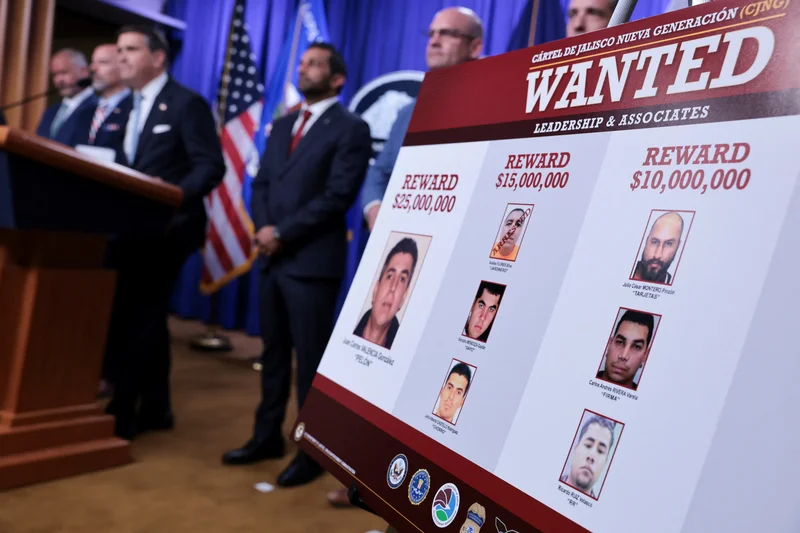
The United States has made it clear that, within the framework of its security and drug-fighting policy, its goal is to pursue, dismantle, and destroy the Jalisco New Generation Cartel (CJNG), Secretary of State Marco Rubio said in a tweet. The message stressed that Washington wants to strike the criminal organization on all fronts, a position reinforced by representatives from the Justice Department, the DEA, and the FBI, among other federal agencies, at a press conference held Wednesday. The pressure ranges from cutting political ties with corrupt officials in Mexico and arresting its top leaders to crippling its finances, the main engine that has allowed this transnational criminal enterprise to operate as it has.
Bigger rewards
The sum of more than $100 million that the U.S. government has offered for leaders of the Jalisco New Generation Cartel goes hand in hand with the “dismantling” strategy it has applied against organized crime in Mexico since the start of Donald Trump’s second term in January 2025. “We are dismantling the Sinaloa Cartel. We are applying the same pressure to the CJNG,” said the head of the DEA, Terry Cole.
Juan Carlos Valencia González, known as “El 03″ or “El Pelón,” has become the United States’ most wanted man. Crowned by Washington as the cartel’s new boss after the killing of his stepfather and former leader Nemesio “El Mencho” Oseguera, he now has a $25 million reward on his head, $20 million more than a month ago. The Justice Department’s top spots are shared with brothers Iván Archivaldo and Jesús Archivaldo Guzmán Salazar, Joaquín “El Chapo” Guzmán’s sons who lead the Los Chapitos faction of the Sinaloa Cartel and remain at large. Up to $10 million is being offered for information as to their whereabouts.
For other members of the CJNG’s new structure, such as Gonzalo Mendoza Gaytán, alias “El Sapo” and son-in-law to El Mencho, and Julio Alberto Castillo Rodríguez, alias “Chorro,” $15 million is being offered. Next on the rewards scale at $10 million are Ricardo Ruiz Velasco, alias “El Tripa”; Julio César Montero Pinzón, alias “El Tarjetas” —who is accused in the 2020 attack on then-Mexico City security chief Omar García Harfuch — and Carlos Andrés Rivera Varela, alias “La Firma.”
Political connections
Washington’s offensive also targets corrupt Mexican officials who, it says, are a key piece enabling the CJNG to maintain its operational capacity in Mexico. Although the DEA said it has identified them, it did not reveal their names on Wednesday. During the conference, DEA Director Cole said the cartel sustains “a powerful influence via violence and corruption in Mexico. This includes members within the Mexican government who shield CJNG leadership from justice and facilitate drug trafficking, money laundering, and violence.”
In his view, those officials share responsibility for the thousands of fentanyl overdose deaths in the United States. “If you traffic deadly drugs, profit from the suffering of others, or use public office to protect the cartels, this is your warning,” he said in a message aimed at the CJNG’s fugitive leaders and their alleged collaborators. “DEA is coming for you. No title, no position, or political connection will shield you.”
So far, no elected official or police commander in Mexico — active or retired — has faced criminal charges in the United States for specific alleged ties to the CJNG. The most relevant precedent are the sanctions the Treasury Department imposed in May 2019 on former Nayarit Governor Roberto Sandoval Castañeda and then-judge Isidro Avelar Gutiérrez, whom it accused of taking bribes from the cartel in exchange for protection and hindering criminal investigations. But they were never criminally charged. In the case of former security secretary Genaro García Luna, who was sentenced in the United States to 38 years in prison, it was because of his ties to the Sinaloa Cartel.
Sandoval Castañeda was sentenced in Mexico in 2025 to seven years in prison for falsifying documents related to the irregular acquisition of a property in the municipality of San Blas. Avelar Gutiérrez, for his part, was acquitted two years ago of a proceeding for alleged illicit enrichment.
After bringing drug-trafficking charges in a New York court against Sinaloa Governor Rubén Rocha Moya and other state officials accused of taking bribes from the Los Chapitos faction, the Trump administration said it would seek to prosecute other Mexican officials. This Wednesday, for the first time, the DEA made clear that strategy also includes public servants who collaborate with the CJNG. “Corruption is cartel activity,” Cole added. “They are enablers, and we will pursue it to the ends to protect our citizens and our country.”
The timeshare fraud
Another illicit activity of the CJNG that the United States has pursued is a timeshare fraud network that caused losses of more than $400 million between 2019 and 2023. According to the Justice Department, the cartel ran fake call centers and, to persuade victims to hand over money, even created websites with misleading information and employed skilled callers who impersonated real estate agents, lawyers, government officials, and even police commanders.
Operations were concentrated in and around Puerto Vallarta, in the state of Jalisco, one of Mexico’s most visited tourist destinations and considered a CJNG stronghold. More than 6,000 Americans fell into this trap, including many seniors who lost their life savings.
At the top of the operation, the Justice Department says, were La Firma, El Tarjetas, and the latter’s sister, Griselda Margarita Arredondo Pinzón, accused of being an alleged financial operator for the cartel. A $2 million reward is being offered for information leading to her capture. In addition to the drug-related accusations, the three face fraud charges in a separate criminal case filed in the U.S. District Court for the Eastern District of New York.
Cutting off the cartel’s money flow
Another front in Washington’s offensive against the CJNG involves dismantling its structures by targeting one of its most important pillars: money. The Department of Justice has set its sights on financial operators who have adapted to intensified law enforcement efforts, as they have found increasingly common ways to send drug proceeds via cryptocurrency from U.S. cities to cartel leaders in Mexico.
A call from a call center offering a week’s vacation, a concert by your favorite singer, or a payment in Bitcoin. Each of these actions may conceal a technique criminals use to launder their dirty money. Gary Shapley, acting commissioner of the Internal Revenue Service (IRS), believes that the cross-disciplinary work the U.S. has been conducting can disrupt the flow of money that allows criminal organizations to maintain their operations, as law enforcement increases pressure on the main drug routes crossing from Mexico into the U.S. “We’re going to track down their funds; we’re going to find their money, and there won’t be a border we can’t cross to find and recover it,” he explains.
Assistant Attorney General Tysen Duva said last February that Justice Department investigators “want to hear on the distribution side how it works, who is involved, and seek additional indictments, and on the money laundering side, exactly the methods that they are using to get the money out of the United States through the U.S. banks.”