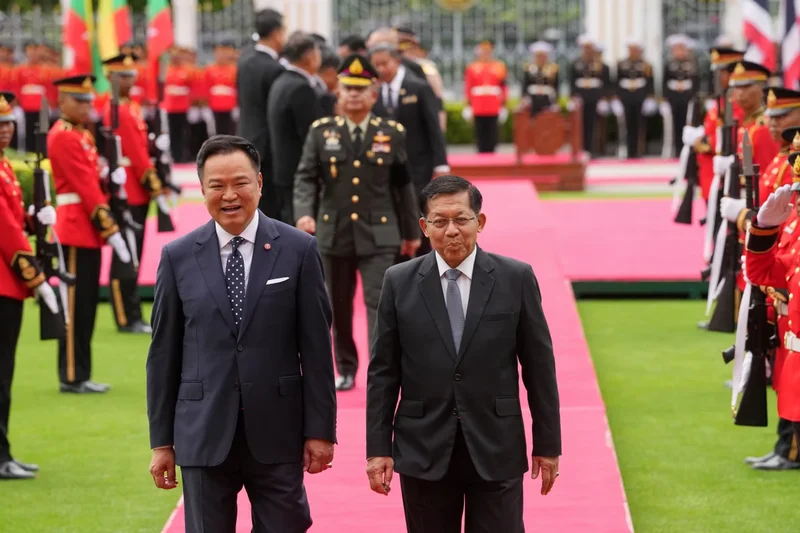
Thailand is facing criticism for rolling out the red carpet for Myanmar’s junta-chief-turned-president who is accused of committing crimes against humanity.
The military band played, the honour guard stood to attention, and the red carpet stretched out in Bangkok as Min Aung Hlaing received a grand welcome rarely afforded to one of the world's most isolated leaders.
But the display sparked criticism from rights advocates who said Thailand risked helping rehabilitate a military ruler accused of overseeing brutal abuses during his country's civil war.
Mr Min, dressed in a dark business suit, walked the red carpet along with Thai prime minister Anutin Charnvirakul, as he inspected a guard of honour on Thursday.
The visiting leader is due to attend an official dinner and hold meetings with parliamentarians later in the day.
Mr Min is using his latest foreign visit to portray normalcy in Myanmar, pledging at a meeting with Thai officials on Thursday to pursue peace at home and improve relations with the Association of Southeast Asian Nations (Asean).
"Myanmar is on the path of democracy and heading towards a better future," he said. "In international relations, as we have worked to strengthen friendly relations for the benefit and interests of the public, we will also work toward fostering better relations with Asean.”
Myanmar’s leader has faced international condemnation over the 2017 military crackdown that led to the mass expulsion of the Rohingya, forcing nearly 740,000 members of the Muslim minority to flee to neighbouring Bangladesh. The US, UK and several other countries have heavily sanctioned him, and the International Criminal Court prosecutor has sought an arrest warrant against him over alleged crimes against humanity linked to the persecution of the Rohingya.
Mr Min seized power in 2021 after launching a military coup against the elected government of Aung San Suu Kyi, triggering a civil war that is estimated to have killed more than 100,000 people in the country.
He ordered the detention of the Nobel Peace Prize laureate, who remains imprisoned after being convicted in a series of military court cases that supporters and rights groups have denounced as politically motivated.
Since shedding his uniform to take on the civilian role of president following a military-orchestrated election earlier this year, Mr Min has been on a diplomatic drive, visiting China, India, Laos, and now Thailand in a bid to bolster his international legitimacy.
The pomp and pageantry afforded to Mr Min in Bangkok has invited condemnation from rights groups and democracy advocates who have argued that Thailand’s high-level engagement with Myanmar without preconditions rewards the regime and increases the human cost of the conflict.
Tun Khin, president of Burmese Rohingya Organisation UK, said Thai authorities should not lend legitimacy to Mr Min’s “murderous regime by rolling out the red carpet” for his visit, but instead set an example on human rights, justice and accountability.
“Min Aung Hlaing is not only one of the chief architects of the genocide against the Rohingya, but has also led the violent repression of the people of Burma for years. He belongs in a jail cell, not posing for photo ops with government officials in Thailand,” he said.
Mr Khin, who was born in Myanmar, is a prominent Rohingya human rights activist, leading the filing of a jurisdiction case in Argentina in 2019 against Myanmar military and civilian leaders for genocide, war crimes, and crimes against humanity.
He called on Thai and Argentine authorities to cooperate on arresting and extraditing Mr Min to Argentina to face trial for genocide and crimes against humanity.
Mark Farmaner, director of the Burma Campaign UK, described the visit as Thailand’s “political miscalculation”.
“Min Aung Hlaing has taken Myanmar back to the path of full military dictatorship, not democracy,” said Mark Farmaner, director of the Burma Campaign UK.
“Bestowing Min Aung Hlaing with the credibility and acceptance he craves is political miscalculation which will harm both Myanmar and Thailand.”
Dulyapak Preecharush, a Southeast Asia expert at Bangkok's Thammasat University, said there was “a fine line between re-engaging and endorsing Min Aung Hlaing's legitimacy”.
"The perception that Thailand is validating or conferring legitimacy on Min Aung Hlaing could rise very quickly."
Thanida Piyachot, human rights specialist at Fortify Rights, said that “shaking the bloodied hands of a war criminal sends completely the wrong message to Myanmar’s civilians suffering grave violations of human rights under Myanmar’s illegitimate military dictatorship”.
Thailand has said it is pursuing "calibrated re-engagement" with the neighbouring country in the hope that Naypidaw will implement a stalled peace plan led by Asean, which has barred Myanmar's leaders from its summits.
Bangkok has also argued that, as neighbours with a 2,400km border, the two countries must engage at the highest levels to tackle shared challenges like transnational crime.
The diplomatic engagement comes even as a conflict monitor says there is no hope of violence abating in Myanmar anytime soon.
According to a report released by the Armed Conflict Location and Event Data Project on Thursday, the Myanmarese military is set to intensify its conflict with ethnic militias in an attempt to consolidate power following the expiry on 31 July of its 100-day peace plan, which sought unconditional peace negotiations with the armed groups.
It notes that Sagaing, Magway, and Mandalay – the heartland of numerous armed groups – are expected to become the military's next focus as it redeploys troops from border regions where ceasefires with some ethnic organisations are now in effect.
As of July, the military had recaptured 27 towns and critical trade corridors, disrupting the economic and logistical capacity of many resistance groups, according to the report. “The military is poised to capitalise on weakened resistance in central Myanmar, but a decisive victory is unlikely in the near term,” it added.
Just in time for the president’s Bangkok trip, the Myanmar government on Monday allowed Ms Suu Kyi to meet a representative of the Red Cross amid mounting worries over her health.
Her son Kim Aris, who had been demanding proof of life for her, told The Independent he was “relieved” to see his mother alive, though he was still “angry that she is being unjustly held”.