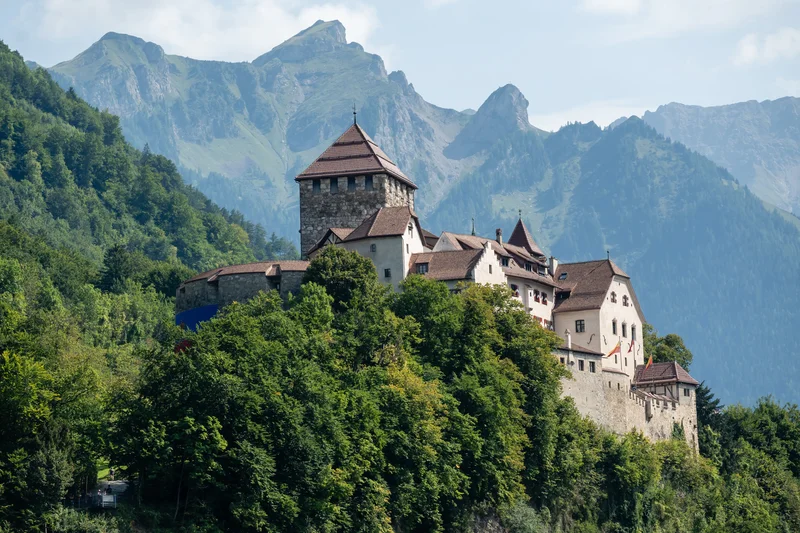
For decades, Liechtenstein has offered high-net-worth individuals a financial haven: political stability, institutions specializing in private banking, and favorable regulations for managing their wealth. But above all, this small country nestled between Switzerland and Austria offered the promise of discretion and the ability to safeguard money within a legal structure without the owner’s name being visible to the public. But that promise has been shattered in recent days.
In late July, hackers gained access for several hours to the official registry that records the identities of the individuals behind companies, foundations, and other entities created or managed from Liechtenstein, according to Bloomberg. The criminals accessed information related to some 31,000 entities.
The country’s government has set up a team to manage the crisis and is trying to determine who is behind the attack. There is no indication that the hackers stole any money or accessed bank accounts or financial data. However, they did obtain the names, dates of birth, nationalities, and countries of residence of the foundation holders. And for those seeking to remain anonymous, this is indeed a significant loss. This is because the registry reveals who is behind the wealth-holding companies based in the country.
This is important information. Homes, businesses, investment portfolios, or bank accounts may be registered in the name of a corporation or a foundation. But behind that structure, there is a person who controls it and reaps any profits it may generate. To give an idea, imagine that a mansion valued at several million euros is registered in the name of a corporation. The shares of that corporation are owned by another company. And the owner of that company is, in turn, a foundation, which is managed by certain individuals and whose beneficiaries are others. If someone wanted to investigate who is behind this entire web, they might find themselves in a labyrinth of legal and corporate names leading to a dead end. The registry that the hackers have breached serves to trace the chain all the way to the end and uncover who is behind it.
Liechtenstein has long been considered a tax haven and has been at the center of several financial scandals. The biggest of these erupted in 2008 when Germany obtained a list of LGT Bank clients who were using Liechtenstein foundations to hide assets. The investigation involved hundreds of wealthy Europeans and also had repercussions in Spain. The Tax Agency, the Civil Guard, and the Anti-Corruption Prosecutor’s Office conducted raids in several cities to investigate whether there were any undeclared investments. The Tax Agency estimated at the time that the hidden capital could exceed €200 million.
In recent years, pressure from the United States and major European countries, along with new regulations against money laundering and the exchange of tax information, have forced the country to open up to international cooperation. In 2015, it reached an agreement with the European Union to strengthen this exchange of information with tax authorities. This allowed European tax agencies to receive information on certain accounts held in Liechtenstein by their residents. The Liechtenstein government stated this week that it has been implementing a “clean money” strategy for years and is adopting international standards.
As far as Spain is concerned, Liechtenstein remained on the blacklist until 2023. That year, the Spanish Tax Agency approved a new list of “non-cooperative jurisdictions” — such as Barbados, the Cayman Islands, and the Seychelles — from which the principality was removed. But that does not mean Liechtenstein has stopped offering advantages to the ultra-wealthy. The change is that its authorities now collaborate with other countries to carry out their audits. That is why this registry exists — and why it has been targeted by hackers. A law that took effect in 2021 to implement European anti-money laundering regulations required companies, foundations, and trust structures to disclose the identities of their beneficial owners. The authorities had access to this information, but it remained off-limits to the general public, except under very limited circumstances.
According to figures in the Liechtenstein government’s latest annual report, there were 22,927 entities and legal structures as of the end of 2025. This is striking given that the country has a population of just 41,000 people. Foundations must report their establishment to the authorities and provide certain documentation, although this information is not available to the public in the same way as information on commercial corporations. Access to the registry is so restricted that the report itself provides specific figures. Throughout 2025, only 35 requests for access to registry data were submitted. Twenty-three were approved — almost all for banks and financial institutions — and not a single request submitted by third parties was granted.
The appeal of foundations for high-net-worth individuals lies in the fact that assets cease to belong directly to an individual and are transferred to the foundation. A board administers them according to established rules. In this way, the person who contributes the money, the person who manages it, and the person who receives the benefits can all be different individuals. This separation makes it difficult for outsiders to trace who is behind the structure.
It also serves to preserve family wealth. A family can use a foundation to preserve the business after the founder’s death, to distribute an inheritance, or to ensure that descendants receive a certain amount of money each year.
In any case, it is worth noting that being listed in Liechtenstein’s foundation registry is not illegal nor does it imply that a crime has been committed. Owning a company or foundation in Liechtenstein is legal as long as the assets are declared in the country of residence and tax obligations are met. In recent years, the principality has sought to balance cooperation with international authorities while preserving the anonymity of those who rely on the country to manage their assets. The beneficial owners registry was the key to maintaining that balance. And although the attack has not yet resulted in any financial loss, in a business built on privacy, losing anonymity causes that promised oasis of discretion to crumble.