In upcoming state elections to be held on September 6, polls suggest the Alternative for Germany (AfD) could win an absolute majority in the eastern German state of Saxony-Anhalt.
Based on the far-right's cultural policy program, museums, theaters and cultural institutions in the region say that artistic freedom is one of the far-right party's targets.
The AfD has announced that artists and institutions would be required to sign a declaration pledging "not to hold in contempt Germany and its culture" if they want to obtain state funding. Many of these organizations and individuals heavily rely on these subsidies.
The AfD's interpretation of disrespect to German culture also ambiguously includes what the party calls "anti-German art."
"We declared in our government program that we no longer intend to spend public funds on promoting anti-German art," said Hans-Thomas Tillschneider, cultural policy spokesperson for the AfD parliamentary group in the state legislature, in a speech held in Saxony-Anhalt's parliament in late June.
Asked by other members of parliament to specify what that meant exactly, Tillschneider said, "Anti-German art is German art that doesn't want to be German." He mentioned as an example an opera production he had seen some years ago; the classical German composer's work was revisited through a "feminist deconstructivist" lens that didn't please him and corresponds to what he sees as "anti-German art."
"This anti-German aversion is still considered de rigueur in large parts of the theater world," he said. "We will no longer support this attitude — let me state that quite clearly."
Bauhaus, a direct target — like in the 1930s
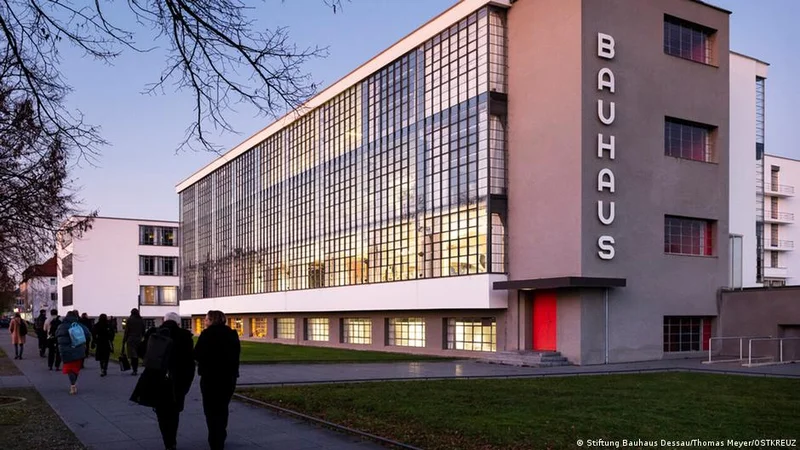
Bauhaus, Germany's iconic architecture, art and design school founded in 1919, was forced to close under the Nazis, who considered their avant-garde ideas and their open-minded attitude to be "un-German." Bauhaus nevertheless went on to become one of design's most important movements of the 20th century; its influence is still felt worldwide.
Today, the AfD once again sees Bauhaus as too modernist and globalist for the "patriotic cultural policy" the party envisions.
"The AfD's criticism of Bauhaus picks up on criticism from 100 years ago; their wording is similar," Barbara Steiner, director of the Bauhaus Foundation, told DW.
The AfD Saxony-Anhalt's program describes Bauhaus as "a controversial school of architecture" and criticizes the current state government for putting too much emphasis on this landmark attraction in their current image campaign, titled "moderndenken" (thinking modern).
The AfD aims to adopt instead a campaign called "deutschdenken" (thinking German), which would downplay the role of Bauhaus and instead "highlight the state's significant contributions to the development of the German nation — from Henry I and Otto I to Luther, Bismarck and Nietzsche."
Historically loaded language
The Alternative for Germany (AfD) strongly rejects comparisons to the Nazi party and Adolf Hitler, often dismissing them as trivializations of Nazi crimes.
Yet in its cultural policy program, the far-right party regularly adopts the language used in Hitler's propaganda, downplays Nazi-era atrocities, challenges Germany's culture of remembrance and uses historically loaded language.
The proposed "deutschdenken" slogan is one example of this: "'Deutsch denken' refers to a speech Adolf Hitler made in 1938" — the "Reichenberger Rede," noted Steiner.
Culture needs state support to thrive
The Bauhaus is not the only cultural organization that feels threatened in Saxony-Anhalt: "As cultural practitioners, cultural initiators and artists, we can say that we are now genuinely afraid, because what's being triggered there is, in fact, the idea that art and culture must be 'German'." Annegret Laabs, director of the Kunstmuseum Magdeburg told DW.
Laabs is a spokesperson for the initiative Kultur ist Vielfalt und Heimat, which roughly translates as "Culture is diversity and home." The initiative brings together a wide range of cultural institutions and artists from the region; they are warning in a joint statement that the AfD's plans could have far-reaching consequences for artistic freedom, historical memory, and public cultural life.
"We all know that what we do — from theaters to museums to libraries — is paid for with taxpayer money. It wouldn't exist otherwise," said Laabs.
Restricting funding based on an arbitrary definition of what constitutes "German" art basically equates to culture's demise, explains Laabs: "If we look at the bigger picture, we see that culture and art have been free for centuries and have known no boundaries — not even national ones. Wherever there are national boundaries, there is no longer any art or culture worthy of that name."
'Resist the beginnings'
Along with threats to funding, the AfD's program also describes Germany's existing culture of Holocaust remembrance as the "perpetuation of a guilt complex" that has "blocked the possibilities for forming a stable national identity." It sees this as an "identity disorder" that needs to be "healed," by focusing on the "positive aspects of German history."
Sabine Schramm, director of Magdeburg's puppet theater, finds "it regrettable that we humans are not willing to draw conclusions from a complex history — conclusions that matter both to us as individuals and to us as a society."
She notes that throughout her 30-year career in theater, she has dealt with Germany's culture of remembrance, grappling with the horrors of Nazism on stage.
"It has always been important to me — especially in productions for young people — to tell stories that address precisely this issue: National Socialism, how it begins, and how the various elements interlock," she points out.
"I can still see myself standing on stage talking about 'resisting the beginnings' — that phrase, 'resisting the beginnings,' has become such a cliché," she says, referring to an idea Germans are deeply familiar with; after the horrors of the Nazi era, the generations that followed were urged to speak out against threats to democracy — before it's too late.
"But where, exactly, are the beginnings?" Schramm asks. "Is this the beginning, or are we still before the beginning? Are we right in the middle of it? What must I do to resist the beginnings?"
Edited by: Brenda Haas