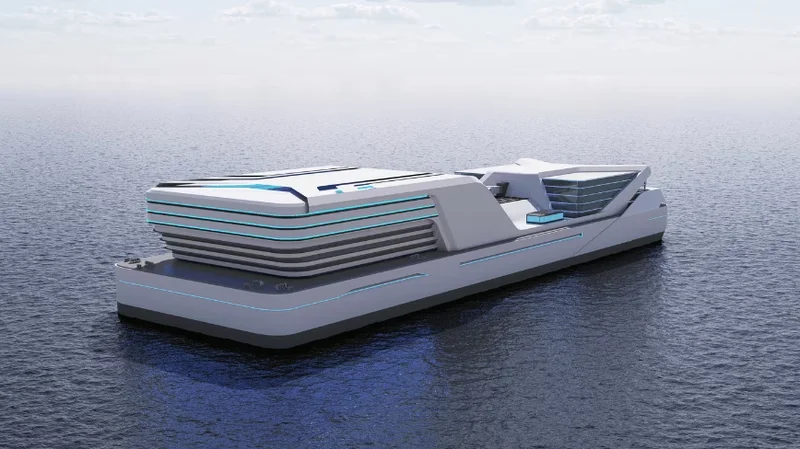
The floating data centre has moved from concept to contract. Samsung Heavy Industries and the Dallas firm Mousterian have signed an engineering deal to design one, The Register reported. The first project is bound for Texas.
The pitch is a neat answer to the AI buildout’s two tightest constraints: land and water. A moored facility needs no scarce plot. Owners can tow it elsewhere if plans change. And it can draw on the water around it for cooling.
A data centre built like a ship
Mousterian calls itself a developer of water-adjacent data centre infrastructure. The plan is a series of bespoke moored barges, each carrying 50 megawatts of computing capacity. Samsung will bring the shipbuilding.
The two firms will jointly handle the design and detailed engineering, a step towards a full construction contract. The American Bureau of Shipping will classify the facilities, as it would any vessel.
Building in a shipyard is the point. “Because the facility is built in a shipyard, fabrication advances in parallel with sitework rather than after it,” said Mousterian chief executive Min Suh. That, he argued, beats the schedule of a conventional build.
The cooling is the other selling point. Mousterian says its system uses no potable water and pours no discharge back into the waterway. Dropping the usual air chillers and fans, it adds, also cuts the noise. Noise is a big reason neighbours fight data centres on land.
Samsung floats a new line of business
For Samsung Heavy Industries, a shipbuilder, this is a new use for an old skill. It moved into seaborne server farms earlier this year, and last month agreed with Supermicro to test AI servers in river and offshore conditions. Its own first facility is not due until 2028.
“Waterborne server farms are a natural extension of the engineering capabilities the firm has honed over five decades in offshore and maritime construction,” said Samsung Heavy Industries chief executive Sung-an Choi.
The Mousterian pilot is meant to prove a sharper claim: that a floating hall moored next to an existing power plant can come online faster than a conventional site. The first one is understood to sit beside a gas-fired plant in Houston.
The grid had other ideas
That location is the problem. The same week the deal landed, Texas governor Greg Abbott paused new data centre grid connections until regulators audit the queue.
The numbers behind that freeze are startling. Grid operator ERCOT is weighing requests for more than 474 gigawatts of new connections, over five times the state’s peak demand. Data centres account for 90% of them.
Regulators now want each project to say whether it will bring its own power or lean on the grid, and how much water it will use. They will deny a connection to any project that does not answer. A barge moored beside its own gas plant may be better placed than most to pass that test, but nobody has said so yet.
The track record gives reasons for caution. A power-starved industry has floated the idea before, hunting for any way to build faster. Most attempts stalled on the practical problems of running critical kit on water. Rivals are chasing the same land and water elsewhere, from Google in India to a $100bn campus in Kentucky.
Samsung and Mousterian have a design that sidesteps the land and the water. The irony is that their first test sits in the one state that just decided the real bottleneck is the grid.
Get the TNW newsletter
Get the most important tech news in your inbox each week.