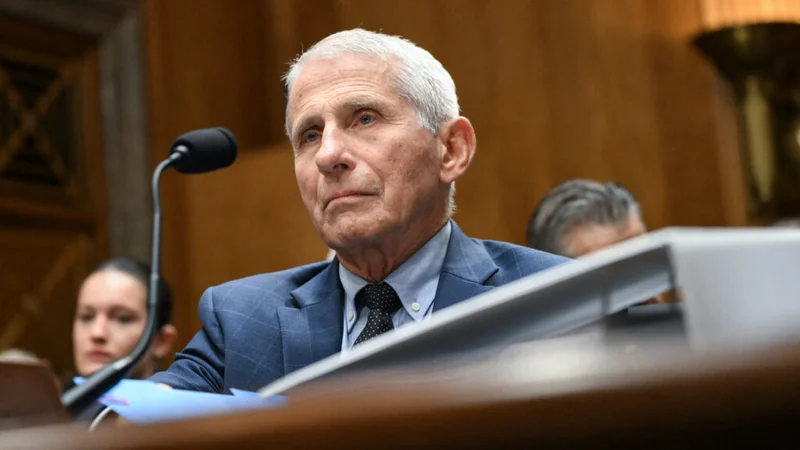
On Thursday morning, the Senate Homeland Security and Governmental Affairs Committee voted along party lines to hold Anthony Fauci in contempt of Congress over his recent invocation of the Fifth Amendment during a hearing about his pandemic-era leadership. Fauci will next face a Senate vote.
While watching these congressional proceedings, my mind has gone to two places at once: the spring of 2020 — and, more importantly, to what comes next.
This is not an argument against accountability. It is an argument for the kind of accountability that prepares us for the next crisis: honest, rigorous, nonpartisan, and focused on systems rather than spectacle The best form for that would be a 9/11 Commission-style independent body. Early in the outbreak, I served on a regional Covid task force. In those first three to four months, the mortality rate for admitted patients in the institution where I work was in the 20% to 30% range; in some cases, it exceeded 30%.
It was a terrifying period. Families were frightened, communities were looking for guidance, and clinicians were desperate for answers. But because we were facing a novel pathogen, the data people wanted simply did not exist yet.
The infectious disease and public health community was forced to make high-stakes clinical and operational decisions inside a complete black box. They were urgent real-time efforts to reduce the loss of life unfolding directly in front of us, based on what we knew about existing infectious disease models at the time, historical precedent, and collective consensus.
Today, with years of data in hand, it is easy to see where choices could have been made differently — regarding how we protected vulnerable elderly populations, how guidance on personal protective equipment evolved as we learned more about aerosol spread, how international outcomes compared, and so much more. Honest, rigorous review is vital. Medical science, public health, and epidemiologic science are naturally iterative; as evidence deepens, protocols must change. In fact, one of the basic principles of outbreak management is to do many things early with what you do know to limit further worsening while you continue to investigate and learn, knowing full well that protocols will adapt as new knowledge emerges.
Now, as a nation, as a medical and scientific community, and as elected leaders, we need to take a deep breath and ask ourselves: What is our actual goal here?
Is the goal simply to find a single scapegoat? Or is the goal to genuinely protect our communities, our health care systems, and the public when the next calamity strikes?
Genuine public health accountability should not be about placing a single person on trial. One misconception in the current debate is that pandemic-era decision-making was authoritarian or dictated by a single individual. Those of us involved in the response know that guidance was built through consensus panels, task forces, and clinical teams, even when one visible spokesperson delivered the public message. For example, during the early months of the pandemic, school closures were not dictated by Fauci, Trump, or any specific member of the White House Coronavirus task force. They offered guidance and recommendations with the information at hand to help states and local communities make decisions.
At the same time, the exact process of how information flowed and how consensus was reached deserves rigorous, objective review. A transparent evaluation would separate what happened from competing political narratives and help us improve for the future.
The congressional hearing with Fauci, so focused on anger, lacked a sustained effort to understand the process: who had authority, who interpreted the evidence, how recommendations changed as data emerged, where federal guidance collided with state and local realities, and which failures reflected individual judgment versus structural weakness.
Calling for “systemic and forward-looking accountability” is easy; achieving it requires decisive, coordinated action and a formal, independent body on the scale of a 9/11 Commission. That’s what we need now.
Among its primary tasks, such a commission should define how crisis decisions are made, identify key parts that should be updated in our public health data infrastructure, and ensure future leaders are better equipped to respond effectively. It should provide a roadmap for a transparent, stakeholder-driven model that includes frontline clinicians, infectious disease specialists, epidemiologists, supply chain experts, business leaders, and community leaders. Importantly, it must bridge the dangerous disconnect between federal guidance and state or local implementation so that future responses are scientifically sound and operationally realistic.
The roadmap must also establish clear frameworks for crisis communication. During a public health emergency, disconnected or conflicting messages from leaders create an immediate vacuum that misinformation can quickly fill. We must get better at explaining iterative science and uncertainty in plain language, while acknowledging when guidance changes and why. Maintaining public trust is not separate from the clinical response; it is one of the most critical issues in today’s hyper focus in the always on media and social media presence. Future leaders need a clear framework, so they do not have to build one from scratch.
When we confuse system-wide learning with individual punishment, we send a chilling message to the next generation of physicians (especially infectious disease physicians), epidemiologists, and public health officers. This comes at a time when the infectious disease workforce is already stretched perilously thin. If stepping up to guide a community through a crisis risks personal and professional vilification once the lights turn on, the best and brightest will simply choose to stay on the sidelines.
We cannot spend our time settling political scores while ignoring the playbook we need to build. Novel health threats will inevitably return in our lifetimes. When they do, we will desperately need brave, capable leaders at the table. Let’s make sure the lesson we teach them is not to stay silent, but to step forward — with better systems, clearer roles, and a country prepared to learn.
Ronald Nahass, M.D. is the current president of the Infectious Diseases Society of America, and the former president and current medical director of research at ID Care in New Jersey.