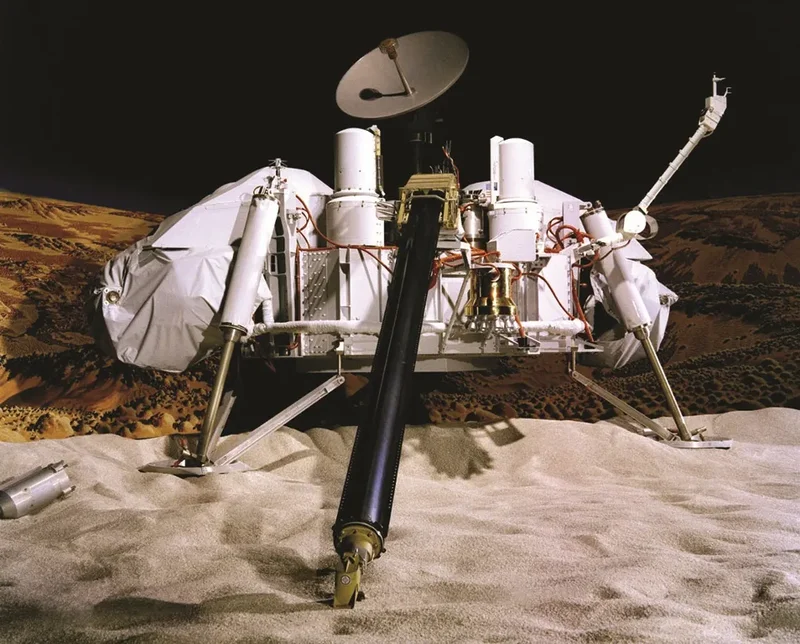
July 20 marked the 50th anniversary of one of the biggest robotic spaceflight achievements in NASA’s history: the landing of the Viking 1 spacecraft on Mars. It was the first fully successful Mars landing — the Soviet Union’s Mars 3 landed in 1971 but stopped transmitting seconds later — and carried a suite of instruments to study the planet, including those seeking evidence of life. (The results continue to be debated to this day.)
“Viking was challenging and high-risk. The challenges and risks greatly exceeded normal NASA projects,” recalled Tom Young, mission director for Viking, during an event on Capitol Hill to mark the anniversary. “The justification to proceed with Viking was based upon the importance of the mission and the capabilities of the Viking team.”
That team included Young, who would go on to become president of Martin Marietta and, in recent decades, an eminence grise of the space industry serving on multiple panels and commissions. It also included a then-22-year-old intern at the Jet Propulsion Laboratory assisting Gentry Lee, one of the lab’s top engineers, at meetings about the mission.
“I feel like the Forrest Gump of space. I stumbled into a variety of things,” said Dave Thompson, who years after that internship co-founded and led Orbital Sciences Corporation, one of the most successful space startups of the pre-SpaceX era.
The event hailed the Viking missions as a crowning achievement of NASA’s initial Mars exploration program, but largely overlooked one aspect of it: Viking was the last NASA Mars mission for a generation. The next lander, Mars Pathfinder, did not touch down until July 1997, almost exactly 21 years after Viking 1.
Some in the Mars science community worry NASA is in danger of another gap in Red Planet exploration. The cancellation of Mars Sample Return (MSR) has put the future of Mars exploration into question as NASA increasingly focuses on the moon. The Perseverance rover continues to collect samples despite uncertainty about when, or even if, they will be returned.
At the event, Lindsay Hays, senior scientist for Mars exploration at NASA, emphasized the 30-year record of Mars exploration at the agency, going back to Pathfinder and Mars Global Surveyor. “I’m really excited about the missions that we have,” she said. “We continue to keep that progress up.”
NASA is involved with as many as four missions going to Mars in 2028, but none is a conventional NASA-led science mission. The Rosalind Franklin rover is an ESA mission with modest NASA participation, including the launch. Mars Telecommunications
Network is a communications spacecraft with only a small science payload, while SR-1 Freedom is primarily a nuclear propulsion demonstration with SkyFall, a set of small Mars helicopters. In June, NASA announced it would provide a science payload for an unnamed Mars mission being developed by Relativity Space.
Plans beyond 2028, though, are unclear. NASA has discussed commercial partnerships for future Mars missions analogous to the CLPS program of lunar landers, but has not made any awards. The high cost of SR-1 Freedom, now estimated to be more than $2 billion, could take funds that had been planned for other Mars missions.
“There’s all kinds of amazing science we can do with CLPS-scale” or other small missions, said Jim Bell, a planetary scientist at Arizona State University who has worked on several Mars missions. “But there are other kinds of questions in decadal surveys that require, I think, flagships. Viking was a flagship.”
Viking was one of NASA’s most expensive science missions, with a cost in present-day dollars of $8.6 billion, according to a Planetary Society assessment. That puts it in range of MSR, which had cost estimates of $8 billion to $11 billion before NASA attempted to restructure the program.
MSR, like Viking, was challenging, high-risk and expensive, but NASA lacked the confidence in MSR or disagreed in its importance to continue it. The success of Viking came at the expense of a two-decade gap in missions that followed. Perhaps the demise of MSR will give scientists an opportunity to revise the program to avoid another long gap.
This article first appeared in the August 2026 issue of SpaceNews Magazine.