U.S. Indo-Pacific Command vowed Thursday that the U.S. "remains committed to the defense of the U.S. homeland and our allies in the region" after North Korea test-fired a ballistic missile.
The launch of the short-range ballistic missile unfolded ahead of large-scale, annual exercises to be conducted by the U.S. and South Korean militaries later this month. South Korea’s Joint Chiefs of Staff said a projectile from North Korea's eastern Wonsan area was detected around 5 p.m. local time.
"We are aware of the missile launch and are consulting closely with our allies and partners. Based on current assessments, this event does not pose an immediate threat to U.S. personnel or territory, or to our allies," U.S. Indo-Pacific Command said in a statement.
"The United States remains committed to the defense of the U.S. homeland and our allies in the region," it added.
South Korea's military bolstered its surveillance posture and is closely coordinating with the U.S. and Japan in the wake of the event, according to South Korea’s Joint Chiefs of Staff.
Japanese Defense Minister Shinjiro Koizumi said the missile landed in the waters off North Korea's east coast and that there were no reports that the weapon reached Japanese territory.
Koizumi added that North Korea's repeated missile launches pose a threat to Japan and the region and that Tokyo lodged a protest to Pyongyang through their embassies in Beijing. South Korea's presidential national security council called the North Korean launch "a provocation" that violates U.N. Security Council resolutions and urged the North to stop it.
It was North Korea's first ballistic missile launch since late June, when it tested a tactical ballistic missile with a "special mission" warhead and other weapons. After watching the testing activities, leader Kim Jong Un said at the time that the military needed to bolster its "deadly and destructive offensive posture."
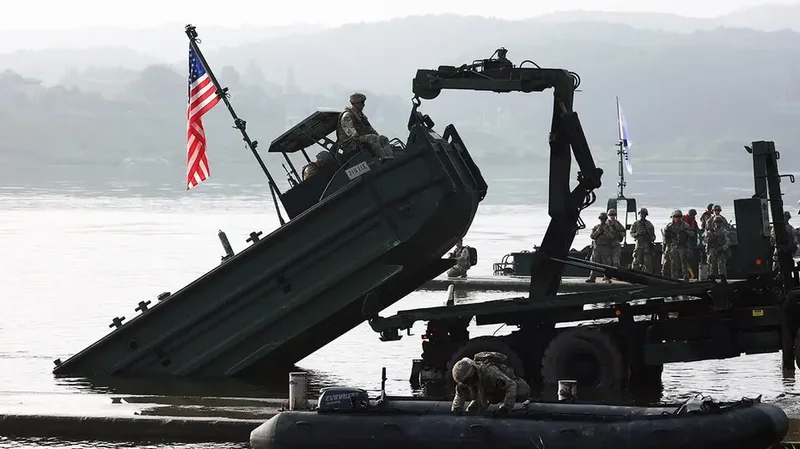
South Korean and U.S. officials haven't yet released details about this year's Ulchi Freedom Shield joint exercise, but the drills are typically held in the latter half of August.
"This annual exercise aims to build understanding between Combined Forces Command, United States Forces Korea, the United Nations Command, and ROK Joint Chiefs of Staff (JCS), ROK government agency, ensuring their ability to fortify the combined defense posture and enhance Alliance response capabilities against a spectrum of security threats," United States Forces Korea said about the exercises on its website.
"It will feature live, virtual, constructive and field-based training, engaging personnel from the various military services," it added.
U.S. and South Korean officials say the training is defensive in nature, but North Korea says the maneuvers are a practice invasion and often responds with missile tests, according to The Associated Press.
Fox News' Liz Friden and The Associated Press contributed to this report.