- See more Daily Mail on Google - save us as a Preferred Source
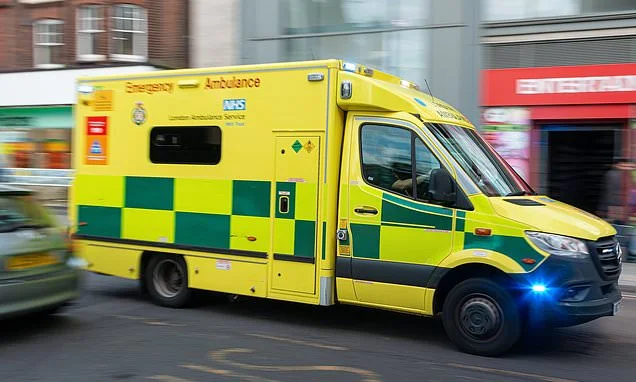
Patients dialling 999 in a heatwave could have to wait for temperatures to drop before an ambulance arrives under union plans to stop crews working in hot weather.
Unison says many emergency workers are expected to work in conditions ‘harmful to their health’ and wants NHS trusts to do more to protect members during increasingly hot summers.
Paramedics have told of being sent out in ambulances in ‘stifling heat’ with faulty or no air conditioning and often with limited access to drinking water or toilets.
This has occurred during shifts where staff have queued for hours outside hospitals to hand over patients, ‘often in temperatures exceeding 30C’.
Ambulance workers also describe being ‘physically and mentally exhausted’ as they spend hours treating patients in care and private homes affected by ‘unbearable’ heat.
Others are required to work for ‘prolonged periods in the glare of direct sunlight at road traffic collisions and other major incidents, wearing heavy uniforms that aren’t designed for hot weather’, Unison added.
It acknowledges elderly patients in particular are also suffering dehydration and heat-related illnesses as temperatures soar.
But it today issued a list of demands for NHS bosses that would make members’ lives more comfortable during heatwaves while subjecting patients to critically long waits for care.
The union Unison says it 'backs the introduction of a maximum working temperature during increasingly frequent periods of extreme heat'.
The union says NHS summer planning must include ‘guaranteed hydration and recovery breaks, proper access to drinking water, and clear policies to remove vehicles from service if air conditioning fails'.
Trusts should also introduce ‘seasonal uniform options, including lighter-weight clothing, shorts for staff who choose to wear them and sun hats for crews when working outdoors’.
'The union also backs the introduction of a maximum working temperature during increasingly frequent periods of extreme heat,’ it adds.
The Trades Union Congress has previously called for a legal maximum working temperature of 30 degrees Celsius, or 27 degrees for ‘strenuous’ work.
Sharan Bandesha, national ambulance officer at Unison, said: ‘Ambulance services have well-established plans for winter. It’s increasingly clear they’re needed for summer too.
‘Extreme heat brings a rise in demand, as more people become seriously unwell and need urgent care.
‘Yet crews are often expected to respond in vehicles with no working air-con, treating patients in overheated properties and care homes, or the back of their searingly hot ambulances.
‘Patients deserve to be transported at a comfortable temperature.
Unison acknowledged elderly patients in particular are suffering dehydration and heat-related illnesses as temperatures soar.
‘These ambulances serve as workplaces, so simple steps such as hydration breaks could make a real difference to staff wellbeing and patient safety.'
The calls came as Yvette Cooper revealed she has ordered NHS trusts to start preparing for summer surges in demand, as they do for winter.
The new health and social care secretary said there has been a ‘big increase’ in people attending A&Es because of the effects of hot weather.
And she called on the public to look out for elderly people and other people vulnerable to the effects of extreme heat.
‘I spoke to A&E staff who were telling me that they’ve had a big increase in patients coming into A&E linked to the heat in a way that you would normally only see in the winter,’ she told LBC Radio.
'So I’ve been clear: the NHS has to make sure we are preparing for summer pressures now in the same way we prepare for winter.
‘What it means is making sure that you’ve got plans in place to respond to higher numbers of people coming in to A&E, for example, who are vulnerable because of the heat; that you’ve got the arrangements in place to make sure people can then be returned from hospital as swiftly as possible; the arrangements in place to manage the conditions.
‘But it also needs much stronger prevention – we know that it’s the elderly and vulnerable who are at risk when you have these heatwaves.’
She added: ‘We need all of us, to be honest, to just keep an eye on elderly, frail relatives or neighbours in these heatwaves in exactly the same way that we might if there was a real cold spell.
'And just recognise that those extremes of weather can affect people in terms of the heat.
'We’ve had, I think, 2,700 additional deaths because of the heatwave in May and June.
‘I think we have to take that seriously in terms of across communities, not just when people arrive at A&E.’
The UK Health Security Agency warned last month that England is on track this year for the highest number of deaths caused by heatwaves since current figures began.
England faced record-breaking heatwaves in May, when temperatures peaked at 35.1C, and June, which hit new highs for the month of above 37C, accompanied by high humidity.