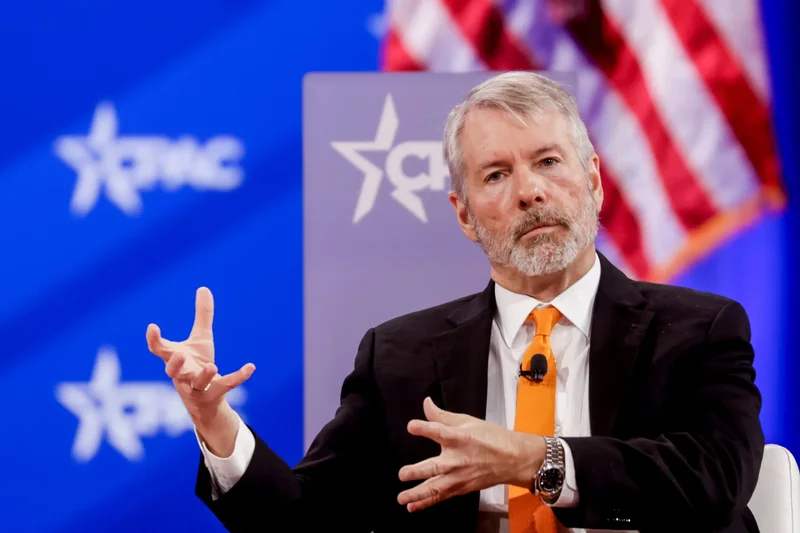
In the age of AI, the key to building wealth isn’t trying to compete with machines—it’s using them to your advantage. That’s at least according to billionaire Michael Saylor, who recently created ChatGPT to help his company make $15 billion last year.
“If you’re in your working years where you want to upgrade the world and make a difference and be remembered for something—then a pretty simple principle is don’t keep doing the same thing over and over, working harder and harder every year, fighting against the modern automation, epidemic,” Saylor said in a Diary of a CEO interview published on Thursday.
“Don’t try to outwork the robots.”
The 61-year-old made the comment after podcaster Steven Bartlett asked him what it takes to build a legacy on the scale of someone like Michael Jackson or Elon Musk—and become globally recognized for your impact.
Saylor’s advice comes from his own experience transforming Strategy, the company formerly known as MicroStrategy. He founded the software firm in 1989 but in the last half-decade shifted its focus toward Bitcoin, becoming the first publicly traded company to adopt the cryptocurrency as a major part of its treasury strategy.
After Strategy exhausted more traditional ways of raising capital to buy more cryptocurrency, Saylor said he turned to ChatGPT to help design a Bitcoin-based preferred stock that lawyers and bankers initially questioned because no one had created a similar product before. Strategy ultimately raised about $15 billion through an IPO and related offerings—leading Saylor to say AI “made” him $15 billion.
For entrepreneurs and workers looking to capitalize on the AI boom, Saylor said using the technology is a “no brainer”—but the advantage comes from asking better questions, not simply automating existing tasks.
“You don’t want to learn how to do things the AI can do. What you want to do is learn how to ask the AI to do something that’s never been done before,” he said. “…If you want to create these incredible success things, you want to locate the magic opportunity.”
Saylor’s Bitcoin bet comes with a familiar risk: going all in
While Saylor’s net worth currently sits at $3.3 billion, according to Forbes, his latest AI-fueled strategy has not been without risks. Strategy’s Bitcoin-heavy approach—and its use of preferred stock to raise more capital—has left the company increasingly tied to the cryptocurrency’s performance. Fortune’s Shawn Tully has described the structure as “dangerously” leveraged to Bitcoin’s price.
That exposure has come into focus this year: Bitcoin is down 26%, while Strategy shares have fallen 38%. However, Saylor argued that big breakthroughs often require enduring setbacks, and his company’s willingness to adapt through challenges has been central to its success.
“We found some extraordinary cool thing. We committed to it with all of our heart and soul and we declared we were going to make it work come hell or high water,” Saylor said. “We got punched in the face a hundred times. And every single time we ran into a problem, we stopped, we recalibrated, we went a different direction.”
It’s not the first time Saylor’s aggressive bets have come with major consequences. After MicroStrategy’s stock surge during the dot-com boom helped make him a billionaire, the company was forced to restate its financial results after disclosing that revenue from 1999 had been overstated by 25%.
The accounting scandal cost him $6 billion in one day—the most any single person had ever lost in the span of 24 hours up to then. The SEC accused him of violating federal securities laws later that year, and he settled the charges, paying $8 million to the agency but never admitting any wrongdoing.
Fortune reached out to Strategy for further comment.
From Satya Nadella to Mark Cuban, business executives agree that AI is a tool for ambitious builders
Saylor is not the only business leader urging professionals to embrace AI as a tool for innovation rather than just a threat to their jobs. Other executives have argued that the biggest opportunities in the AI era will come from people who combine the technology with uniquely human skills.
Microsoft CEO Satya Nadella has said that while AI will help workers get more done, the future of work will require more than just adopting the technology.
“I see these technologies acting as a co-pilot, helping people do more with less,” he said at the World Economic Forum’s annual Davos, Switzerland, meeting in 2023. “The future of work is not just about technology and tools. It’s about new management practices and sensibilities to the workplace.”
Billionaire entrepreneur Mark Cuban has taken the idea even further, predicting that entrepreneurs who know how to use AI to solve problems could create unprecedented wealth.
“There’s always something bigger and better that’s created by an innovative entrepreneur,” Cuban said on the High Performance podcast last year. “But AI just dwarfs all that.”
breaks the traditional barrier between audience and newsroom. The show transforms
Fortune DailyFortune’s trusted reporting into actionable, conversational, and entertaining insights for an emerging class of business leaders.
Watch here.