China tensions and new defence treaty on the agenda for Pacific foreign ministers' meeting
Tensions with China and New Zealand's interest in a new defence treaty will be on the agenda for Friday's annual Pacific Islands Forum Foreign Ministers' Meeting.
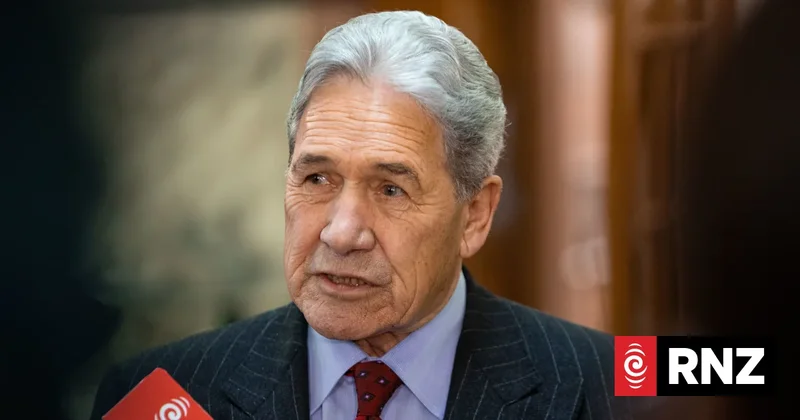
Winston Peters is in Suva, Fiji, along with foreign ministers from 17 other Pacific countries.
The meeting gives ministers a chance to prepare for the PIF Foreign Leaders' Meeting in the tiny Micronesian islands of Palau early next month, which Prime Minister Christopher Luxon will attend.
It comes amid tension with China which last month, with just a few hours' warning, test-launched a nuclear-capable ballistic missile with a dummy warhead into the Pacific Ocean - a nuclear-free zone.
It was met with condemnation from some Pacific leaders, and Luxon said the New Zealand government made clear to China that the move was unacceptable - but there has not been a unanimous statement from Pacific nations.
China, which is a PIF partner country, in June gave the PIF secretariat more than USD $1 million which the secretariat said "reaffirmed its commitment to regional development and cooperation".
Some viewed the missile firing as intentionally timed, given it happened shortly after a new defence treaty was signed between Australia and Fiji.
New Zealand is considering joining the Ocean of Peace Alliance, which is likely to be discussed in Suva.
The defence treaty committed its parties to "act to meet common danger".
Peters has previously acknowledged China may label New Zealand's interest an act of provocation, but said the country would allege that whether or not it was true.
Ahead of the Suva meeting, he said the Pacific had seen recently how global events impacted the region.
"It is timely to discuss those events and chart a common course for the Pacific.
"As New Zealand prepares to host next year's Pacific Islands Forum, we look forward to working with members to advance the priorities of the Blue Pacific and reinforce the value of strong regional cooperation."
In Suva, Peters would also hold a range of bilateral discussions with Pacific counterparts.
The talks would also centre on resilience and cooperation as the fuel crisis continues, as well as climate change and the role and influence of PIF partner countries.
The decision to ban partner countries - including heavy hitters like China and the US - at last year's meeting in the Solomon Islands ramped up tension between Pacific countries.
Peters has spoken out repeatedly about "outsiders" influencing the Solomon Islands Prime Minister Jeremiah Manele to implement the ban, which Manele denied, arguing the block made sense while PIF leaders considered how best to respond to the increasing interest from partners wanting a seat at the regional decision-making table.
No unified statement on China yet
Otago University international relations professor Robert Patman said it may be difficult to get consensus on a unified statement about the China missile.
While some Pacific nations would be privately angry about it, they were also conscious that the United States also launches missiles into Pacific waters, Patman said - noting that was usually with the cooperation of the Marshall Islands.
"Some Pacific Island leaders believe it's hypocrisy just to single out China," he said.
"New Zealand and Australia are very quick to criticise China for doing that, but they've been rather more restrained when it comes to the United States."
Patman said New Zealand and Australia must be careful not to nudge its neighbours towards alignment with either side of the US-China rivalry, saying that would be "disastrous".
"If you're a Pacific Island nation and you're relatively poor, you want to accept assistance where you can get it," Patman said.
"Secondly, they jealously guard their sovereignty, their vision of the future doesn't rest in Washington or Beijing."
Peters' attack on Chinese born MP risks weakening NZ's credibility - expert
Patman said questions would be raised in Suva about Peters' comments in Parliament last week towards Chinese-born Green MP Lawrence Xu-Nan.
Faced with heckling from Xu-Nan, Peters responded "go back to your own country", and continued, "that's where they lie like a flatfish".
He later doubled down, refusing to apologise and saying his comments were defending democracy.
It drew protest from the Chinese Embassy in New Zealand, which lodged "solemn representations" with the foreign affairs ministry.
Patman said some Pacific leaders would not look fondly on the affair.
"It could affect New Zealand's credibility in the eyes of some Pacific Island nations," he said.
"A large number of people from the Pacific live in New Zealand, and so I just think that, given that these countries are friendly with China - a number of them are, and have close economic ties - they would have noticed and observed the comments by our foreign minister in our Parliament."