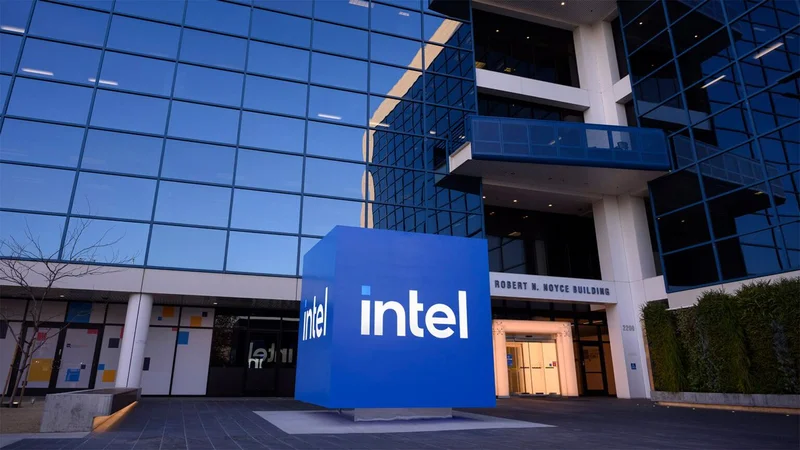
Intel will design, package, and fabricate Fortinet's sixth-generation Security Processor (SP6) on its Intel 4 node, the companies announced on July 21, giving the process its first named external foundry customer, roughly three years after it entered production. Intel told Tom's Hardware the agreement reflects "the strategy Intel outlined for Intel 4 several years ago," including support for custom networking ASIC workloads. Intel's own record from those years reads differently, however, with the company's 2021 roadmap having scoped Intel 4 to two internal products. And through 2022, it told engineers and investors that Intel 3, not Intel 4, would be its first process offered to foundry customers.
Intel 4's record
Intel's Accelerated announcement back in July 2021 said that Intel 4 would reach production readiness in the second half of 2022 for products shipping in 2023, naming "Meteor Lake for client and Granite Rapids for the data center." The release and its accompanying fact sheet, however, contained no reference to foundry customers, networking, or custom ASICs on the node.
At VLSI 2022, Intel disclosed that it wasn't building a high-density library for Intel 4 and that Intel 3 would be the first new node offered through what was then Intel Foundry Services. A 2024 post on Intel's own foundry blog describes Intel 3 as "Intel Foundry's first leading-edge process node," and Intel's fiscal year 2024 annual report listed the processes available to external customers as 18A, Intel 3, Intel 7, Intel 16, and a 12nm node co-developed with UMC. Intel 4 appears nowhere on that list.
Latest Videos From
Ericsson's RAN Compute processors, announced in November 2023, were built on Intel 4, so Fortinet's part won't be the first third-party silicon to come off the node. That work grew out of a bespoke Intel-Ericsson collaboration, though, and Ericsson's formal foundry agreement with Intel, announced in July 2023, covered 18A. Fortinet is the first named customer buying Intel 4 as a foundry service, and the first cybersecurity vendor on any Intel node. The Ericsson engagement is also the closest thing in the public record to networking silicon on Intel 4, two years after the strategy Intel now says it outlined for the node.
Fab 34 economics
Intel 4 entered high-volume manufacturing at Fab 34 in Leixlip, Ireland, in September 2023, producing the compute tile for Meteor Lake-based Core Ultra chips, and shares the fab with Intel 3. Intel sold a 49% stake in the facility to Apollo-managed funds for $11.2 billion in June 2024, then bought it back in April 2026 for $14.2 billion, funded with $7.7 billion in cash and $6.5 billion in new debt. That buyback returned 100% of Fab 34's wafer economics to Intel at a premium of roughly 27%, and it only pays off if the fab's EUV capacity stays loaded.
Meteor Lake is aging out of Intel's lineup as 18A-based Panther Lake ramps through 2026, which leaves open the question of what fills Intel 4 capacity next. A multi-generation firewall ASIC program is a reasonable answer with mature yields, a customer that values supply stability over bleeding-edge density, and a part Intel described as tailored for cost-sensitive applications. Intel said in April that yields were improving across Intel 4, Intel 3, and 18A.
Fortinet's supply chain
Fortinet's 2025 annual report names Renesas and Toshiba America as the contract manufacturers for its ASICs, utilizing foundries in Taiwan and Japan operated either by TSMC or by the contract manufacturers themselves. The current SP5, a monolithic 7nm Arm-based SoC announced in February 2023, sits in that supply chain, so SP6 on Intel 4 moves Fortinet's next flagship security processor out of a TSMC-linked flow and into Intel's. The disaggregated design language in the announcement points to a chiplet-based part, a first for Fortinet's SP line.
Fortinet re-engineered three FortiGate models in 2022, the 70F, 600F, and 3700F, to accept alternative components during the chip shortage, and CMO John Maddison told SDxCentral at the time that the company wouldn't wait for parts to arrive in 2023. The "resilient and diversified" supply chain used in the SP6 press tracks back to that experience. Ken Xie called Fortinet "the #1 firewall leader with a 55% unit market share" in the company's 2025 results in February, with approximately six million FortiGates deployed, so there’s real, substantial volume here even if the parts are relatively inexpensive.
Intel Foundry reported $307 million in external revenue for 2025, up from $159 million the year before, against total foundry revenue of $17.8 billion and an operating loss of $10.3 billion. External revenue in Q1 2026 was $174 million. Fortinet's hardware business runs at roughly 30% of its revenue, and, per analysis from ServeTheHome, SP6 is ultimately a component of a portion of an annual hardware stream around $2 billion, so the deal won't move Intel's foundry line materially, even at full production.
CEO Lip-Bu Tan told CNBC in May that he expected commitments from multiple foundry customers in the second half of 2026, and Intel told investors in January that two prospective customers were evaluating 14A test chips. The SP6 announcement comes inside Tan's stated window, and it finally gives Intel something its foundry marketing has lacked in a named customer with shipping volume on a node with mature yields. Meanwhile, an 18A or 14A commitment from a major external customer is still missing, and Fortinet's cost-sensitive parts on a 2023 node don't substitute for one.