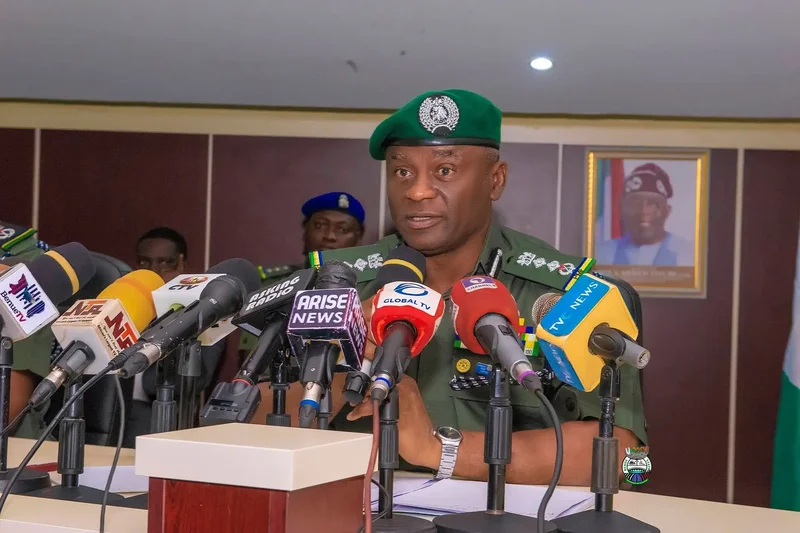
Former Nigerian police chiefs have raised concerns about the country’s proposed state police framework and submitted recommendations to strengthen the model before it is finalised, the Inspector General of Police (IGP), Olatunji Disu, has revealed.
Mr Disu stated this while delivering his opening remarks at a workshop organised by the National Institute of Police Studies in Abuja on Thursday. In his remarks, livestreamed by the police spokesperson for new media, Ali Giwa, the IGP said the retired police chiefs had reviewed the draft framework and offered inputs that would be incorporated into the final document.
“Retired Inspectors-General of Police have visited me, and they have shown their concern,” he said. “We have deliberated, and they have put their contributions into this as well.”
“You have the opportunity to help us look at it so that every important detail that will be needed is inputted into it,” he added.
| | |
|---|
Mr Disu said the committee completed its draft framework within 17 days despite commencing work after governors had begun developing their own proposals.
“We started late. We caught up with them, and I’m happy to say our work is what they are deliberating on today, and we still need to put some finishing touches to it,” he said.
He added that the committee benchmarked its recommendations against policing systems in countries with sub-national police structures, including India, the United States and Pakistan.
Mr Disu also urged senior police officers to familiarise themselves with the proposed reforms and help educate colleagues about the planned policing structure.
“There are fears everywhere, and it’s our duty to educate them and let them know what state police is all about,” he said.
Many Nigerians have called for the establishment of state police to address the country’s security challenges, although others have raised concerns.
President Bola Tinubu has made the establishment of state police a cardinal objective of his administration.
In April 2024, Mr Tinubu said at the National Dialogue on State Policing that his commitment to reforming the Nigeria Police Force and enhancing national security was “unwavering.”
PREMIUM TIMES reports that Nigeria faces multidimensional security threats, and the police are expected to be at the forefront of tackling them. But they are understaffed and poorly equipped, resulting in the militarisation of internal security and the overstretching of the military, which should respond only to external threats.
At the 2024 forum, Mr Tinubu described state policing not just as a policy idea but as a potential milestone in the evolution of Nigeria’s law enforcement, allowing policing to be more responsive to local needs.
Concerns by former police chiefs
At the workshop, Mr Disu did not disclose the identities of the former IGPs or the specific issues they raised.
However, some of his predecessors have publicly rejected state policing. The immediate past IGP, Kayode Egbetokun, had said that Nigeria is not “mature” to adopt the policing model.
“There is the potential for abuse of power by the state political leadership,” Mr Egbetokun said at the same 2024 forum where President Tinubu was advocating for state policing.
“State governors could use the police forces under their control for political or personal gain and undermine human rights and security,” he continued. “There would also be a conflict of jurisdiction.”
Mr Egbetokun’s stance on state policing and other administrative issues, including his handling of attacks on the press, would later contribute to his removal from office. Although he was expected to remain in office until 31 October 2027, President Tinubu asked him to resign nearly two years earlier.
In 2012, nine former police chiefs warned ex-President Goodluck Jonathan not to establish state police, warning that state governors would use it to torment their political opponents.
Instead, the retired police chiefs—Muhammadu Yusuf, Sunday Adewusi, Gambo Jimeta, Aliyu Atta, Ibrahim Coomasie, Musiliu Smith, Tafa Balogun, Sunday Ehindero and Mike Okiro—advised the former president to strengthen the intelligence and investigative arm of the police to meet the standard required to cope with contemporary challenges.
Background
PREMIUM TIMES reported that the federal government announced a seven-week roadmap, including a call for memoranda on how to seamlessly transition Nigeria from a unitary policing system to one that allows for state police.
This followed the submission of a 75-page framework titled “A Comprehensive Framework for the Establishment, Governance and Coordination of Federal and State Police” to the Senate Committee on the Review of the 1999 Constitution.
The document, prepared by an eight-member committee chaired by Olu Ogunsakin, a professor of police studies, was presented as the Nigeria Police Force’s professional input into the proposed security reform.
Also, the National Assembly has passed legislation to establish state police. In June, this newspaper reported that both chambers passed a constitutional amendment bill proposing a dual federal and state policing system, although the proposal must still be harmonised, approved by at least 24 state Houses of Assembly and assented to by the president before it becomes law.
The proposed legislation, as explained in a PREMIUM TIMES report, provides for state police services to be coordinated alongside the federal police under an expanded National Police Council, while introducing safeguards such as legislative confirmation of state police commissioners and independent state police service commissions to oversee recruitment and discipline.