New Indian airport pitches gateway to Southeast Asia
VISAKHAPATNAM, India— The next gateway to Southeast Asia may not be Singapore or Bangkok, but a fast-growing city on India’s southeastern coast, more than 4,000 kilometers from Manila.
That’s the bet of GMR Airports Ltd., which has opened a new international airport in the Andhra Pradesh region, hoping to turn Visakhapatnam into a regional aviation hub.
Article continues after this advertisement
GMR developed and previously operated Mactan-Cebu International Airport and now serves as its technical services provider.
It also built Clark International Airport and has committed to the development of Sangley Point Airport.
Located in Bhogapuram, Andhra Pradesh, the roughly $500-million Alluri Sitarama Raju International Airport is designed to strengthen connectivity between India and Southeast Asia. GMR sees the Philippines, Singapore, Vietnam, Thailand and Indonesia benefiting from expanded air links.
The airport will begin full commercial operations on Aug. 17.
“There are so many different strides happening between India and the Philippines. The whole of Southeast Asia, we expect it to be better connected with the air connectivity community,” Srinivas Bommidala, GMR business chair for energy and international airports, tells reporters.
Article continues after this advertisement
He says the airport will support tourism, trade, cargo, investments and people-to-people exchanges as Andhra Pradesh attracts investments in ports, shipbuilding, steel, data centers and other industries.
“A lot of associated businesses and value chains will be created from Southeast Asia, predominantly Vietnam, China, Japan and the Philippines,” Bommidala adds.
Article continues after this advertisement
While there are no direct flights to Manila, the airport is expected to establish links with Singapore first, providing onward connectivity to other Southeast Asian destinations.
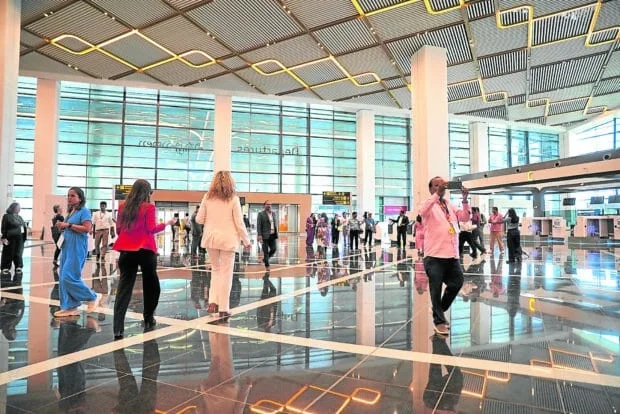
The airport is also designed as a showcase of Andhra Pradesh’s coastal identity and cultural heritage.
Its sweeping roofline resembles the paravai meen, or flying fish, which is commonly found in the Bay of Bengal. The roof appears to dip into the ground like a fish diving back into the sea, while large glass panels allow natural light to flood the terminal.
Located in a cyclone-prone coastal region, the terminal was engineered to withstand winds of up to 275 kilometers per hour.
The airport opens with an initial capacity of 6 million passengers annually and is designed to eventually accommodate more than 40 million passengers.
It features a 3,800-meter runway capable of handling wide-body aircraft, an artificial intelligence-powered Airport Predictive Operations Center, biometric passenger processing, self-service baggage facilities capable of processing up to 120 bags per hour and a 5,000-square-meter cargo terminal that can handle up to 25,000 metric tons annually. INQ