Nathan Moote has a haunting memory of finding two people dead in his driveway.
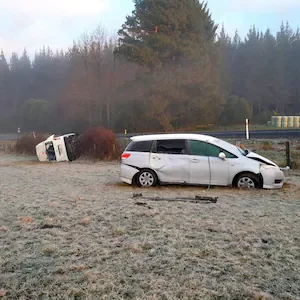
Now a series of vehicles skidding on black ice amid Rotorua’s recent cold snap, in which temperatures plunged to -4C overnight, has brought back the “terrible sight”.
Nathan Moote has a haunting memory of finding two people dead in his driveway.
Now a series of vehicles skidding on black ice amid Rotorua’s recent cold snap, in which temperatures plunged to -4C overnight, has brought back the “terrible sight”.
The two-vehicle crash that “really shook” Moote occurred early in the morning on January 15.
Moote found Gisborne man Saul Rerekura, 42, and Rotorua woman Taukirangi Hewitt, 32, dead in their vehicles.
“[It’s] something I can’t ever forget ...
“Now, whenever it’s icy on the roads ... I have trouble sleeping ...
“I worry what I’m gonna find out there,” he said.
Moote said six vehicles had skidded off the stretch of State Highway 30 outside Titoki Tihi Farm in the past two weeks.
Thankfully, only one person was injured in the crashes.
Every winter brings more crashes along the length of the farm. Moote estimated a “minimum” of 20 since he started living and working there eight years ago.
His 21-year-old son, who works alongside him, had also witnessed his share.
The experience has turned Moote into an unwitting first responder. Many times, he has rushed to help motorists and has pulled their vehicles from the farm fence with his tractor.
Moote said the highway was a “reasonably straight piece of road” where drivers could safely travel at 100km/h in normal conditions.
The speed limit increases from 80km/h just past Hell’s Gate Geothermal Reserve and Mud Spa, a tourist attraction about 2km before the farm.
“It’s just on those cold mornings when there’s ice there; that’s when people need to just slow down ... have their wits about them,” Moote said.
Moote drove the stretch of road regularly and said he had only noticed ice and grit warning signs in the past few weeks.
Farm co-owner Jon Marshall said the property was often a “few degrees cooler” than Rotorua town.
A forestry block across the road kept part of the highway in shade, allowing ice to remain on the road late into the morning on some days.
Jon and his wife, Debbie, split their time between the farm and Auckland, where they run a business, returning to the property every second week.
They have also become accustomed to rushing out to check on motorists when crashes happen.
Debbie had considered refreshing her first aid training so she knew exactly what to do if waiting for an ambulance.
But Moote was the one most affected, they said. Finding Rerekura and Hewitt had been “traumatic” for him.
Jon said Moote was left “freaking out” when crashes occurred, worried he would again find “something he doesn’t want to see”. The following days were spent repairing damaged fences to prevent livestock wandering on to the road and causing further crashes.
Some crashes in past years had happened in the middle of the night. The couple only knew when they found a section of damaged fence the next day.
The majority of motorists who had caused damage had not paid any compensation, Jon said. Claiming insurance was “hardly worth it”.
The process was lengthy and the excess could cost almost as much as repairing the fence, he said.
The Marshalls and Moote said they had asked police to install warning signs alerting motorists to icy conditions.
In the past week, a civil construction service had spread grit on the road to improve grip in icy conditions, Jon said.
He believed gritting needed to occur more often as it wore away quickly.
An NZ Transport Agency Waka Kotahi spokesperson said the agency “actively monitors and treats” the section of SH30 during winter.
Permanent ice and grit warning signs have been in place for “many years”. They were unfolded to be on display during winter when icy conditions are possible and folded away over summer.
The spokesperson said crews spread grit on the road on eight days in July and again on August 2 and 3.
Gritting was guided by weather forecasts, site inspections and ongoing assessments, and was carried out when ice posed a risk to motorists.
“We are continuing to assess conditions on this section of SH30 and will review whether any additional measures are appropriate,” the spokesperson said.
Drivers travelling on cold winter mornings should reduce their speed, increase following distances and take extra care, the spokesperson said.
“Black ice can form quickly and is often difficult for drivers to see.”
Rotorua road policing manager John Stapleford urged motorists not to brake harshly in icy conditions.
It was safer to lose speed by decelerating, Stapleford said.
He urged people stopping to help after a crash to remain visible, avoid blocking the road and stay clear of any downed power lines.
“Call emergency services, don’t assume someone else has called ... call 111 so the appropriate service can attend,” Stapleford said.
A police spokesperson said local police could definitely attribute one crash outside the farm in recent weeks to black ice.
The local police did not believe the stretch was more prone to black ice than other roads.
They said it was possible other crashes during the same period may have gone unreported.
Annabel Reid is a multimedia journalist for the Bay of Plenty Times and the Rotorua Daily Post, based in Rotorua. Originally from Hawke’s Bay, she has a Bachelor of Communications from the University of Canterbury.