Sign in. It’s quick, free and it’s up to you.
An account is an optional way to support the work we do. Find out more.
(Seo alt ónár bhfoireann Gaeltachta. Is féidir an bunleagan as Gaeilge a léamh anseo)
ROAD BOWLING IS part of our distinctive cultural heritage, and for the sport to have a chance to survive and grow, it needs corresponding protection from the United Nations, the Secretary General of the Irish Road Bowling Association, Séamus Ó Tuama, has said.
The association is seeking recognition from the United Nations Educational, Scientific and Cultural Organisation (UNESCO), on a par with the recognition already given to hurling, harp music and uilleann pipe music.
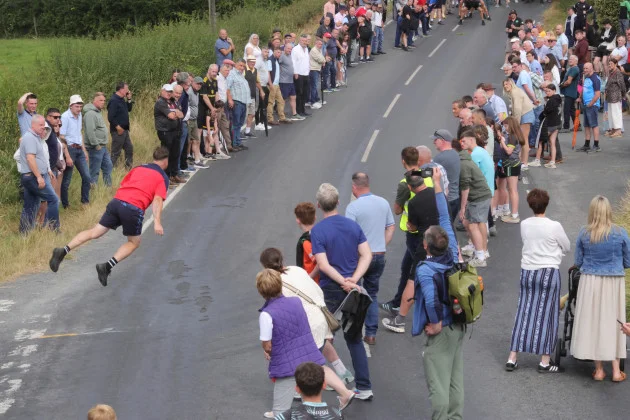
Road bowling is a sport played on public roads in counties Cork and Armagh for the most part and is also now spreading to other counties as well as being played internationally.
Two players or bowlers compete against each other, with the aim of throwing a small iron ball weighing 28 ounces along a course of between two and three kilometres. The winner is the bowler who completes the course in the fewest throws. It is similar to golf.
The earliest recorded reference to road bowling dates from 1714 in Derry, when the city council banned the playing of the game on the city walls, and there are also stories of Irish soldiers playing the game with cannonballs during the American Civil War.
Speaking to The Journal this week, Ó Tuama said there was enormous interest in the sport across the world, even though the Bowling Association – the national governing body – was poorly resourced and relied entirely on voluntary workers at a time when it was becoming harder for people to set aside time for such activity.
“The problem is that people in Ireland look at bowling the way Irish-Americans look at Ireland,” he said.
“They don’t see it as a sport for supreme athletes and highly skilled players who are competing at international level and representing Ireland internationally.
“When you go outside the heartland – say Cork and Waterford in Munster, Armagh, Tyrone and Monaghan in Ulster, and Mayo in the west – and there is a new club and active bowling community in County Louth – people don’t understand the crowds attending scores [bowling matches].”
The Ból Chumann is a member of Sport Ireland but, according to Ó Tuama, that body isn’t fully suited to the organisation of which he’s secretary.
“That is why it is important that bowling would have protection under UNESCO – it needs to be viewed in the broader context so that it is recognised as part of the cultural heritage.”
Ó Tuama is of the view that sufficient respect is not given to the elite players of the game about which he and many others are so passionate. He gave as an example the fact that no mention was made of the achievements of Armagh women’s bowler Kelly Mallon – who has won 12 all-Ireland titles at senior level – during discussions by sports commentators on the top women in sport last year.
“We have great respect for the likes of Rachael Blackmore and the other outstanding women who are mentioned, but Kelly’s place was earned in that conversation – I am not aware of any other sports hero in the world who has won as many national titles as she has.”
What road bowling needs now is some tender loving care, said Ó Tuama.
“There needs to be some kind of process to support us – we all need to be working towards the same goal, so that people understand that bowling is part of our heritage.
“Don’t get me wrong – there is more life in the sport now than there has been in 30 or 40 years. More people are playing it, there are more competitions, there are more people active in it – that is what attracts the voluntary workers; they want to train children, they want to organise the competitions.
“Some of the things other sports had done for them, we had to do ourselves – we had to come forward and develop, and that is no bad thing; it adds to our resilience and independence and so on.
“But we need to be thinking about the long term, rather than just the present moment – about the generation to come and the generation after that, and where we are going with this distinctive cultural and sporting heritage – how can we protect it for the generations to come.”
This appeal has received support from Fine Gael TD for Cork North West, John Paul O’Shea, who is seeking to raise the matter with the Minister for Sport, Patrick O’Donovan.
“Road bowling is a major and important part of our living heritage, particularly here in Cork and across many rural communities — it is a tradition that has been passed down from generation to generation and it brings communities together to this day,” he said.
“I have seen for myself how strong the tradition and passion for road bowling is in our communities,” he said, referring to the all-Ireland championships held recently in Ballynagree and Castletown Kenneigh.
He raised the matter in the Dáil recently and the written response he received gave him an insight into the process for being listed on Ireland’s UNESCO cultural heritage list.
“The Department of Culture, Communications and Sport accepts applications from practitioners who would like a practice to be added to the national list,” it was stated.
“An Expert Advisory Committee assesses each application and sends recommendations to the Minister.”
It was indicated that 42 practices from across the country are on this list in Ireland.
Ó Tuama said it was the Association’s intention to begin the process now to have road bowling added to that inventory.
The Journal’s Gaeltacht initiative is supported by the Local Democracy Reporting Scheme.
This article was originally written in the reporter’s native Irish and has been translated to English here. AI was used as part of the translation process before final edits.
To embed this post, copy the code below on your site