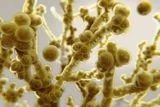
A patient recovering in a hospital bed has no way of knowing if Candida auris is living on their skin. There's no rash, no itch, nothing to feel or see. The danger starts only if a wound or IV line gives the fungus a route past the skin into deeper tissue.
Once it takes hold, there's no reliable way to clear C. auris from the skin. Researchers at the University of California, San Francisco wanted to know why, and their study, published in Science, traces the answer to a structure most people never think about — inside the hair follicle, where the fungus turns one immune signal to its own advantage.
“Candida auris colonizes skin way better than most other fungi, setting it up to invade once the immune system is weakened,” said Dean Merrill, first author of the study, in a press release. “The big clinical problem is that we have no effective way to remove it from the skin.”
First identified in Japan in 2009, the fungus has since spread worldwide. In the U.S., it is associated with roughly 3,000 deaths each year among people in hospitals and nursing homes.
How C. auris Tricks the Immune System Into Helping
C. auris
To see what set C. auris apart, researchers compared it to Candida albicans, a related skin fungus. In mice, skin cleared C. albicans within days. C. auris, on the other hand, didn't leave; it settled into hair follicles and stayed there.
That difference traces back to which immune signal each fungus provokes. C. albicans triggers a molecule called IL-17, which refreshes the skin's surface and ramps up anti-fungal defenses, clearing the fungus within days.
C. auris manages something stranger. It reshapes its own cell wall to expose more of a substance called chitin, prompting nearby immune cells to release interferon gamma, a signal more commonly associated with antiviral defenses.
That signal works against the skin here. It suppresses IL-17, dulls the skin's anti-fungal response, and it slows how quickly the follicle sheds and replaces its own cells, so worn-out cells linger instead of being cycled out, creating exactly the kind of stagnant environment C. auris needs to settle in.
“Chitin is widespread in nature, so it’s not like the human skin never encounters it, but we were surprised to see that C. auris actively uses its chitin to turn the skin into a perfect nest,” said Suzanne Noble, co-senior author of the paper, in the press release.
Read More: A Deadly Superbug Named Candida Auris Is on the Rise — Who Is at Risk?
Potential Treatments Could Target C. auris Skin Colonization
Since the fungus survives by leaning on one immune signal while shutting down another, that split gives researchers something concrete to aim at.
One idea is a treatment that quiets the interferon gamma response and lets IL-17 get back to its usual job of refreshing the skin. Merrill also pointed to a second angle, a drug that blocks chitin or prevents it from amplifying the interferon gamma response.
Neither approach has been shown to clear C. auris from human skin, but the study points to two places a future treatment could act, either on interferon gamma or the chitin that triggers it.
Living With Something That Doesn't Announce Itself
Among more than 21,000 patients who tested positive for C. auris colonization between 2016 and 2023, a CDC analysis found that only about 7 percent went on to develop a clinical infection. Among those who developed a bloodstream infection, it took a median of 86 days after the first positive test.
“It's only when it reaches deeper tissues in medically vulnerable patients that it becomes dangerous,” said Ari Molofsky, co-senior author of the paper. “Understanding how it survives on the skin may help explain how it eventually causes serious infections.”
If researchers can interrupt the fungus's ability to settle into hair follicles, they may eventually remove it before it reaches deeper tissues.
Read More: New Antibiotic Could be 100 Times More Potent and Has Potential to Save Countless Lives
This article is not offering medical advice and should be used for informational purposes only.
Article Sources
Our writers at Discovermagazine.com use peer-reviewed studies and high-quality sources for our articles, and our editors review for scientific accuracy and editorial standards. Review the sources used below for this article:
- This article references information from a study published in Science: The fungal pathogen Candida auris exposes chitin to trigger IFNg and persist in hair follicles
- This article references information from the CDC: Progression from Candida auris Colonization Screening to Clinical Case Status, United States, 2016–2023