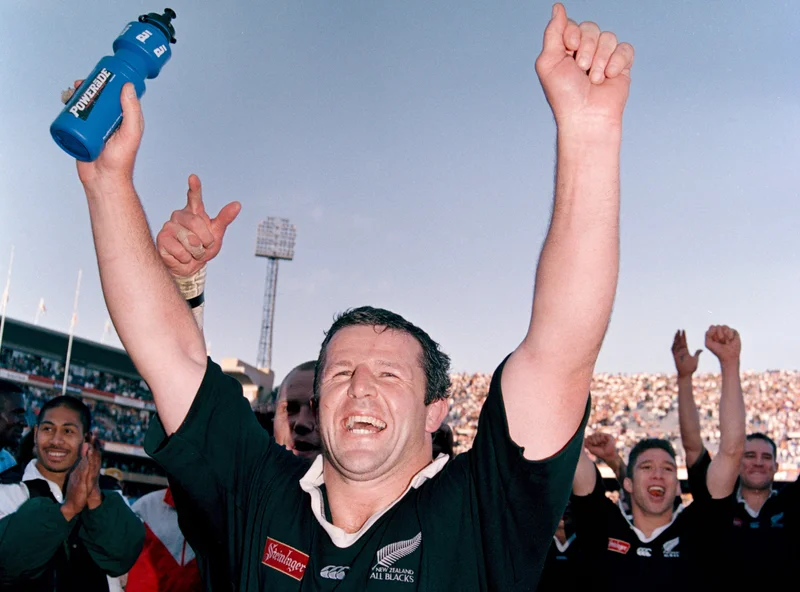
One of the seminal images in the history of rugby is of All Black skipper Sean Fitzpatrick on his knees, punching the Loftus Versfeld turf in elation. Behind him is a pile of bodies scattered across the New Zealand tryline.
His 1996 All Blacks had spent the final three minutes of the second Test of the series camped in their red zone, holding off waves of Springbok attacks.
The Boks needed a try and a conversion to draw and to keep the three-match series alive, having lost the first Test by 23-19 in Durban.
But Fitzpatrick and his men, by hook or by crook, held firm. And when the final whistle blew to give the All Blacks a 33-26 victory and with it an unassailable 2-0 lead in the series, New Zealand players were sprawled across the ground after such a monumental effort and achievement.
They were too exhausted to celebrate at that moment. They had just become the first All Black team to win a series in South Africa in 68 years of trying. They remain the first and last New Zealand team to win an away series against the Boks.
âDon Clark, the great All Black fullback from the 1950s and â60s, was living in Johannesburg at the time,â Fitzpatrick told Daily Maverick from his London home this week.
âDon hugged me in the tunnel as we walked off and said, âYou know Sean, I can die a happy man now because Iâve now witnessed an All Black team winning in South Africaâ.â
Thatâs how much it meant. Fitzpatrick admitted that it probably ranks higher than winning the 1987 World Cup on home soil.
âI say to anyone, and I said to the current All Black manager, if you want to see what it takes to win in South Africa, show them the last three minutes of that Loftus game. And youâll realise that we are dying on our feet. Thatâs what it takes,â Fitzpatrick said.
It was also the first series officiated by neutral referees, which changed the bias of previous tours, whether unconscious or otherwise.
The 1996 SA Rugby Annual, in its review, rather uncharitably lays the blame for the series defeat on some Bok injuries and officiating, when the reality was that the All Blacks were that little bit better.
Over the three Tests, they scored 78 points to the Boksâ 77 and outscored the hosts by 10 tries to nine. The difference came down to goal-kicking with Joel Stransky struggling in the first two Tests, landing only 50% of his shots at goal. Those are always the margins.
âAt some point the great Danie Craven said to me, âevery time we (the Boks) go to New Zealand, we get cheated. Every time you come to South Africa, we cheat you. This will be different because it is under neutral refereesâ,â Fitzpatrick recalled.
Brutal series
The last time the All Blacks embarked on a âproperâ tour to South Africa, the internet was in its infancy, commercial cellphone connectivity in South Africa was only two years old and President Nelson Mandela wasnât even halfway through his term of office.
Rugby, in 1996, was in its first year of professionalism and little did anyone know it then, lengthy tours were in the throes of extinction.
The launch of the Tri-Nations in 1996 ushered in a new way of competing and forging ties between South Africa, New Zealand and Australian rugby, and long tours were no longer part of that vision.
But the 1996 tour had been decided and agreed before the Tri-Nations was born, and so, in a curious result of timing, the Springboks and All Blacks clashed five times that year.
The first two Tests were part of the new Tri-Nations, with meetings in Christchurch and Cape Town in between matches against Australia.
The All Blacks won 15-11 in Christchurch, which was the first Test between the sides since New Zealand were famously beaten 15-12 by the Boks at Ellis Park 12 months earlier in the final of Rugby World Cup 1995.
The second confrontation took place in Cape Town, marking the first of four Tests in South Africa between the teams in 1996, although the Newlands clash stood outside of the actual three-Test, seven-match tour which was to follow.
The All Blacks won another bloody battle 29-18 in Cape Town, which saw Bok skipper Francois Pienaar badly injured and ruled out of the upcoming Test series.
The inexperienced Gary Teichman was made captain by coach André Markgraaff for the series proper, but the results didnât immediately change.
âI had only played six Tests and was trying to cement my place in the team more than worry about being captain,â Teichmann told Daily Maverick.
âWhen coach André Markgraaff asked me to be captain, it came as quite a surprise. I hadnât been involved in the 1995 World Cup, and it meant taking over from a guy (Pienaar) that had achieved some incredible things.
âIt wasnât an easy decision. I was in two minds. I spoke to my father, and he said to me, âYou will probably only get this opportunity once. If you donât take it, donât expect it to come around againâ.â
Of course, Teichmann had the misfortune of leading the team to a series defeat as it turned out, but the margins were incredibly small and over the course of three matches, not much separated the teams.
Distractions?
Itâs true that the Boks had more injuries over the series, with the All Blacks fielding the same pack of forwards for four Tests in a row, if you count Cape Town.
âYou had two teams that were quite even,â Teichmann recalled. âBut we werenât as settled as them. They also had a lot to prove. Losing Francois and being a new captain who wasnât involved in the World Cup was a big disruption to a team that was quite well settled and had achieved a lot. âAnd when itâs so close, and the teams are so tightly matched, if youâre a little bit off the game in terms of preparation or certain things going on within the team environment, it sets you back.â
It didnât help that Markgraaff selected hooker Henry Tromp for the series. Tromp had been convicted of manslaughter of a black farm labourer years earlier, and the optics became huge news â especially so soon after Mandela had turned up wearing a Bok jersey at the 1995 World Cup final, symbolically extending an olive branch to the white community.
Although the players were reasonably sheltered from the brief media storm that selection provoked, it was another unwelcome distraction for Teichmann.
The All Blacks had their share of distractions, albeit of a different kind. South African âfansâ often crept into the parking lots of hotels where they were staying and rocked cars to set off alarms in the early hours of the morning.
They eventually needed more security around hotels.
âThe things that really stood out for me were the intensity on the field, obviously, but also off the field. It was just relentless,â Fitzpatrick said.
âThe car alarms were a big part of it, but thatâs just all part of the experience. I always say, me being the most hated man in South Africa in those days, was a mark of respect. At least thatâs what I tell myself.â
Teichmann felt the intensity and pressure in a different way as skipper of the home team, leading a squad with many World Cup 1995 survivors. In some ways, he was an outsider in the Bok set-up, but fortunately those veterans of the glory a year earlier got behind the new captain.
âIâve got to admit that the â95 World Cup players were extremely supportive,â Teichmann said.
âI must mention the late Joost van der Westhuizen because he stood up and said, âWeâve got to support Gary as the captain.â They were extremely supportive.
âThere were quite a few Natal guys in the squad such as André Joubert, Mark Andrews and a couple of others. Even though I was a pretty reluctant captain initially, I was very fortunate in that I got the support of the World Cup â95 group. That was vital.â
Happy time?
Obviously, depending on your perspective, it was a positive experience. For the All Blacks, it was the pinnacle for a great team that had fallen short a year before. In many ways it was redemption for 1995.
âIt was such a happy time in rugby. It was the start of professionalism and it was on the back of the 1995 World Cup,â Fitzpatrick said.
âSuper Rugby that season was unbelievable and then to have the first Tri-Nations was fantastic.
âWe played 10 Tests in about 12 weeks. We had a new coaching regime under John Hart and the tour to South Africa was the first time in several years (since 1976).
âThe challenge of potentially winning a Test series in South Africa for the first time was a huge motivating factor after the disappointment of â95.
âSo, even though the Test at Newlands wasnât part of the series (it was the last game of the inaugural Tri-Nations), we saw Cape Town as a pivotal moment.
âIt was a matter of making a statement that we were going to try and get parity, if not a bit of dominance at scrum time. At Newlands, we showed that, and we knew a week later going to Kingâs Park we had to win that game to have any chance up on the highveld.â
The All Blacks spent the first 10 days preparing in Plettenberg Bay and from then, the squad was split into two groups. The midweek team â the dirt-trackers â took on Boland, Eastern Province, Western Transvaal and Griquas and then helped prepare the Test team.
They were fit and hungry. There were hardly any changes to the Test team over the course of the series, even for the dead-rubber third Test, which the Boks won 32-22 at Ellis Park.
âJohn (Hart) and I have spoken about it subsequently, and we probably should have made changes for the third Test,â Fitzpatrick said. âBut it wasnât the way we did things in those days.â
New era
This yearâs tour, marketed as Rugbyâs Greatest Rivalry, is similar to the 1996 visit with eight matches â four games against provincial clubs, but four Tests as opposed to three.
Unlike 30 years ago though, the first Test is on the highveld and not at sea level. What small advantage that brings for the Boks is being used immediately.
While the current Boks, with a cupboard full of silverware, start as favourites, both former captains acknowledge that you can probably throw stats out the window when it comes to the Boks and All Blacks.
âPlaying at altitude was a much bigger issue then than it is now,â Fitzpatrick said in reference to how science and preparation have moved on.
âObviously, New Zealand players donât come to South Africa for Super Rugby any more, so a number of these players have never been to South Africa, let alone played against the Boks.
âBut Dave Rennie and the current team have tapped into the â96 team a little bit. They hosted a dinner before they left where that â96 team was invited. A few stories were told. And the big thing I told them is that itâs a 24-7 job on tour in South Africa.
âRennie is a smart coach, and they are well prepared.â
Teichmann doesnât buy into the theory that the All Blacks are huge underdogs.
âRassie Erasmus will certainly make sure the players are aware of the challenge, and I canât see any complacency creeping in,â Teichmann said.
âTests against the All Blacks are always going to be on a knife-edge. I think one or two key injuries could play a part in the final outcome.â
Fitzpatrick is also optimistic that the All Blacks will make the Boks sweat over the course of the series.
âThe Springboks and the All Blacks are basically the same beast,â he said.
âWe have the same mentality. We believe weâre never going to lose.â DM