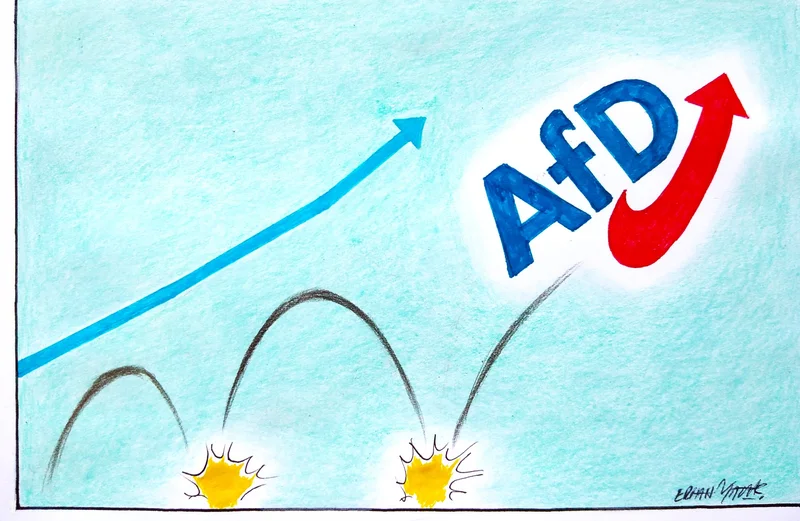
More than 1,000 German legal professionals have backed a call for proceedings to ban the Alternative for Germany (AfD). The initiative, organized by the Republican Lawyers’ Association, had collected 1,051 signatures by early August, including lawyers, judges and prosecutors. Its supporters argue that the AfD violates the constitutional principles of human dignity and democracy and that Germany should act before the party can translate its programme into state power.
Their concerns should not be dismissed. Germany’s post-war constitution was deliberately designed according to the principle of a “militant democracy”: a democratic order is not required to remain passive while its enemies seek to destroy it. Article 21 of the Basic Law therefore allows the Federal Constitutional Court to ban a party that aims to undermine or abolish the free democratic basic order. A party ban is therefore not automatically undemocratic. It is a constitutional instrument shaped by Germany’s historical experience.
Yet the existence of such an instrument does not mean that its use would necessarily be politically wise. The debate surrounding the AfD increasingly reveals a dangerous temptation: replacing political competition with administrative and judicial containment.
The AfD won 20.8% of the vote in the February 2025 federal election, almost doubling its result from 2021 and becoming the largest opposition force in the Bundestag. Current national polls have also repeatedly placed it either close to or ahead of Chancellor Friedrich Merz’s conservative bloc.
The situation is even more striking in eastern Germany. Saxony-Anhalt will hold a state election on Sept. 6, 2026. An Infratest dimap poll published in late July put the AfD at 41%, far ahead of the Christian Democratic Union at 24%. For the first time in the history of the Federal Republic, the party has a realistic prospect of becoming the strongest governing force in a federal state, although coalition arithmetic and the refusal of other parties to cooperate could still prevent it from forming a government.
These figures change the nature of the political problem. Whether or not the AfD fully meets the academic definition of a catch-all party, it can no longer be treated as a marginal protest movement. It has developed into a mass electoral force whose support extends far beyond a limited extremist milieu.
This does not make radical positions harmless. Nor does electoral success protect a party from constitutional scrutiny. Democracy is more than majority rule: It also safeguards minorities, human dignity and the rule of law. But when millions of citizens repeatedly vote for the same party, the democratic system must also ask why its own political responses have failed to convince them.
Germany’s established parties have relied heavily on the so-called “firewall,” refusing cooperation with the AfD at federal, state and local levels. As an independent political decision, this is legitimate. No party can be forced to cooperate with another party whose programme, personnel or political values it fundamentally rejects.
But the firewall was intended not only to prevent coalitions. It was also supposed to isolate the AfD, limit its political influence and prevent its normalization. Judged by these objectives, it has failed. The AfD has grown stronger rather than weaker.
The party has used its exclusion to cultivate the image of a persecuted outsider confronting a closed political establishment. Every new sanction, restriction or institutional measure can then be presented as further evidence that the political system fears the AfD and the voters demanding change.
The same problem surrounds the classifications issued by Germany’s domestic intelligence services. Several AfD state organizations, including the party’s branch in Saxony-Anhalt, have been classified as confirmed right-wing extremist organizations. At the federal level, however, a Cologne court temporarily prevented the domestic intelligence agency from treating the entire party as a confirmed right-wing extremist organization while the main legal proceedings continue.
This distinction matters. In a constitutional state, classifications that have major political and reputational consequences must rest on precise evidence, proportionality and effective judicial review. Otherwise, security institutions risk being perceived as participants in political competition rather than as neutral guardians of the constitutional order.
The more frequently such instruments are used against an increasingly popular opposition party, the more difficult it becomes to convince its supporters that the political system is treating them fairly.
The legal threshold for banning a political party is rightly high. The Federal Constitutional Court has stressed that a prohibition cannot merely target unpopular opinions, nationalist ideology or radical rhetoric. It requires evidence that a party is actively and aggressively seeking to undermine the free democratic basic order. There must also be a realistic possibility that the party could successfully pursue its anti-constitutional objectives.
The AfD’s electoral strength may make this final criterion easier to establish than it was in the failed attempt to ban the far-right National Democratic Party of Germany in 2017. Yet the AfD’s political relevance also makes the possible consequences of a prohibition considerably more serious.
Banning the country’s largest opposition party would not eliminate the convictions of its voters. It could radicalize parts of its electorate, move political organization into less transparent structures and reinforce the belief that meaningful change is no longer possible through democratic elections.
Germany should therefore resist the illusion that a court ruling could solve what is fundamentally a political crisis. A ban may eliminate a party organization and its name. It cannot eliminate social anger, distrust of institutions, concerns over migration, economic insecurity or the perception that political decision-makers no longer listen to large sections of society.
The more effective response is also the more demanding one: better government, credible migration policies, economic renewal, stronger public services and a direct confrontation with the AfD’s political proposals. Mainstream parties must explain where their program is unrealistic, economically harmful or incompatible with constitutional principles. They must also acknowledge where their own mistakes have contributed to the AfD’s rise.
Germany has long presented itself internationally as a model of liberal democracy, freedom of expression and constitutional restraint. Its criticism of authoritarian governments carries weight because Germany claims that political opponents should be defeated through democratic persuasion and institutions governed by the rule of law, rather than suppressed for political convenience.
That credibility weakens when intelligence classifications, parliamentary exclusion and party-ban proceedings appear to replace substantive political debate. Germany has every right and duty to defend its constitutional order. But a confident democracy should first attempt to defeat a powerful opposition party at the ballot box.
The AfD should be investigated where concrete evidence justifies such action and its members should be prosecuted where laws have been violated. Its rhetoric and programme must also be subjected to strict public scrutiny. Yet the central confrontation must remain political.
A democracy proves its strength not by making difficult parties or dissatisfied voters disappear, but by presenting better arguments, developing more convincing policies and winning those voters back.