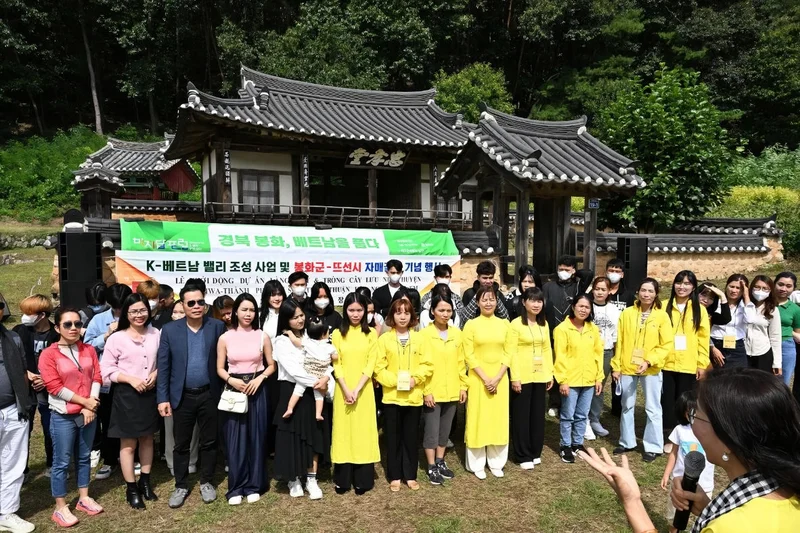
Bonghwa County, an isolated mountainous region in North Gyeongsang Province roughly 210 kilometers southeast of Seoul, has officially been named Korea’s newest Special Regional Development Zone in a major bid to deepen ties with Vietnam, government officials said Thursday.
The designation by the Ministry of SMEs and Startups approves the K-Vietnam Valley project, an ambitious $253 million (347.6 billion won) regional development program that leverages an extraordinary 800-year history of cross-border exchange. The initiative builds on the 13th-century arrival of Prince Lu Long Tuong of Vietnam’s Ly Dynasty, whose descendants, the Hwasan Lee clan, still reside in the rural county.
The unusual lineage traces back to 1226, when the prince fled royal purges in Vietnam by sea, eventually washing ashore on the Korean Peninsula during the Goryeo Kingdom. Granted asylum and land by King Gojong, the prince and his followers integrated into local society and helped defend the territory against Mongol invasions, establishing the Hwasan Lee clan. Today, Bonghwa houses Chunghyodang — a historic shrine honoring a 13th-generation descendant who died fighting in the 1592–98 Imjin War, the devastating conflict sparked by Japan's invasion of the Korean Peninsula — making the county the sole physical repository of this shared royal ancestry in Korea.
Central planners hope to convert this long-standing historical connection into a vibrant hub for bilateral tourism, cultural integration and rural economic survival.
"The Bonghwa K-Vietnam Valley Special Zone represents a novel attempt to connect an 800-year history of bilateral interaction directly to cultural tourism and regional economic vitality," said Vice Minister of SMEs and Startups Roh Yong-seok following the committee meeting in Sejong.
The project spans nearly 880,000 square meters of land and will unfold across eight specialized tracks through 2030. A 200 billion won cultural and educational facility honoring the Ly Dynasty lineage forms the center of the site, serving both as a tourist attraction and a dedicated settlement support node for Vietnamese immigrants and multicultural households. Additional elements include a Vietnamese-themed resort at Changpyeong Reservoir, high-tech smart farming zones and eco-tourism infrastructure across the Baekdudaegan mountain range.
To facilitate construction and operations, Seoul is granting 10 statutory exemptions. These administrative waivers ease rules governing foreign worker visas and stays while reducing regulatory barriers tied to municipal planning, land acquisition and housing supply.
Korea’s special zone mechanism, established in 2004, grants municipal governments targeted exemptions from federal law to spur localized growth. Officials currently oversee 171 operating zones across 135 local districts.
For Bonghwa, the initiative addresses an urgent demographic crisis.
Like many agrarian counties across Korea, the municipality faces severe population depletion as younger residents migrate to major urban centers. By building its economic trajectory around historic ties to Vietnam, local planners aim to draw international visitors, strengthen diplomatic relationships, and secure long-term demographic stability. The initiative illustrates how remote rural communities are testing historic preservation as a strategy to counter modern economic contraction.
This article was published with the assistance of generative AI and edited by The Korea Times.