SCIENCE
Astronomers spot exomoon candidate that's almost as massive as Jupiter
Object orbits a brown dwarf, which circles another star, confusing the cosmic taxonomy
Scientists may have found the first moon outside our Solar System – depending on what astronomers ultimately decide counts as one.
Either way, the groundbreaking research, published in Nature this week, promises a path to clearer sightings of so-called exomoons.
Kevin Hoy, a PhD student affiliated with Universidad Diego Portales and the European Southern Observatory in Chile, has found an object orbiting a brown dwarf, which in turn orbits a host star, which sits about 73 light-years from the Sun in the southern celestial hemisphere.
Brown dwarfs present a problem for astronomers. They fill the gap between gas giant planets – like Jupiter or Saturn – and the smallest stars. They are not massive enough to sustain the hydrogen fusion that powers the Sun and other main-sequence stars, although they can fuse deuterium, a heavier isotope of hydrogen. That leaves the object found by Hoy and his collaborators in a definitional gray area.
"This is the first time, to our knowledge, this technique has produced evidence of satellites around a companion brown dwarf," the paper said.
The first confirmed exoplanets were discovered orbiting a pulsar in 1992, but exomoons have so far proved elusive, despite there being hundreds in our own Solar System.
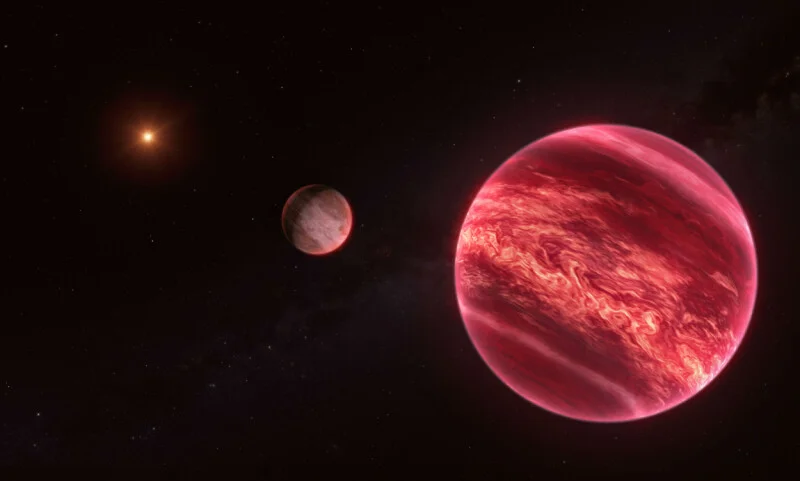
The researchers found that the new object, which for now they are calling an exosatellite, is decidedly unmoon-like, being at least as massive as Jupiter. The brown dwarf it orbits is around 30 times the mass of Jupiter.
"This system is somewhat hard to define using Solar-System-based words like 'planet' and 'moon,'" Hoy said in a statement. "The exosatellite is clearly massive enough to be a planet, but it does not orbit a star, though it orbits an object that orbits a star. Being the third wheel in this system makes us want to call it a moon, even if it is nothing like the small, rocky moons we have in our system."
The research team employed the radial velocity method used by Michel Mayor and Didier Queloz to discover 51 Pegasi b in 1995, the first exoplanet found orbiting a Sun-like star. The technique detects the gravitational "wobble" induced in a host object – usually a star, but in this case a brown dwarf – by something orbiting it. Modeling of the data indicates that there is at least one orbiting satellite. Models for two satellites are possible but highly unstable. Whether a moon or not, the object has a minimum mass about nine-tenths that of Jupiter and completes an orbit every 170 days.
"Although it is uncertain whether this exosatellite will fulfil the presently undefined criteria for qualifying as an exomoon, it is a marked step towards that first uncontroversial detection, as advancing technology will allow the same method to be applied to less massive targets," the paper says.
At roughly Jupiter's mass, this is no forest moon of Endor. Finding something more like the moons in our own neighborhood will have to wait for sharper instruments. ®