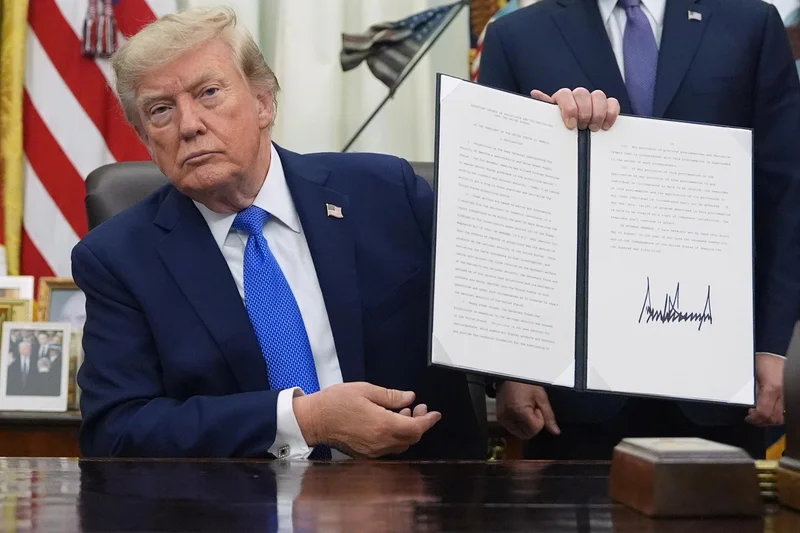
U.S. President Donald Trump signed a proclamation Thursday (local time) imposing a 15 percent tariff on polysilicon derivative products and minimum import prices (MIPs) on polysilicon, ingots and wafers, creating both opportunities and risks for Korean solar-material and panel makers by potentially narrowing the price gap with Chinese suppliers in the U.S. market.
The measures, which will take effect on Dec. 4, are aimed at strengthening U.S. production of polysilicon and its derivatives, a key material for both the solar and semiconductor industries.
“Polysilicon is the base material underpinning the security of America’s semiconductor and solar-power supply chains,” Trump wrote in the proclamation. “These tariffs — combined with the MIP program — will promote United States production of polysilicon derivatives by ensuring a commercially viable market for them.”
The proclamation sets minimum prices at $21 per kilogram for polysilicon, $100 per kilogram for polysilicon ingots and wafers, 22 cents per watt for solar cells and 38 cents per watt for solar modules.
For Korean suppliers, the impact is likely to be mixed. The new rules could improve their competitiveness against Chinese rivals, although rising U.S. production could eventually make it harder for Korean companies to export to the market over the longer term.
Jang Sang-sik, head of trade trend analysis at the Korea International Trade Association, said Chinese suppliers have enjoyed a significant price advantage over Korean companies in the U.S. market, whether shipping directly from China or routing products through Southeast Asia.
“I don’t think it will be that unfavorable for Korea,” he said.
“Since the price difference between Korean and Chinese products will disappear in the U.S. market (with the measures), the price competitiveness that Korea has lacked compared with China will be somewhat resolved.”
The measures could benefit Hanwha Qcells and OCI Holdings, which have built supply chains outside China.
Hanwha Qcells has built a vertically integrated U.S. solar supply chain, producing ingots, wafers, cells and modules at its facility in Georgia, while OCI produces polysilicon at its Malaysian plant, positioning both companies as potential alternatives as U.S. buyers seek to reduce reliance on Chinese suppliers.
Hanwha Qcells welcomed the White House decision, saying it would support investments and jobs while advancing efforts to bring the entire solar supply chain onshore in the U.S.
“Today's decision from the White House balances the reality of where America's solar energy manufacturing is today while advancing our collective ambition to onshore the entire supply chain from polysilicon to finished panels in the U.S,” the company’s Global CEO Andy Park said.
OCI Holdings said the reduction in uncertainty was “somewhat positive,” but added that it needed to examine the details before assessing the impact on its business.
The company noted that the Section 232 measure was not separated by country, making the final impact dependent on how the rules are implemented.
In response to the proclamation, the trade ministry said it would consult closely with Washington to minimize the impact on Korean businesses. It explained exports to the U.S. of polysilicon derivatives covered by the proclamation totaled an estimated $430 million in 2025.
“The government will promptly hold a meeting with relevant ministries and industry to closely assess the impact on exports to the U.S. and companies operating there,” the ministry said.
Meanwhile, the four-month grace period before the measures take effect could prompt suppliers to build up inventories in the U.S. to avoid higher costs later. Jang said Korean and Chinese suppliers may seek to accelerate shipments during the transition period.
The proclamation also directs the U.S. Department of Commerce to monitor imports during the period before the measures take effect and take action against efforts to circumvent the new restrictions through stockpiling.
Over the longer term, however, domestic exporters could face a tougher market if U.S. production expands.
“If U.S. factories are built and domestic production increases significantly in the long run, it may become more difficult for products from Korea to enter the U.S. market,” Jang said.