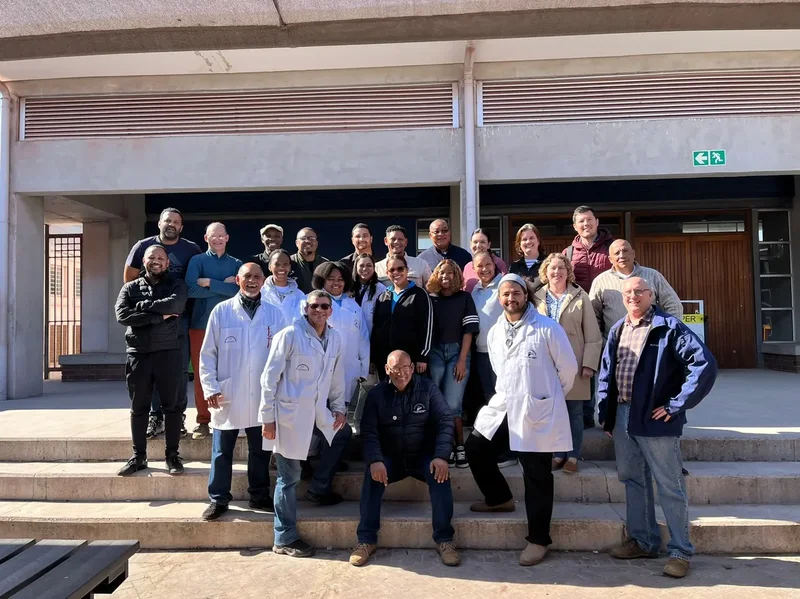
Advancing Knowledge NPC (AK NPC) concluded its 2026 professional development programme with West Coast teachers. The award-winning organisation presented two SACE-endorsed Inquiry-Based Science Education (IBSE01) courses for Natural Sciences teachers from the West Coast Education District on 31 July and 1 August 2026. The InterSen Phase (Grades 4–7) astronomy and physics courses were offered on Friday, followed by the Senior Phase (Grades 8–9) courses on Saturday.
The training was hosted at the Science Teaching and Learning Centre (Science TLC) at Louwville Secondary School in Vredenburg. The facility was developed through a partnership between Advancing Knowledge NPC, the Garden Cities Archway Foundation, and the Western Cape Education Department.
The programme focused on the Energy and Change (Physics) and Planet Earth and Beyond (Astronomy) knowledge areas of the CAPS curriculum, preparing teachers for the third and fourth terms through inquiry-based, practical learning. Participation was coordinated with West Coast Subject Advisor Mr Ferdie Greeff, with particularly strong attendance from Senior Phase teachers.
Facilitators included Mr Robert Solomon (Energy and Change) and Mr Andrew Firth and Mr Mark Ogilvie (Planet Earth and Beyond), supported by science interns Somila Dlakavu and Siphiwuthando Qeqe, together with Projects Coordinator Melissa Petersen. Opening the programme, Professor Shaheed Hartley, Director of AK NPC, encouraged teachers to integrate inquiry-based, practical investigations into their daily science teaching.
EXPLORING PLANET EARTH AND BEYOND
The astronomy programme strengthened intersen and senior phase teachers' understanding of the Earth–Sun–Moon system and the physical processes responsible for day and night, seasons, tides, lunar phases and eclipses. Teachers explored Earth's rotation and revolution, gravity, celestial motion, the Solar System, the Milky Way and the wider universe while connecting these concepts directly to CAPS requirements.
A major focus was translating scientific knowledge into classroom practice. Participants installed freely available astronomy applications on their laptops and mobile devices to identify celestial objects, simulate astronomical events and support inquiry-based investigations both inside and outside the classroom.
Teachers participated in practical investigations including modelling the phases of the Moon, explaining eclipses and seasons, investigating tides, identifying constellations and constructing a sonometer to measure the Sun's apparent movement. These activities promoted observation, measurement, prediction and evidence-based reasoning while demonstrating affordable classroom approaches suitable for diverse school contexts.
Collaborative discussions and guided investigations increased teachers' confidence in teaching astronomy and equipped them with practical strategies to deliver engaging, curriculum-aligned lessons that promote scientific literacy and curiosity.
Teacher Reflections
- "The workshop stimulated my curiosity and strengthened my confidence in teaching astronomy. It showed how inquiry-based learning encourages learners to ask questions and develop scientific understanding through investigation."
- "The hands-on activities demonstrated how simple, low-cost resources can explain complex concepts. Constructing and using a sunometer provided an excellent classroom activity that I can immediately implement."
- "The astronomy applications introduced new ways of making the curriculum interactive and engaging. They provide authentic opportunities for learners to investigate astronomy both inside and outside the classroom."
SPARKING ENERGY AND CHANGE
The Energy and Change workshops developed teachers' conceptual understanding of physics while modelling inquiry-based teaching strategies for one of the most demanding sections of the Natural Sciences curriculum.
Beginning with engaging demonstrations, teachers explored electricity, magnetism, electromagnetism, forces and energy transfer through carefully sequenced investigations that challenged misconceptions and strengthened scientific reasoning. Rather than focusing solely on curriculum coverage, the programme emphasised understanding the scientific principles underlying physical phenomena.
Teachers investigated electrical, thermal, light, sound and mechanical energy, explored energy transfer and conservation, and connected these concepts to everyday experiences that make science meaningful for learners.
Practical investigations included constructing salt-water cells, assembling electrical circuits from inexpensive materials, testing conductors and insulators, measuring voltage, current and resistance with multimeters, and investigating balanced and unbalanced forces. Senior Phase teachers also explored thermal energy transfer through conduction, convection and radiation using classroom-friendly experiments.
Throughout the programme, facilitators modelled inquiry-based pedagogy by encouraging participants to observe, predict, question, investigate, analyse evidence and justify conclusions using scientific reasoning. The emphasis on affordable resources demonstrated that high-quality practical science is achievable even in schools with limited laboratory facilities.
Teachers collaborated enthusiastically throughout the sessions, creating a vibrant professional learning community focused on improving science teaching and learner achievement.
Teacher Reflections
- "The workshop challenged my understanding of electricity and strengthened my confidence by linking theory with practical investigation using real measurements."
- "Although working with electrical circuits and multimeters initially seemed intimidating, the practical investigations helped me understand the relationships between voltage, current and resistance."
- "Developing explanations before testing them through experiments demonstrated the value of inquiry-based learning. I can immediately adapt these investigations for my own classroom."
The West Coast Subject Advisor observed that the programme successfully moved teachers beyond superficial curriculum coverage by strengthening conceptual understanding, addressing misconceptions and building confidence to teach physics through inquiry and investigation. The training demonstrated the value of sustained, inquiry-based professional development in strengthening teachers' subject knowledge, pedagogical skills and confidence to facilitate practical science learning. By combining rigorous scientific content with affordable, curriculum-aligned investigations, the programme equips teachers to foster curiosity, critical thinking and scientific literacy while improving learner engagement and achievement in Natural Sciences.
This initiative is made possible through the partnership between Advancing Knowledge NPC, the Garden Cities Archway Foundation, and the Western Cape Education Department. Organisations interested in supporting the expansion of inquiry-based STEM teacher development are invited to contact Professor Shaheed Hartley, Director of Advancing Knowledge NPC (shartley@skatt.co.za), or visit www.skatt.co.za.