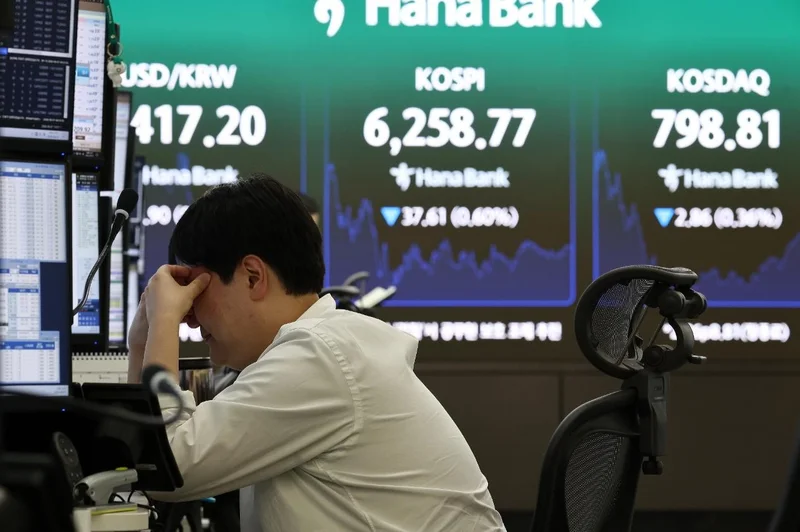
The KOSPI edged lower Friday as investors remained cautious, with weakness in chip stocks and lingering inflation concerns over the Middle East conflict keeping risk appetite in check.
The benchmark index closed at 6,258.77, down 0.6 percent from the previous session. It opened 1.09 percent higher but gave up its early gains and slipped into negative territory.
Foreign investors sold a net 858.1 billion won ($605.7 million) worth of shares, while institutional and retail investors bought a net 579 billion won and 267 billion won, respectively.
SK hynix fell 4.88 percent to close at 1.422 million won, while Samsung Electronics edged up 0.22 percent to finish at 231,000 won.
Reports that Nvidia is considering lowering the high-bandwidth memory (HBM) specifications for its Rubin Ultra platform dampened sentiment toward chip stocks. SK hynix, which has greater exposure to HBM, came under pressure and dragged the benchmark lower.
Still, Micron reiterated that memory supply remains tight, noting that memory chips now account for as much as 50 percent of the value of artificial intelligence computing systems.
Inflation concerns also weighed on the market, with international oil prices rebounding after hopes for U.S.-Iran negotiations faded. Investor caution deepened after the U.S. Federal Reserve chair said the central bank was prepared to raise interest rates in September if inflation surges again.
Analysts said the benchmark index is still taking a breather after rallying 18 percent on July 31, with profit-taking continuing to weigh on the market.
"The KOSPI has been volatile since the start of August, triggering two sell-side sidecars and one buy-side sidecar in just four trading sessions, as the market comes under renewed correction pressure," said Han Ji-young, an analyst at Kiwoom Securities.
"While bouts of short-term consolidation and profit-taking may continue, the medium-term case for a recovery is strengthening, supported by upward revisions to earnings forecasts and increasingly attractive valuations," Han added.
The Kosdaq also edged lower, falling 0.36 percent to close at 798.81 after four consecutive sessions of gains driven by perceptions that the market had become oversold.
The won continued to strengthen against the dollar. The won ended onshore trading at 1,416.1 per dollar, up 7.7 won from the previous session.