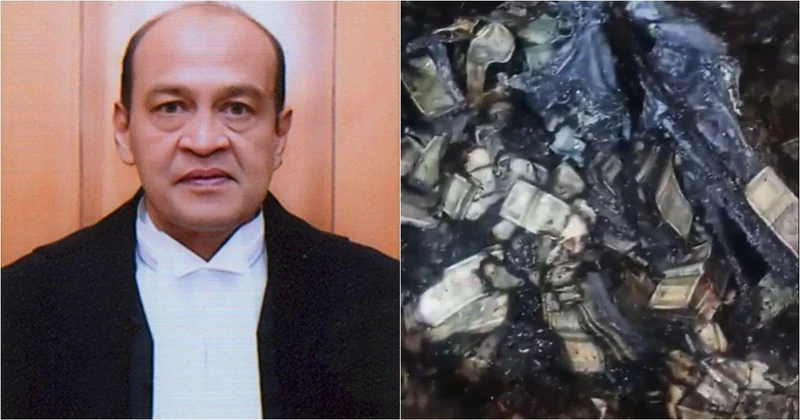
The Supreme Court on Friday dismissed a petition seeking a probe by a Special Investigation Team into the recovery of unaccounted cash from former Allahabad High Court judge Yashwant Varma’s residence in Delhi, reported Bar and Bench.
The petition was filed for “cheap publicity”, said a bench of Justices PS Narasimha and Alok Aradhe.
Unaccounted cash was allegedly recovered at Varma’s official residence in Delhi when emergency services responded to a fire there on March 14, 2025. He was a judge at the Delhi High Court at that time.
The judge said that he was in Bhopal when the cash was discovered and claimed that it did not belong to him or his family.
The controversy prompted his transfer to the Allahabad High Court.
In April, he resigned from his post, more than two months after Union Parliamentary Affairs Minister Kiren Rijiju said the process to impeach the judge was underway.
The petitioner in the present plea had told the Supreme Court that Varma is not immune from criminal liability merely because he had resigned, reported Bar and Bench. He sought a first information report against him.
“Earlier similar petition was dismissed on technical ground that no complaint was filed before filing the petition,” Bar and Bench quoted him as saying. “That is done now.”
However, the bench held that it was not inclined to hear the plea.
Less than two months before Varma resigned, a three-member committee set up under the 1968 Judges Inquiry Act by Lok Sabha Speaker Om Birla was reconstituted to investigate the charges against the former judge.
Proceedings before Varma resigned
On March 22, 2025, the Supreme Court released a report, including a video and three photographs, showing bundles of notes that were allegedly recovered from the judge’s home.
The court had also set up a three-member committee to look into the allegations against Varma.
The redacted report showed that Delhi High Court Chief Justice Devendra Kumar Upadhyaya had written to Varma on March 21, 2025, asking him to “account for the presence of money/cash” in a room located in his bungalow.
As Varma had at the time declined to voluntarily retire or resign, Sanjiv Khanna, the chief justice of India at the time, sent the final inquiry committee report on the incident to the president and the prime minister.
The committee, in its report, had concluded that there was “sufficient substance” in the charges against Varma. The report dated May 3, 2025, held that the judge’s misconduct was “serious enough to call for initiation of proceedings for removal”.
To impeach a judge in Parliament, a removal motion is required to be signed by 100 Lok Sabha MPs or 50 Rajya Sabha MPs. If the motion is admitted in both Houses, a three-member judicial committee investigates the matter. Parliament votes on the impeachment if the committee finds misconduct. If the motion gets two-thirds of the votes, the president is advised to remove the judge.
On July 25, Rijiju said that the decision to impeach Varma was unanimous and that 152 MPs from the ruling coalition and the Opposition parties had signed the motion.
The Lok Sabha speaker on August 12 formed the three-member committee, comprising Supreme Court Justice Aravind Kumar, Shrivastava and advocate B Vasudeva Acharya.
While Birla had stated in the House that the committee would submit its report at the earliest, the investigation was delayed since Varma challenged the legality of the inquiry committee in the Supreme Court.
On January 16, the Supreme Court rejected his petition.
Edited by Neerad Pandharipande.
We welcome your comments at letters@scroll.in.