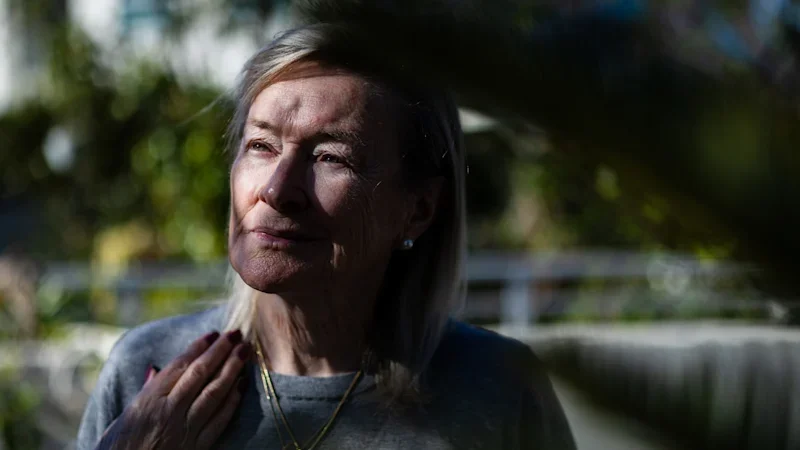
Elizabeth Young says only luck has spared Australia from a repeat of the 2024 mass stabbing at Bondi Junction that claimed her daughter’s life, as she added her voice to calls for the state government to improve its response to the mental health crisis.
The mother of Jade Young, one of six killed when Joel Cauchi, 40, stabbed 16 people at Bondi Junction Westfield while psychotic, said mental health needed to be taken much more seriously, and urged the government to do more to provide short- and long-term beds for people living with psychosis, depression and other illnesses.
“We just hope that things do improve, and I’m fully behind the group of psychiatrists and medical people who are insisting that the government must take action,” she said.
Asked whether the government’s response had been enough to avoid a future crisis, Young said, “No, not in the climate we have now. I think we’re lucky that there hasn’t been another major stabbing.”
Young’s clarion call was echoed by the state’s peak body for community mental health organisations, which criticised the government’s response to the Bondi Junction coronial inquest for supporting recommendations in principle that were “de-prioritised and underfunded in practice”.
Jade Young, 47, was shopping with her nine-year-old daughter when she was attacked. The coronial inquest determined Cauchi, who had schizophrenia, was psychotic on the day of the attack.
The Minns government on Wednesday accepted 11 of the coroner’s 13 recommendations in full. These included a new, health-led response model for mental health emergencies backed by more than $270 million over 10 years, reforms to knife-scanning laws after the statutory review of NSW’s wanding powers, and improving emergency service communications, training and major incident response arrangements.
However, the government will only support recommendation seven – urging modelling demand for short-term accommodation services in greater Sydney to support those suffering mental health episodes and homelessness, and supporting the establishment and evaluation of long-term accommodation based on existing models – in principle.
A number of the sector’s leading figures decried the government’s response, including Mental Health Coordinating Council chief executive Dr Evelyne Tadros, who said it was “all talk and no action”.
Young acknowledged the system failures that contributed to the mass stabbing went beyond the government’s handling of the mental health system, but said additional funding to support beds dedicated for those suffering mental illness was imperative.
“I do not want to be in an ambulance being ramped at our local hospital because they’ve been obliged to bed people suffering mental illness, when those people should be being treated, helped, supported in a facility that is dedicated purely to them,” she said.
The NSW Mental Health Alliance has warned the government’s response will not address structural issues within the mental health system and would not prevent similar tragedies from happening in the future.
The statement said that “acceptance is just the first step” and called on the government to model, cost and fund supported housing services to meet the high demand in NSW.
“We need to be clear about what the inquest found: Joel Cauchi slipped through the cracks of an underfunded mental health system and was without stable housing on April 13, 2024,” it read.
BEING Mental Health Consumers chief executive Giancarlo de Vera, who signed the statement, said: “There absolutely should be investment and action toward ensuring housing-first solutions to prevent people like Joel Cauchi from committing the horrors that were unleashed that day.”
Some 45,900 people, one-third of the total using Specialist Homelessness Services around Australia, have a current mental health issue. Meanwhile, NSW mental health emergency department presentations were up 44 per cent, and too many people were already missing out on care beyond crisis, which was evident in Cauchi’s case.
Mental Health Minister Rose Jackson said the government’s commitment to reform included a $111 million package to support community mental health, and the “largest investment in social housing” delivered in the 2024-25 budget.
“However, we also recognise for some people with complex needs, they require more than social housing. That is why, as well as building social housing, we are also building dedicated homes for people living with complex, long-term mental health needs,” she said.
“The reason we supported recommendation 7 in principle is that whilst it identified Habilis and Haven as models for consideration (models we are also funding), we are choosing to scale other NSW-supported accommodation models that achieve the same goal.”
If you or someone you know need support, contact Lifeline on 13 11 14 or Beyond Blue. SANE phone and digital support services can be accessed at sane.org. In the event of an emergency, dial Triple Zero (000).