Italy has placed all its major cities on the top level of health alert amid scorching temperatures.
It comes as Hungary switched off the lights at some of its most renowned buildings in a bid to save energy as a heatwave continued to grip large parts of Europe.
Europe has suffered from record-breaking heat and devastating wildfires this summer. France and Spain have been hit particularly hard in recent weeks.
The EU’s environment commissioner told Reuters that it will push members to spend more on precautions to reduce the risk of wildfires, as experts said the economic cost of this summer's blazes had already surpassed €15 billion.
Meanwhile, Bulgaria was the most recent EU country to experience wildfires, with the main Trakia highway closed in both directions on Thursday after wind carried the flames of a huge fire across it around 70 km southeast of Sofia, NOVA news portal reported.
Pilgrims and tourists face scorching heat in Italy
Italy is accustomed to hot summers, but the red alert issued by the Health Ministry stretched from Palermo on the southern island of Sicily to Bolzano in the mountainous north.
The warning indicated a potential health emergency with prolonged high temperatures posing a serious health risk to the entire population.
Pilgrims gathered under a blazing summer sun in the hilltop town of Assisi were sprayed with water to cool them off as Pope Leo paid a visit to mark the 800th anniversary of the death of St. Francis.
"I think that when you really care about something, when you truly believe in it, even if it's hot, you make the effort,” said Miriam Mariotti, a volunteer at the event.
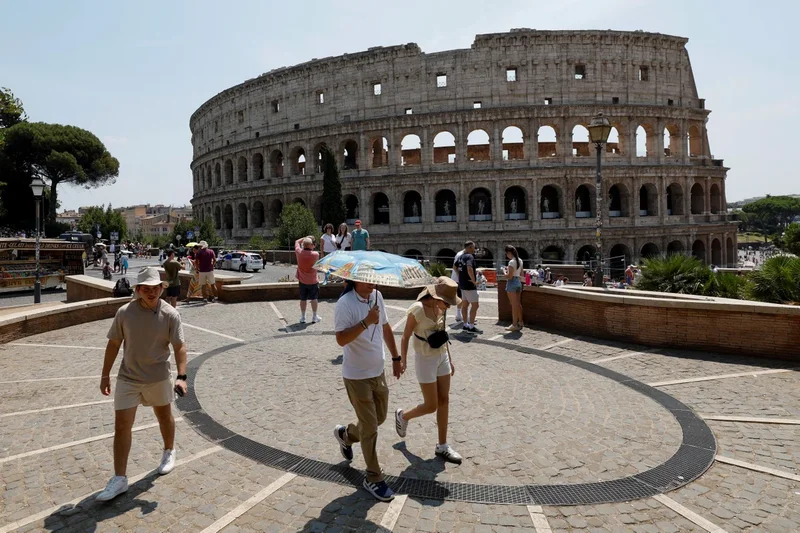
Tourists in Rome used umbrellas to keep the sun off and dipped their hands in the city's fountains.
"We try to avoid going out during the hottest part of the day and instead go out in the evening or early in the morning," said Gianni Arlotta, visiting from the northern Italian city of Trieste.
Temperatures topped 40 degrees Celsius (104 degrees Fahrenheit) in several areas of the northern region of Emilia-Romagna on Thursday, one of the hottest areas in Italy, reaching 42.8 C (109 F) in Bagnacavallo, near Ravenna.
Low water levels cause problems
Hungary has switched off decorative and non-essential lighting at all state institutions – including its parliament, most of the Buda Castle and Chain Bridge – at night to save energy.
Record-low water levels on the Danube have forced the country to largely shut down its sole nuclear plant, which uses the river for cooling, stretching power supply capacity to its limits.
Romania was preparing to sink four rock-filled barges into the Danube to divert water to its only working reactor and buy a few more days of operation.
The authorities in the capital Bucharest have dimmed the intensity of street lights by a third and switched off lighting at night at landmark buildings and museums to save power.
In Moldova, where temperatures hit more than 38 C, Prime Minister Vasile Tofan issued a fresh appeal to consumers to reduce power use or face rolling blackouts as neighbours Ukraine and Romania were unable to make up for shortages at peak periods.
"We need to use a bit of common sense, we need to turn off the lights," he told reporters. "We're not sending a good signal when Chisinau is lit up like Las Vegas."
Low water levels are causing problems for shipping on the Rhine in Germany, where many vessels can sail only part-loaded, raising freight costs. The river is an important shipping route for commodities such as grains, minerals, coal and oil products.
Dodging the heat in a cool cave
In Bosnia, tourists have taken shelter in the constantly cool temperatures of the UNESCO-listed Vjetrenica cave to escape outside temperatures of 40 C.
Vjetrenica, which means wind cave, is located in the south of Bosnia and Herzegovina, about 25 km north of the Adriatic town of Dubrovnik, where cruise liners arrive daily with thousands of visitors.
Numbers allowed to visit the cave are limited because of the sensitivity of the environment. Its constant 11 C (51.8 F) temperature year-round has made it a refuge for biodiversity as well as for humans.