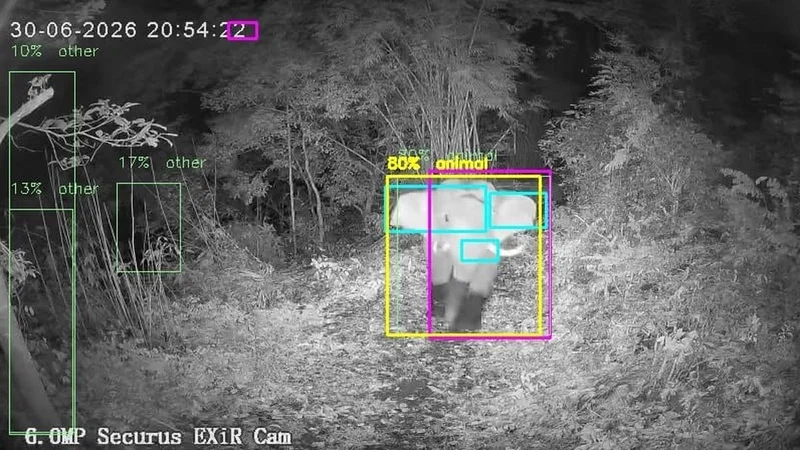
Marking a major leap in human-wildlife conflict management, an AI-driven digital sentry system deployed across six high-risk forest zones in Kerala has achieved a near-100% success rate in repelling wild animals.
First piloted at Mankala coming under Paruthippally range of Thiruvananthapuram, the ‘Farmguard’ units were later expanded to five critical forest fringes in Kollam, Thrissur and Palakkad during the last couple of months. Early reports from field officials indicate an unprecedented success rate in deterring wild animal intrusions, prompting Forest authorities to consider rolling out the technology to more hotspots.
Acting as autonomous digital sentries, these units harness advanced machine learning, night-vision capabilities, and high-resolution cameras to distinguish between living creatures and inanimate objects.
“Positioned along perimeter lines, multi-directional camera setups continuously scan a radius of up to around 200 meters. The moment a target animal such as an elephant, wild boar, leopard, tiger, bear, or gaur steps into the monitored perimeter, the system’s integrated algorithms identify the specific species. It instantly triggers real-time alerts via SMS, WhatsApp, and Telegram to forest officials and Rapid Response Teams (RRTs),” says Thiruvananthapuram Divisional Forest Officer A. Shanavas.
Simulated threats
To safely drive animals back into the forest, the device uses a multi-frequency acoustic defence system loaded with over 100 audio patterns and specialised frequency profiles. Since animals can become accustomed to the warnings, the device cycles through simulated threats such machine gun fire, grenade blasts, and loud crowd noises along with low-frequency infrasound designed to mirror natural wildlife communication.
The villagers of Chippanchira in the Kulathupuzha range say the past two months have brought a long-awaited sense of calm as the newly installed system could effectively block elephant incursions.
“Earlier, the elephants would wander onto our main roads, knock down boundary walls, and destroy our crops. Since the system went live, those incursions have stopped,” says ward member Sheeba Sreekumar.
At present, forest authorities are strategically deploying the technology to reinforce vulnerable gap areas rather than attempting continuous, end-to-end boundary coverage. In Palakkad, field officers have utilised the units to bolster frequently broken entry and exit paths used by wild elephant herds.
“Since wild animals quickly grow accustomed to repetitive noises, it automatically alters the sound output, timing, and frequency during every encounter. This dynamic variation prevents target species from becoming familiarised with the device, effectively scaring them back,” says Subair N., Range Forest Officer, Alathur.
Practical challenges
Meanwhile, forest officials also point out some practical and logistical challenges along with the need for substantial budget allocations. The system operates most efficiently on flat terrains and clear sightlines, which are not consistent across Kerala’s undulating forest topography. While dense canopy cover can affect solar power generation, remote field conditions pose another issue.
Officials also point out that dust accumulation and regular wear on sensors require prompt technical servicing. While the short-term performance is proven, its long-term durability, maintenance requirements, and overall scalability across rugged forest terrains remain under evaluation.
Published - August 07, 2026 02:48 pm IST