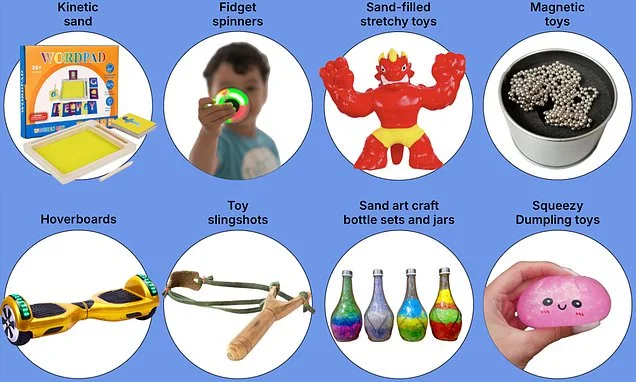
- UK safety expert Craig Delahaye shared his verdicts
- READ MORE: Why you should NEVER have water beads in your home
- See more Daily Mail on Google - save us as a Preferred Source
They might seem like harmless fun, but experts have issued stark warnings against numerous popular children's toys which can leave your children at risk of choking, skin irritation and chemical burns.
Some even contain carcinogens and pose deadly hazards, despite often being widely available for cheap on major online retailers, and even touted on social media platforms as the next 'in thing' for your child's generation.
'There are more toys on the market than ever before, but gone are the days of handmade Hamley's quality,' said Craig Delahaye, Associate Director of Legal Operations at the National Accident Helpline.
'Instead, cheap slop has flooded the shelves, but some of it is so bad, that it could be dangerous.'
Most recently, sand toys have sparked concern, with NHS GP Dr Ross Perry warning against purchasing kinetic sand, especially cheaper versions, after various popular choices were found to contain cancer-causing asbestos.
And alarm bells have also been sounded for the viral squeezy dumpling toys; Craig stressed that parents must purchase from a trusted retailer and avoid fake imitations, which have been found to contain benzene, an extremely dangerous substance that can cause cancer.
Read on to learn which products should be avoided - many of which are also facing product recalls.
Kinetic sand
Amazon's popular Craftplay Sand Art Bottles (pictured) were recalled this week after they were found to contain asbestos
This sand art tray sold on Alibaba, Amazon Marketplace and TikTok Shop was found to contain asbestos
Children love recreating that beach feeling at home with sand kits, but according to experts, they're not worth the risk after an investigation found asbestos in kits sold online and in Asda.
As recently as this week, Amazon's popular Craftplay Sand Art Bottles were recalled after they were found to contain asbestos.
Speaking to the Daily Mail, GP, Dr Ross Perry, Medical Director of Cosmedics said: 'This recall is a stark reminder of the importance of buying children's products from reputable retailers and registering purchases where possible, so you're more likely to receive recall notifications if a safety issue comes to light.
'Asbestos has no place in children's toys, and any product found to contain it should be treated with caution.'
Earlier this year, experts from Which? discovered two products sold on popular online marketplaces contain the harmful substance.
One toy, marketed as a 'Montessori sand art tray', was being sold on Amazon Marketplace and TikTok Shop.
The kit is designed for hands-on learning to support fine motor skills by encouraging children to draw in the sand.
However, testing revealed that the sand in the kit contained tremolite asbestos - a banned substance.
Researchers also found tremolite asbestos in the 'GL Style Sand Bottle Art Heart or Stars' set purchased from Asda.
What appeared to be the same kit was also listed for sale on eBay from three private sellers.
Tremolite asbestos is an incredibly harmful, naturally occurring mineral that can become airborne and cause severe lung diseases if inhaled, even at low levels of exposure.
The International Agency for Research on Cancer has classified all forms of asbestos as carcinogenic to humans.
Products containing asbestos in any quantity, including trace amounts, are prohibited for sale in the UK.
It is believed the affected toys contain sand sourced from specific quarries in China, where naturally occurring asbestos is present.
Dr Ross said: 'If you've bought one of the recalled products, stop using it immediately and follow the official disposal guidance.
'Avoid shaking out the sand or creating dust, as it's the inhalation of fibres that's the concern.
'If the sand has already been used, wear gloves and a suitable face covering while cleaning with damp cloths rather than sweeping or vacuuming, which can disturb particles.
'Wash hands thoroughly afterwards and keep children away from the area until it's been cleaned.'
A spokesman for Amazon said it is in the process of removing all products in this category while it investigates further, while Asda said it issued a full product recall after being made aware of the findings.
A representative for eBay said it removed the items identified in the investigation and is conducting further sweeps to identify similar listings, while TikTok said the product identified had already been removed from its shop.
Squeezy Dumpling toys
The Office for Product Safety and Standards issued an urgent national recall on TikTok over fake versions of the toys, sold in a plastic basket tray containing a squishy, colourful dumpling, branding them a 'severe chemical risk'. Stock image used
They might look innocent enough, but Craig issued a stark warning against Squeezy Dumpling toys.
He said: 'Cute, cosy, and… deadly? These may seem innocuous but, unless bought from a reputable supplier, likely contain harsh chemical goo which will cause irritation when they inevitably burst.'
It comes after The Office for Product Safety and Standards issued an urgent national recall on TikTok over fake versions of the toys, sold in a plastic basket tray containing a squishy, colourful dumpling, branding them a 'severe chemical risk'.
It found an imitation version of the product contained an excess concentration of the toxic chemical benzene, which can cause cancer.
Inhaling the chemical can irritate the eyes, nose and throat, while exposure to large amounts may cause skin irritation and a burning sensation throughout the digestive tract.
Parents have been warned to keep the toys out of reach of children and to stop using them.
The toys have become this year's playground craze as TikTok videos showing them being unboxed, squeezed and stretched have gone viral.
The squishy toys are also collectable – as you don't know what colour dumpling you will receive before buying one.
Like other viral toys, Mystery Squishy Dumplings are becoming increasingly difficult to track down, with retailers selling out within hours of restocking.
As a result, fake versions are beginning to appear – many of which don't meet UK regulations.
The product has been recalled by Samsons Cash and Carry Ltd, a distributor based in Cardiff.
There are no batch numbers or product identifiers on the product or packaging, making it difficult to know if the toy is affected.
Rhys Harries, Swansea Council's Trading Standards Officer, previously said: 'These products are clearly attractive to children because they are being driven by online trends, but that does not mean they are safe.
'When a toy gives off a strong chemical smell and is missing basic safety information, that should ring alarm bells for parents and retailers alike. Our main concern is the risk posed to children if unsafe items end up in homes, school bags or play areas.'
Fidget spinners
Despite being popular, trading standards officers have warned against fidget spinners
They've proven to be a huge craze among children, but just because they're popular doesn't mean fidget spinners are always safe, especially cheaper versions.
Previously, trading standards officers have removed almost 300 fidget spinners from shops amid claims they contain 'dangerous' parts.
The Bath and North East Somerset council said some of the spinners included LED lights with lithium-ion batteries, which could cause internal bleeding if ingested.
Other toys had small parts that could easily pop out, making them a choking hazard to young children, while some featured a blade with sharp, pointed edges.
Martin Veale, cabinet member for community services at B&NES, previously said: 'Fidget spinners are… very popular among young people.
'We want to ensure that, when using these devices, young people are safe.
'Our Trading Standards officers have been looking at some of the spinners on sale and found them to have very small dangerous parts, so for public safety it's only right that they be withdrawn from sale.
'Anyone buying a fidget spinner should purchase it from a reputable trader and ensure the safety warnings can be clearly seen on the packaging.'
The playground toys are marketed as devices to help focus and concentration, and were initially designed to help youngsters with autism or other special needs to develop motor skills.
Microwave 'gel' toys
Violet Zerbst was squeezing a cube-shaped Needoh toy she had heated in the microwave for just 30 seconds when it exploded and its gel-like contents burst across her face, leaving her burnt and badly blistered
Last month, a young Queensland schoolgirl suffered horrific burns to her face after a dangerous social media trend promoted placing a viral squishy toy in a microwave to soften it.
Violet Zerbst was squeezing a cube-shaped Needoh toy she had heated in the microwave for just 30 seconds when it exploded and its gel-like contents burst across her face, leaving her burnt and badly blistered.
The 10-year-old said her plan was to heat the stress-relieving toy to make it softer and she didn't realise there was a danger it could become super hot and unstable.
'If it (the toy) is really hard, you think... warm it up,' she told 7News.
'So I went to the microwave and I put it in and I was just waiting... and then I got it and I was just squishing it.
'The liquid was like at the bottom and then it went into a sort of ball and it burst onto my face.'
Violet's father, Jody Zerbst, said 'it literally just exploded', with the young girl adding she had been in 'a lot of pain' and could 'feel my skin coming off'.
Similar incidents involving the toys have happened overseas, notably in the US and UK.
Craig warned that the trend - and toys - are 'toxic' and must be avoided.
'What better idea than to put the aforementioned toxic goo in the microwave, so that it becomes superheated?' he said.
'Children playing with cooking devices is a bad idea in the first place, even more so when their 'recipe' consists of cheap plastic and molten chemicals.
'Many councils have already issued warnings over this, and so this category of toy is best avoided altogether.'
Medical experts have also issued warnings of the dangers of a trend for heating 'squishy' toys in the microwave after several children suffered serious burns.
The Royal Hospital for Children (RHC) in Glasgow has treated six youngsters with injuries linked to the trend in the past eight months, with some needing surgery including skin grafts.
Videos circulating online show the toys, which are soft and easy to squeeze, being heated to make them even softer.
However, experts warn this causes pressure to build inside the squishy, increasing the risk it may explode and release the hot gel inside that can stick to the skin and cause severe burns.
One of those injured was eight-year-old Joseph Erskine, from Clackmannanshire, who needed weeks of treatment and a skin graft after a toy burst across his chest and hand in May.
His mother Stephanie Ewing said: 'My husband and I were home. We were sitting in the living room next door when Joseph came in holding a towel to his face.
'He had already wiped off the burning gel which had also taken off his skin. He was saying that his squishy burnt him and we initially thought he meant a chemical burn. Then he told us that he had put it in the microwave.
'We were shocked as it had never crossed our minds that he would do that with a toy. He has never used the microwave before.
'One of us had heated something earlier and so the clock was already set at 40 seconds. Joseph just hit start.
'It was that quick and easy for him.'
She said Joseph had seen the trend online and she urged parents to chat about it with their children and discourage them from doing something similar.
Ms Ewing added: 'Joseph's burn wouldn't heal on its own and required a graft, where skin was taken from his thigh and applied to his chest.
'He is normally such an active and sporty child with six clubs per week, but all of that is on hold until he heals.'
Her son must now avoid direct sunlight to the graft area for two years, which she said will be 'tricky over the summer months'.
Another young patient, 11-year-old Scarlet Rowe, from Irvine, in Ayrshire, was treated for burns to her face and eyelid after a similar incident last month soon after she received a squishy toy.
Her mother Gina said: 'We didn't realise what had happened at first, it just looked like slime on her face. It was only after a few minutes we realised it had been heated and was burning her skin.
'The swelling was so bad that we weren't sure what the outcome would be.
'Thankfully, no graft was required but it is so close to her eye that this could have been a lot worse.
'These toys are very popular and easy to buy, but we had no idea about the risks. We had only bought them that day.'
Burns specialists said injuries caused by heated squishy toys can be particularly severe because the gel inside can remain extremely hot and get stuck to the skin, prolonging the burn.
Sharon Ramsay, a burns nurse at the RHC, said: 'Unfortunately, we are seeing a growing number of children with preventable injuries linked to this trend.
'When these toys are heated, the contents can explode and stick to the skin, causing deep burns.
'These injuries can be very serious and may require long-term treatment, including surgery and rehabilitation.
'In some cases, children are left with permanent scarring. We strongly urge parents and carers to speak to their children about the risks.'
Magnetic toys
Magnetic toys have led children to be hospitalised with serious injuries (stock image)
Magnetic toys might seem like a fun, interactive way to teach children about science, but they could prove deadly.
Hundreds of children a year are being hospitalised in Britain after swallowing magnets, a study by experts at the University of Southampton revealed last year.
Doctors and safety campaigners say youngsters are being put at risk by popular toys, and called for a new crackdown on the online sale of products containing magnets.
About 300 under-16s were admitted to A&E in a single year after ingesting the tiny metal items found in items such as 'fidget toys' - with one in ten needing life-saving operations.
Warnings about the risks have been backed by the mother of a girl who was left fighting for her life as a two-year-old after ingesting 14 brightly coloured magnetic balls.
Doctors had to temporarily remove Rebecca McCarthy's intestines to reach the magnets, which had attracted together and buried deeply into her tissue.
Her mother Sam, from Basildon in Essex, said: 'I would hate for any other child to go through what Becca suffered because of buying dangerous toys from sellers on online marketplaces.'
Doctors have said that children who swallow two or more magnets are at a far higher risk of long-term damage, as the pieces can clamp together in stomachs.
Magnets are found in a wide range of toys, such as magnetic ball sets, fake piercings and other household objects.
Six per cent of swallowing cases were linked to viral social media trends in which children, mostly girls, try to imitate tongue piercings by placing small magnets in their mouths, the new study found.
More than two in every 100,000 children swallow magnets each year according to data by 66 UK hospitals between May 2022 and April 2023.
However, that figure is likely to be far higher, according to lead author Prof Nigel Hall, because not all hospitals across the country shared their information.
Rebecca McCarthy's mother Sam has told of how her ordeal after swallowing the 14 marbles 'devastated the whole family' - and the trauma remains years on.
She said the first sign Rebecca was unwell was when she vomited one lunchtime.
Sam said: 'She had months of ongoing health issues. I still find it incredibly painful to think about.
'The memory will never fade. I would hate for any other child to go through what Becca suffered because of buying dangerous toys from sellers on online marketplaces.'
Hoverboards
They might look like fun, but hoverboards have caused serious fires in recent times (stock image)
They might look like plenty of fun, but owning a hoverboard comes with a multitude of dangers.
While children are prone to accidents due to the board's acceleration capacities, they can also be a major fire hazard.
In 2019, a mother warned parents to take care when buying hoverboards after her son's went up in flames while charging next to his bed.
Steph Edwards, from Abergavenny, Wales, bought her then-10-year-old son Josh a two-wheeled self-balancing electronic scooter known as a hoverboard for Christmas from a website she thought was reputable for around £200
Despite Josh having used it a couple of times with no problems, when he went to charge it fully for the first time, the hoverboard set alight and flames spread to his bed and flooring.
Ms Edwards fears that if her then-12-year-old daughter Tirion hadn't heard the device 'making popping noises' from her bedroom, the fire could have destroyed her home.
And others haven't been so lucky; one home in Eastbourne was destroyed in a catastrophic blaze, with a fire report confirming a hoverboard's lithium battery was to blame.
Mother Chelsea Fiekert had purchased the Chinese kit from Amazon after losing the original charger, and it arrived at noon on the day of the inferno.
She was charging the hoverboard in the hallway at about 9pm when she turned around after hearing a popping sound, and witnessed the charger explode. Within five minutes, flames had reached the ceiling.
Consumer safety experts have repeatedly warned that damaged or defective lithium-ion batteries can experience what's known as 'thermal runaway,' a chain reaction that can rapidly produce intense heat and fires that are difficult to extinguish.
Water bead toys
The beads are made from materials that absorb water. This makes them expand dramatically. However, if a child accidentally swallows them, they absorb water inside the body and expand, creating potentially fatal blockages. Stock image used
They might look innocent enough, but experts have issued stark warnings against water beads amid reports of serious harm and fatalities.
While the bouncy, colourful beads are popular among children for the unique sensory experience, adults have utilised them as home decor or to release moisture into soil to water plants.
But it's their attractive appearance that makes them so harmful - a child or vulnerable adult could, very realistically, mistake them for a sweet.
And if ingested, the small beads can balloon up to 400 times their original size, which can block the gastrointestinal passage, cause choking and result in death.
In February last year, then-eight-year-old Kipley Haugen, from Texas, suffered brain damage after swallowing water beads, which got stuck in her intestines, shutting off blood supply to her brain.
Doctors believe that the 'toxic' materials used to make the beads, polyacrylamide and acrylamide, are 'known neurotoxins' and may have disrupted her normal cognitive function and caused permanent damage. Kipley now battles with speech delays, muscle weakness and has trouble walking.
One month later, the US Consumer Product Safety Commission (CPSC) and toy company Buffalo Games recalled more than 50,000 'Chuckle & Roar Ultimate Water Beads Activity Kits' after a different infant was injured and another died.
Speaking to the Daily Mail, GP Dr Ross Perry explained that the beads can be a silent killer: they're difficult to detect on X-ray because their composition matches body tissue, which can delay diagnosis as the condition worsens.
The doctor explained: 'Water beads may look harmless, colourful and decorative, but they pose a very real and potentially life-threatening risk, particularly in homes with babies, toddlers and young children.
'Their appearance can easily be mistaken for sweets or small toys, making them incredibly appealing for children to pick up and swallow.
'The danger is that these tiny beads can absorb large amounts of liquid and expand many times their original size once inside the body.
'If swallowed, they may grow within the digestive tract and cause a blockage, which can lead to severe pain, vomiting, dehydration, bowel damage and, in some cases, require emergency surgery.
'Because the beads are often transparent and don't always show up clearly on standard X-rays, diagnosis can also be delayed, increasing the risk of serious complications.
'The risks don't stop there. Water beads can also be inserted into the nose or ears, where they continue to expand, potentially causing tissue damage, infection or hearing problems.
'There have also been reports of eye injuries caused by high-speed water bead projectiles from toy guns.
'Many people also purchase them for plant hydration, sensory play or decorative purposes without realising the significant hazard they can present. A single dropped bead on the floor may be enough for a curious child to find.
'If you have young children or vulnerable individuals in your home, it is safest not to keep water beads at all.'
And according to Craig Delahaye, Associate Director, Legal Operations, National Accident Helpline, water beads sold for adult use are no better.
He told the Daily Mail: 'Beads not designed as toys are no safer; they are simply non-coloured versions sold in different packaging.
'Any parent buying them for flower arranging must realise that it is very easy to drop one of the tiny pellets on the floor whilst doing their craft, where it will sit undetected and may eventually be hoovered up by a child or even a pet.
'The dangers are no tall tale; the Office for Product Safety Standards has recently issued a serious product safety alert warning consumers, childcare settings, and businesses against the harms which can arise from water beads.
'They advise that any household with children under five should avoid them altogether, even if they are only intended to be used by adults.'
Certain types of infant teething and pull-string toys
Sili Factory Pull String Teething Toys were pulled from shelves this summer because, as per the US Consumer Product Safety Commission, the 'silicone strings are smaller and longer than permitted'
Shops tout countless 'teething' toys aimed at relieving toddlers' discomfort - but experts warn that some of these, particularly long and stringy variants, can be choking or strangulation hazards.
'Baby toys need to be some of the most rigorously tested on the market, and yet unlicensed online sellers are peddling cheap, dangerous knockoffs which could end up restricting your baby's ability to breathe,' said Craig.
'As a rule of thumb: no strings or items which could wrap around a little neck or limbs.'
They're available all over the world, but have faced recent recalls in the US.
Sili Factory Pull String Teething Toys were pulled from shelves this summer because, as per the US Consumer Product Safety Commission, the 'silicone strings are smaller and longer than permitted'.
'The strings can reach the back of children's throat and become lodged, posing a serious risk of respiratory distress and deadly choking hazard.'
Sand-filled stretchy toys
Sand-filled stretchy toys have been known to contain cancer-causing asbestos
Like multiple sand-related toys on the market, stretchy toys might contain cancer-causing asbestos.
This year alone, 74 sand-filled stretchy toys have been recalled due to asbestos contamination, including 40 from the HTI Stretcherz range, The Sun reported.
While parents might think there's no immediate harm given the sand is encased inside the product, stretching and squishing the toys increases the likelihood of bursting.
In February, the Office for Product Safety and Standards (OPSS) recalled the HTI Stretcherz range, saying it does not meet the requirements of the Toys (Safety) Regulations 2011.
The OPSS wrote: 'The product presents a risk to health as the sand may be contaminated with a small quantity of asbestos.
'Asbestos is a banned substance because it poses a risk to health even at low levels of exposure.'
Battery-powered and electronic toys
In 2024, the UK saw recalls of an electric mini Range Rover for kids, supplied by Hyper Toy Company Ltd
There is a whole world of battery-powered child toys and accessories out there, featuring everything from light-up headbands to race cars.
And while these can be 'fine', Craig said, having a reputable supplier is the key.
'Lights, noise, and movement can make playtime much more engaging, but fire is not welcome in the playroom,' he continued. 'Always check for a fire safety and electrical certificate before bringing electronic toys into the home.'
In 2024, the UK saw recalls of an electric mini Range Rover for kids, supplied by Hyper Toy Company Ltd.
'A potential safety concern has been identified, where a number of products have been produced without a fuse,' an Argos report said.
'There is a chance this could result in a short circuit of the wiring. In some cases, this could result in wires melting producing smoke and possibly a fire.'
Elsewhere in America, 80,000 LED toys and shot glasses were recalled in May - after a battery hazard was discovered.
It included a toy light-up headband, bird toys which light-up and chirp and 'electronic pet cages'.
'The recalled children's toys violate the mandatory standard because they contain button cell batteries, and the compartments that hold the batteries can be easily accessed by children, posing a deadly ingestion hazard to children,' the report said.
'When button cell and coin batteries are swallowed, the ingested batteries can cause serious injuries, internal chemical burns and death.'
Baby neck floats
The floats are designed to be worn around a child's neck, where the infant's head is supported by the float while the body remains suspended in the water
Teaching your child to swim is a priority for many parents, but Craig warned that baby neck floats should be avoided at all costs.
The floats are designed to be worn around a child's neck, where the infant's head is supported by the float while the body remains suspended in the water.
He explained: 'More recently, these have been sold via AI-generated adverts on TikTok, and even from those videos, the dangers are clear.
'Dangling a baby via their neck in a swimming pool is a very poor decision. Drownings and serious spinal injuries have been recorded from doing so – only ever use accredited pool aids in a supervised, professional setting.'
The UK government has previously recalled the floats, stating that using a neck float increases the risk of drowning: 'These products present a risk of drowning as they may place inappropriate pressure on the infant's neck and may restrict normal movement or airway positioning.
'They may also increase the risk of the infant slipping through, becoming trapped, overturning, or being left in an unsafe floating position, potentially resulting in neck injury, asphyxiation, drowning, or other serious harm.'
Toy slingshots
Despite being intended for harmless fun, toy slingshots can cause serious damage (stock image)
Children love exploring outside, and a slingshot might create a thrilling adventure, but in reality, the toys can cause serious harm, including fractures and eye damage, as well as spark an interest in more sinister versions.
Last year, a campaigner called for a slingshot ban after a group of boys turned their catapults on a mother after she challenged them for targeting animals.
Last March, Holly Collins was caught up in the encounter in broad daylight at St Clements Lake in Greenhithe, Kent, when she says catapults and ball bearings have become the weapons of choice for attacking ducks, swans, and even people.
She said: 'I pulled up outside their house, and there were teenagers aiming at ducks in the lake.
'I shouted at them, 'You better not be hurting those ducks, because I'll call the police,' and they all started swearing at me.'
Ms Collins estimated the boys to be around 12 or 13 years old and what started as an animal attack quickly escalated into a direct threat.
In 2018, a total of 80 offences involving the weapon were recorded in Kent - double the amount in 2017.
And according to FOI data by KentOnline, there were 12 recorded incidents of catapult offences in the Tunbridge Wells vicinity in 2022, and five last year.
In Maidstone, a family was left devastated after their pet peacock was shot more than 20 times with slingshots and catapults.
Sand art bottle craft sets and jars
They might look pretty, but sand art craft sets might contain asbestos (stock image)
They might look pretty and encourage creativity, but sand art bottles may contain cancer-causing asbestos, which can cause harm even at low levels.
Over 39 recall notices have been issued between November and June, Sky News reported, including options sold on Amazon Marketplace and TikTok Shop.
The kits typically come with a jar or vase and a selection of coloured sands for players to layer.
Asbestos is most dangerous when it becomes airborne and can be inhaled, for example during demolitions and renovations of older homes, where it was a common building material.
Inhaling any form of asbestos (fibres, dust, microparticles) can cause mesothelioma – a cancer that affects organ tissue, particularly the lungs – as well as lung cancer and asbestosis, a chronic lung disease that causes shortness of breath.
There is no safe level of exposure. However, the risks increase with the amount you're exposed to, meaning a small amount can be dangerous.
Toddler Activity Cubes
In 2022, in the UK there was a product recall on an 'Infant Development Educational Box' which was made in China and sold across retailers like AliExpress
They're aimed at educating children about shapes, sounds and colours - but have raised watchdogs' concerns in recent years.
In 2022, there was a product recall on an 'Infant Development Educational Box' in the UK, which was made in China and sold across retailers like AliExpress.
'The product presents a risk of choking as small parts can be easily detached or produced when the product is used, particularly near water or when under tension,' the Office for Product Safety and Standard said at the time.
'A young child may place the small part in their mouth and the parents/carers may not notice in time, with the small part able to block a child's airways.
'The product also requires improvements to labelling. The product does not meet the requirements of the Toys (Safety) Regulations 2011.'
Elsewhere, in the US, a wooden toy cube also faced recalls this year.
Some 70 wooden activity cubes, sold online through Amazon for less than $30, were pulled.
They featured a popular design, which included screws that could be detached, a xylophone, and loops to pull attachments through.
'The recalled toys violate the small parts ban because the toys are intended for children under three and the toys' xylophone screws and clock hands can detach,' the Commission's report read.
'In addition, the toys violate the mandatory safety standard for children's toys because the mallets have spherical ends, posing a choking hazard.'
Even popular board games like Monopoly can pose a risk when young children are around, experts warned.
'There may be hidden dangers. Small dice, counters, and characters all pose a choking hazard,' said Craig.
'There is also the risk of injury if these are dropped onto the floor and then stood on or crawled over.'
'Parents should be careful to closely supervise all board game sessions and to keep them out of reach when not in use.'