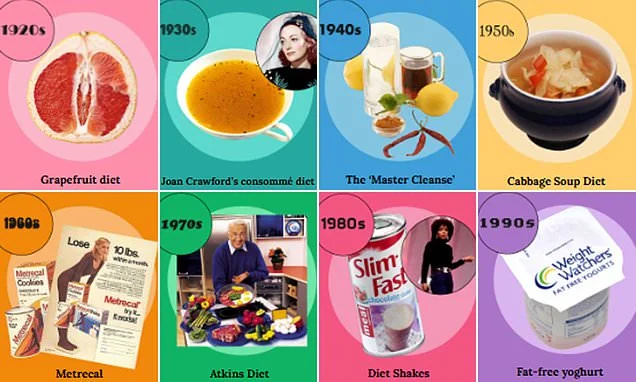
- A number of diet trends have been around for a myriad of decades
- READ MORE: I once tipped the scales at 18 stone and was so fat I needed to use a wheelchair. Then I tried this unfashionable retro diet
- See more Daily Mail on Google - save us as a Preferred Source
It feels like everyone is either 'proteinmaxxing' or on Mounjaro to lose weight, with diets like SlimFast and Atkins now a distant memory.
Diet culture started taking shape 100 years ago when Hollywood stars swore by a diet of 'fat-burning' grapefruit and consommé - a clear soup - so they could slip into their flapper outfits.
Nutritionist Brenda Heather told the Daily Mail: 'Every decade seems to have its own wonder food. One generation was drinking meal-replacement shakes, another was living off cabbage soup, and a later one was blending kale into just about everything.
'The foods change, but the message stays exactly the same: fast weight loss with barely any effort.
'More recently, keto diets, intermittent fasting, high-protein snacks, wellness powders, and social-media food trends have attracted attention.
'The main lesson from past diet crazes is that fast results and lasting results are not the same.
'Very restrictive diets may cause short-term weight loss, but they can be difficult to maintain and may leave people tired, hungry, or short of important nutrients.
'A healthier approach is usually less exciting but more realistic. It includes regular meals, enough protein and fibre, fruit and vegetables, wholegrains, healthy fats, enjoyable physical activity, and portions that suit the individual.
'Cabbage, kale, juice, and weight-loss shakes can all be part of a healthy diet. What is most important is the overall way a person eats. No single food can change your health, but small healthy choices can make a real difference over time.'
While the diet foods of each era inevitably fall out of fashion, could any of them be due a revival?
Speaking to the Daily Mail, nutritionists Zoe Griffiths of Numan and MyFitnessPal's Head of Nutrition Melissa Jaeger have given their verdicts.
1920s
Grapefruit Diet
A grapefruit 'diet' was even championed, suggesting a diet mostly made up of the citrus fruit, orange, egg, and Melba toast
Still in the ilk of the skinny long frames that came from the 1920s' flapper era, it saw a surge in grapefruit as a 'superfood'.
A grapefruit 'diet' was even championed, suggesting a diet mostly made up of the citrus fruit, orange, egg, and Melba toast.
On day two or three, a small piece of lamb chop or steak was permitted (no fat allowed), and it continued before 'breaking point' - i.e. starvation - was reached.
'This diet, which consisted of eating mostly grapefruits and nothing else, would likely cause, dangerous, rapid weight loss alongside a range of nutritional deficiencies that lead to a drop in bone density and even hair loss,' said Zoe.
'Grapefruits can themselves be part of a healthy balanced diet, containing fibre and vitamins, but do not form a nutritionally complete diet on their own. This is, in essence, a starvation diet and so it is no surprise that people who followed it experienced rapid weight regain after stopping.'
'While grapefruit does contain a variety of vitamins and minerals - like vitamin C which supports our immune system - there is no scientific evidence to support the claim that it causes the body to "burn" or "melt fat",' Melissa added.
1930s
Joan Crawford's meal plan
One magazine recounted her very 'unappetising' daily menu, which featured a 'breakfast' of hot water and eight tablespoons of consomme (clear soup), two saltine crackers and 'a quarter of a pound of tomatoes for lunch'. In total, this only provided some 138 calories in two meals
Starlet diets, including Joan Crawford's, also became popular for very restrictive eating
One magazine recounted her very 'unappetising' daily menu, which featured a 'breakfast' of hot water and eight tablespoons of consomme (clear soup), two saltine crackers and 'a quarter of a pound of tomatoes for lunch'. In total, this only provided some 138 calories in two meals.
For supper, Joan could have cottage cheese, two ounces of pineapple and a glass of buttermilk. In one whole day, this accrued to a measly 305 calories.
'These crash diets, popularised by figures such as Joan Crawford, provide very few calories and almost no nutritional value,' Zoe said.
'Any weight loss will, again, result from the extreme calorie deficit rather than actual sustainable lifestyle changes and health benefits.
'Eating just consommé for weeks on end is neither sustainable nor realistic and will lead to nutrient deficiencies, fatigue, and a generally disordered relationship with food and eating and risks of clinical eating disorder development.
'It's also worth noting that an extremely restricted food intake can cause hormonal imbalances, especially in women.'
Melissa agreed that these were not safe, nor recommended.
'A total daily intake in the low hundreds of calories comes with real health consequences,' she shared. 'It's nowhere near the solution to supporting long-term wellbeing.
'Fewer calories over time can lead to weight loss, but at this extreme, it leads to nutrient deficiencies and other poor outcomes instead. A balanced, nutrient-dense approach paired with regular activity is what actually supports a healthy lifestyle long term.'
1940s
'Master Cleanse'
Food was sparse thanks to rationing in the 1940s, and many lost weight for this reason alone.
However, it wasn't enough to stop the desire for svelter waists - so diets persisted.
Among them was the 'master cleanse'.
Developed by 'naturopath' Stanley Burroughs, it promised to 'detox' the body if you drink nothing but a special 'elixir' for four to 14 days.
It was made with water, lemon juice, maple syrup, and cayenne pepper - a concoction that Beyonce admitted to trying in 2006 to lose weight for her role in Dreamgirls.
Zoe has warned against trying it.
'Amazingly, even during rationing and war, people still found time for fad dieting,' she shared.
'The 'master cleanse' is perhaps the precursor to the 21st century's juice cleansing trend and was every bit as unhealthy.
'The diet centred around a so called "elixir" which was, in fact, simply water with syrup and pepper – it goes without saying that consuming solely this concoction for two weeks was dangerous and, like the 1930s diets, only caused weight loss through extreme restriction of calories.
'There was no protein, fat, or minerals in this "diet", and so it should be avoided at all costs.'
1950s
The Cabbage Soup Diet
It still maintains its popularity today, but the cabbage diet dates as far back as at least the 1950s, promising weight loss if you eat largely just one, low calorie soup.
'The idea of losing 10 pounds in only a week may sound tempting but there is no scientific evidence to support the claims of weight loss resulting from this diet, and it has not been reviewed for its safety,' Melissa said.
'In addition, cabbage cannot provide all of the nutrients you need. We need to focus on building long term, sustainable dietary practices and avoid short term, dietary fads.'
Audrey Hepburn's sparse diet plan
Audrey Hepburn (pictured) was one example, with one magazine saying she had just two boiled eggs, whole wheat toast, and three to four cups of coffee
Celebrity diets were once again in fashion as movies became big business.
Audrey Hepburn was one example, with one magazine saying she had just two boiled eggs, whole wheat toast, and three to four cups of coffee. Lunch was, meanwhile, a conservative cottage cheese and yoghurt followed by raw vegetables while dinner ended on red meat with cooked vegetables and 'occasionally a glass of wine'.
'This was a very structured period for dieting, with magazines publishing detailed instructions for what to eat for breakfast, lunch, and dinner,' said Zoe.
'Hepburn's iteration, which revolved mostly around bread and boiled cabbage, is not the worst offender on the list, though it is still very unwise to follow it. Again, any weight loss here will come from caloric restriction, and prolonged adherence will lead to nutrient deficiencies, hair loss, muscle wastage, and fatigue.'
1960s
The Stillman Diet
The swinging sixties were all about slender bohemian frames - but conversations around food became much broader, with the West first making a foray into vegetarian and vegan 'hippy' diets.
Among the many discussions being had on nutrition was helmed by a Dr. Irwin Stillman - who came up with a diet focusing on high protein and low carb intake.
He also advised avoiding fats and carbs completely while drinking a lot of water.
While this plan is not as meagre as its earlier iterations, Zoe warned that this doesn't make it healthier.
Weight loss will be achieved because there is a lack of calories, but it would not be done in a healthy way.
'This diet, backed by "doctors" was very successful when it came to weight loss as it reduced calorie intake to almost zero,' she explained.
'Whilst not as narrow in terms of what could be eaten as others, it was extremely strict about what couldn't.
'Followers had to cut all carbohydrates and fats from their meals, leaving them with very little choice and a dangerously low intake of vitamins and minerals.
'It's also important to remember that fat is not the enemy – we need healthy fats to absorb vitamins, build cell membranes, hormones and brain tissue.'
Elsewhere, Melissa advised against any diet which severely restricts macronutrients.
'I wouldn't recommend trying this,' she said. 'Protein matters, but it's not the only nutrient your body needs enough of each day.
'Carbohydrates, protein, and fat all contribute to your daily calories, and finding the right balance between them is what actually supports your goals.
'Diets this restrictive make it hard to meet your nutrient goals, and they tend to take the joy out of eating too.'
Metrecal
'Metrecal, Huel's mid-century cousin, could cause rapid, dangerous and short-term weight loss as calorie intake remained too low,' Zoe said
Before we had Huel, there was Metrecal - a 900-calorie-a-day liquid diet plan, where each meal was substituted with canned slush.
'Metrecal, Huel's mid-century cousin, could cause rapid, dangerous and short-term weight loss as calorie intake remained too low,' Zoe said.
'The milkshakes were designed to contain all the necessary protein and vitamins which were missing from earlier crash diets and so, in theory, this was a healthier way to lose weight.
'The longevity of these losses, however, is dubious: weight regain was common after stopping as people returned to their old routines and choices, having done no work on their overall eating patterns and relationship with food.'
Melissa added: 'Meal-replacement products still exist today, but it's worth considering who they're actually appropriate for, the nutritional make-up of the meal replacements, and the role they're meant to play in someone's overall diet.'
The Egg and Wine Diet
For breakfast it's one hard-boiled egg and a glass of white wine, for lunch it's two more eggs and two more glasses, and for dinner it's a steak and the rest of the bottle - with a cup of black coffee accompanying each meal. Stock image used
A daily bottle of wine, paired with three hard-boiled eggs, doesn't sound like the optimum way to lose weight.
But the 'wine and eggs' diet, first made popular in the 1962 book Sex And The Single Girl, is a three-day plan that promises a weight loss of up to five pounds and for women to feel 'sexy, exuberant and full of the joie de vivre'.
The book, written by future editor of Cosmopolitan Helen Gurley Brown, offered women advice on how to stretch their money when it comes to eating and decorating, how to eat well, and encouraged them to have sex before marriage.
For breakfast it's one hard-boiled egg and a glass of white wine, for lunch it's two more eggs and two more glasses, and for dinner it's a steak and the rest of the bottle - with a cup of black coffee accompanying each meal.
'This is the undisputed queen of bizarre diets, consisting of nothing but eggs, wine (at breakfast!), and steak,' Zoe said.
'Followers would likely find themselves rapidly losing weight due to caloric restriction, but also inebriated morning-to-night, and quickly nutrient deficient.
'The diet is actively unhealthy as it centres heavily on round-the-clock alcohol consumption, for reasons which to this day remain unclear.'
'This does not make for a balanced diet,' Melissa agreed. 'It has a high concentration of calories coming from alcohol - not the makings of a safe, balanced, nutrient dense diet.
'The diet also encouraged the consumption of 30 units of alcohol over three days. The NHS recommends we drink no more than 14 units over a week!'
1970s
The Atkins Diet
Another meal plan which still gathers traction to this day, the Atkins diet came about by a cardiologist, Dr. Robert C. Atkins.
Not unlike the Stillman diet, this called for high protein intake and low carb meals. However, unlike Stillman, Atkins encouraged consuming fats.
Zoe said that 'this famous low carbohydrate diet can have health benefits for some people, supporting short term weight loss and improved blood sugar control'.
However, she added: 'Long term success depends on whether someone is able to maintain the strict eating pattern and make sure to still include a good balance of nutrient rich foods.
'Generally, this is a safe diet for a healthy adult to follow, but poor planning can lead to nutrient deficiencies and excessive fat intake.
'Before embarking on any diet, even a safe one, it is important to consult a doctor or dietitian to ensure that what you have planned is safe not just in general, but for you specifically.
'There is evidence that low-carbohydrate diets can work for people living with obesity to manage their weight longer term, but sustainability is the limiting factor.'
'Cutting out an entire macronutrient is hard to sustain and can create real nutrient gaps,' Melissa added.
'Carbohydrates break down into glucose, your brain's primary fuel source, so severely restricting them can bring on headaches, fatigue, or dizziness.
'Many carb-rich foods are also fibre-rich, and fibre plays a role in cholesterol and blood sugar management, digestion, and satiety, all things you'd be missing out on too.'
The Scarsdale Diet
Yet another cardiologist, Herman Tarnower emerged in the 70s with his own diet - named after the New York town where he practiced medicine.
This one called for 43 per cent protein, 35.5 per cent carbs and 25.5 per cent fat - however, it was perhaps more famous not for its methodology but rather the fact that he was murdered by his ex-lover.
'This exceptionally strict and precise diet may lead to some weight loss (it is a maximum of 1,000 kcal per day), but most struggle to maintain the precise percentages of certain macronutrients required,' Zoe advised.
Meanwhile, Melissa said: 'Unsafe and extremely restrictive are the two words I'd use here, this isn't one I'd recommend or consider healthy.
'It capped calories well below recommended daily goals and came paired with a restricted food list that cut out plenty of nutrient-dense foods. Quick-fix diets aren't appropriate to follow long term, and rapid weight loss claims aren't a guarantee they'll work the way they're advertised.'
1980s
Slimfast & Optifast
Oprah first spoke publicly about her weight loss journey on television in 1988 during a now-famous episode of The Oprah Winfrey Show
It was the age of neon Lycra and aerobics classes, but people still yearned for diet foods.
Enter, Optifast.
The broadcaster, who had launched her eponymous talk show two years prior, strutted onto stage looking noticeably slimmer as she told her audience she had lost a whopping 67 pounds thanks to a 'liquid diet' known as Optifast.
Wearing a figure-hugging black turtleneck and a pair of size 10 jeans, Oprah wheeled out a wagon 'full of 67 pounds of fat' during the programme.
While many celebrated her transformation at the time, Oprah later confessed she had 'starved herself' to achieve the results after trying 'just about every diet known to womankind'.
'For four solid months, I didn't eat a single morsel of food,' she recalled in a post on her website. 'When I started Optifast in July 1988, I was at 212 pounds. By fall, I weighed 145 pounds.
'I'd saved a pair of Calvin Klein jeans from my days of working in Baltimore, and my goal was to get back into those jeans.
'Wearing my size 10 jeans, I pulled a wagon full of fat - representing the 67 pounds I'd dropped - onto the stage.'
She added that the diet messed up her 'metabolism' and that 'two weeks after she returned to real food,' she quickly gained 10 pounds back.
Oprah has commented on the wheel moment several times since, calling it one of the 'biggest ego trips of my life' and a 'big mistake' in an interview with Entertainment Tonight in 2011.
Nutritionist say that nutrition shakes on their own aren't inherently bad - and can even help in some cases - but need to be an addition to a diet rather than a replacement.
'The results of this talk show diet, promoted by Oprah Winfrey, vary wildly based on what liquids the adherent chooses to consume,' Zoe explained.
'If they select balanced, nutritionally complete meal replacement shakes designed for this purpose then a degree of success may be possible.
'In fact, there is good evidence that total diet replacement can support disease remission in type 2 diabetes when paired with a structured behavioural programme of support.
'However, what's missing in many of these replacement type diets is a lack of underlying changes to lifestyle; food choices, routines and habits that help to sustain benefits.
'If people choose things like juices and smoothies alone, they will likely become deficient in protein, carbohydrates, and essential fats.'
1990s
Quorn
A beloved staple to anyone who has dabbled in plant-based eating, Quorn became popular in the 90s.
While not intended as a 'diet' food so to speak, but emerged as a 'healthy' substitute for meat which was lower in fat, and higher in fibre.
'Quorn is neither healthy nor junk food; it is simply a meat replacement,' said Zoe.
'Often high in protein, it can form a core component of a healthy plant-based diet, though consumers should be aware that it is often ultra-processed and high in salt.'
Weight Watchers meals
It rebranded as WW in 2018 to keep up with a cultural shift away from dieting towards wellness and body positivity. Sarah Ferguson was one of the brand's representatives in the 90s
Founded in New York in 1963, WeightWatchers has helped tens of millions slim down via its memberships and diet meals.
It rebranded as WW in 2018 to keep up with a cultural shift away from dieting towards wellness and body positivity.
It enjoyed a peak in the 90s, offering a selection of its own meals.
Zoe said that while an emotional relationship with food is important, such pre-prepared meals can still be helpful.
'Pre-prepared, calorie counted meals can be a good way to monitor intake whilst still eating a variety of foods but should not be used as a replacement to all other cooking and eating,' she said.
'These ready meals may also be higher in ultra processed ingredients vs home cooked meals.'
Fat-free yoghurts
The 90s were the golden age for television adverts which showed slender, attractive women indulging guiltlessly in creamy yoghurts which promised to make you feel like you're in Greece.
So it's perhaps no wonder that fat-free yoghurts became so big - and still are to this day - promising a lean start to the day which is also filling.
'These are a good replacement for those wishing to cut down on their fat intake without restricting their dietary variety,' Zoe said.
'It's important to also pay attention to the kinds of sweeteners and additives, and to consume them as part of a wider, balanced diet.'
Melissa agreed that reading the labels is key.
'The fat-free trend of the 90s reshaped grocery aisles, but removing fat often meant replacing it with sugar, salt, or other ingredients to make up for the lost flavour,' she shared.
'Today's landscape looks different, and plenty of fat-free yoghurts can fit into a balanced, healthy diet. I'd recommend reading labels closely and reaching for options that are higher in protein with live and active cultures for gut health.
'Plain, fat-free Greek yoghurt topped with chia seeds and fruit is one of my go-to filling snacks.'
2000s
Special K diet
Kellogs' cereal Special K - touting memorable ads featuring a slim woman in a red swimsuit - came out with a 'challenge' to help people lose 'up to six pounds' in just two weeks. Pictured: Actress Monica Cruz presenting the new winter Special K Breakfast in 2009
The era of the stick thin supermodel was in full swing and 'heroin chic' was in fashion. Diet culture was deeply embedded in daily life, among them, your breakfast.
Kellogs' cereal Special K - touting memorable ads featuring a slim woman in a red swimsuit - came out with a 'challenge' to help people lose 'up to six pounds' in just two weeks.
It encouraged people to replace two meals a day with a bowl of its cereal made with low-fat milk.
As per Healthline: 'You can also snack on whole fruits, vegetables, and portion-controlled Special K bars or shakes a couple of times a day. The third meal of the day can be a regular, balanced meal.'
Beyond being only a short-term solution, Zoe said, it's also - simply put, boring.
'This is one of the dullest diets, consisting of just cereal,' she said.
'It can work temporarily, but, like it's 20th century counterparts, relies on pure caloric restriction rather than actual health benefits.
'It is also an exceptionally poor idea to restrict your food intake to just one food as it guarantees deficiencies.
'Some cereals do have added minerals and vitamins, but it is unlikely that a person can get a nutritionally complete diet from cornflakes alone.'
Low-calorie cereal bars
Joining Special K on supermarket shelves, there were also low calorie cereal bars which promised a quick filling 'snack'.
However, while they were a key lunchbox staple for many, nutritionist warned that they are often very processed.
'These are a handy snack but should not form the core component of any diet,' said Zoe. 'They vary widely in their fibre, sugar, vitamin, and protein content and are often highly processed while giving little nutritional benefit.'
Melissa added: 'Low-calorie snacks and bars had their moment in the 2000s, but our bodies aren't quite as simple as calories in, calories out.
'Lower-calorie foods can absolutely fit into a balanced diet, they just don't need to make up the whole thing. What matters more than any single low-calorie snack is the overall nutrient mix and variety across your day.
'A diet built entirely around packaged low-calorie foods misses that bigger picture. Tracking can help you see how these snacks actually add up alongside the rest of your nutrient goals for the day.'
South Beach Diet
Thirty years after the 70s, it was time for yet another heart doctor to emerge with yet another diet plan. This time, it came from an Arthur Agatston, M.D., who named the plan after the stylish, sun-soaked area of Miami.
While it focuses on reducing carbs, it doesn't advise cutting them out - especially ones which are likely to cause weight gain, such as candy, baked goods, sugar and syrup.
Instead, it prioritised foods with 'complex carbs', which the body turns into fuel - including
South Beach Diet
This lower carbohydrate diet recognises that weight loss needs to be sustained after its initial phase, so include specific phases in the approach. Successful followers who have support from professionals, find this to be a safe, non-restrictive, and effective diet.
There is evidence that low-carbohydrate diets can work for people living with obesity to manage their weight longer term, but sustainability is the limiting factor (PMC9546386).
2010s
Detox juices
In the noughties, colourful smoothies and juices began to flood social media feeds as raw vegetables became the trendiest commodity of the 21st century.
'The 2010s saw the unfortunate return of nonsense to the diet world, with the infamous juice cleanse at the top of the list,' Zoe said.
Brands came out with packages promising to 'flush out toxins' and encourage weight loss.
'This crash diet is very similar to those from the 1920's, causing rapid weight loss through extreme restrictive "eating",' she added.
'Followers will find themselves nutrient deficient, starving, and regaining weight as soon as they stop.
'There is no credible evidence detox diets accelerate toxin elimination beyond what the liver and kidneys already do - and there are real safety concerns from laxative-containing products.'
Melissa added: 'Detox juices, teas, and liquid cleanses often promise rapid weight loss or better gut health, but those claims aren't backed by strong science.
'Your body already does a great job filtering out waste on its own, it doesn't need an expensive juice to do that work.
'These products are also commonly missing key macro and micronutrients. A better approach is eating whole fruits and vegetables and cooking with the herbs and spices often used in these juices, as part of a balanced diet that doesn't eliminate any food groups.'
Detox teas
Others also claim to help with overeating, baby weight and constipation. Jamie Laing pictured with a detox tea box in the 2010s
The cousin of the juice cleanses, 'detox teas' have in recent years come on the market and promise to 'supplement your body's cleansing processes' or 'flush out' alleged toxins from the body.
They come in sachets and powders, often featured in TikToks showing influencers frothing and whisking them into elusive green drinks.
Others also claim to help with overeating, baby weight and constipation.
'There is no evidence these remove toxins, and in fact, the body naturally does this itself,' Zoe said.
'Any weight loss will be temporary through calorie restriction, and some of the products actually contain laxatives, causing problems with dehydration and salt intake.
'These products also carry extra risk for anyone with a history of disordered eating, given the restrictive/purging-adjacent behaviour they encourage.
'There is no credible evidence detox diets accelerate toxin elimination beyond what the liver and kidneys already do - and there are real safety concerns from laxative-containing products.'
Paleo diet
The concept has been tossed around since the 70s, but the paleo diet resurged in popularity during the 2010s as people began exploring what our ancestors would have eaten during the Paleolithic Era, around 2.5 million years ago.
Its main focus is avoiding processed foods and working with what is 'naturally' available.
As per Mayo Clinic, this includes 'fruits, vegetables, lean meats, fish, eggs, nuts and seeds'.
It explained that the purpose of a paleo diet 'is to eat foods likely eaten by early humans' and is based on the idea that 'our genes are not well adjusted for modern diets that grew out of farming.'
The site added: 'Farming made foods such as grains and legumes more easily available. And it introduced dairy. Also, farming changed the diets of animals that people ate.
'The paleo diet idea is that these changes in diet outpaced the human body's ability to change, or adapt. This mismatch is believed to contribute to obesity, diabetes and heart disease today.'
'This may have some benefits, with its focus on whole foods, and as such supports weight loss when followed properly,' said Zoe.
'Unlike others, this is not a diet centred solely on weight loss, rather a slightly new age philosophy of returning to a more "primal" way of eating.
'Any slimming on this diet is likely down to overall reduced calorie intake, not purely the types of food being consumed. There is a limited evidence base for this dietary approach, showing modest benefits, but in small trials with mixed results.'
'Paleo diets look back to what humans may have eaten during the Paleolithic era, based on the idea that our bodies haven't adapted well to more modern, farmed foods,' Melissa continued.
'People typically turn to it for weight loss. It does encourage nutrient-dense foods like vegetables, fruit, lean meat, fish, nuts, seeds, and eggs, and cutting back on added sugar, salt, and highly processed foods which is genuinely positive.
'But it's also restrictive, removing grains, dairy, certain starchy vegetables, and even beans and lentils, all of which can contribute valuable nutrients to a balanced diet.
'Restrictive diets are hard to sustain long term and can raise the risk of nutrient deficiency.'
The Military Diet
The three-day 'Military Diet' - which has no links the military - first emerged in the 80s, but became more known in the 2010s, thanks to its popularity on social media platforms and fitness blogs.
It features a strict, regimented diet plan with sparse portions of meals included canned tuna, toast, coffee, grapefruit and cottage cheese, among other items.
Melissa said: 'The name is misleading, this diet has no real tie to the armed forces. It's a commercial fad that's never been formally tested or verified, so the name shouldn't carry any weight.
'The 3-days-on, 4-days-off structure and low daily calorie targets aren't sustainable or the foundation of a balanced diet. I wouldn't classify this as healthy or recommend it.
'The restrictive food list also isn't nutritionally complete, and even though the restriction is short-term, it's not a template for building lasting habits.
'Everyone responds differently to restriction, so any weight lost this way isn't guaranteed to stay off. For reference, general weight loss guidance caps at about 2 pounds a week, not 10.'
Bulletproof coffee
In the 2010s, that's exactly what paleo-diet-adjacent enthusiasts were doing, inspired by yak-butter tea drank in Tibet. Stock image used
What better way to start your morning than with a cup of Joe and a stick of butter?
In the 2010s, that's exactly what paleo-diet-adjacent enthusiasts were doing, inspired by yak-butter tea drank in Tibet.
It called for 'low toxin' coffee beans, unsalted grass-fed butter and some MCT oil - a manufactured oil which is known for being digested quickly.
According to nutritionist Zoe, 'this may help with satiety for people on restrictive diets, but there is little proof it has any health benefits on its own'.
She added: 'If large amounts of butter are being added to the coffee, new problems can surface due to increased fat intake.'
2020s
Protein-maxxing
You can't escape cottage cheese, eggs and creatine in any recipe touted by fitness influencers these days - fuelled by a collective desire for more protein in our diets.
The trend has become known as 'protein-maxxing', with followers hoping to feel fuller on less calories.
'Increasing your protein intake can have health benefits, but only when combined with a healthy balanced diet and being active,' Zoe said.
'These "maxxing" trends, spread via social media, tend to take things to the extreme, creating the risk of crowding out the other foods needed in a balanced diet in favour of protein packed everything.
'There are limits to healthy levels of protein intake. The Recommended Dietary Allowance of protein for a healthy adult with minimal physical activity is currently 0.8 g protein per kg body weight (BW) per day, while the upper limit is recommended at 3.5 g per kg BW per day.
'Depending on where you get your protein source from and your current health, emerging evidence suggests that chronic overconsumption (>2 g per kg BW per day for adults) may lead to bone, liver and kidney health issues and increased risk of heart disease and some cancers. More research is needed here to understand optimal protein intakes.'
However, she added: 'It is important to note here though, that protein needs actually increase somewhat during GLP-1-supported weight loss to help preserve lean mass.'
'Protein is essential, it's needed for muscle growth, tissue repair, and a long list of body functions you don't always see or feel,' Melissa said.
'But most people don't need as much as this trend suggests, and maxing out on one macro can crowd out room for everything else your body needs. It's really about balance, not volume.
'Don't let protein-maxxing push out the other macro and micronutrients your diet depends on.'
Korean cutting jelly
The Coleology Cutting Jelly from Foodology is 'designed to support appetite control, carbohydrate metabolism, and daily weight management routines,' per the official website
This year Kylie Jenner was slammed by fans after advertising a red jelly 'laxative' on TikTok, with some labeling the move as 'irresponsible.'
The 28-year-old beauty mogul - who is believed to have an estimated worth of nearly $1 billion - appeared in a video for the company Foodology to plug its viral Coleology Cutting Jelly stick.
In the short reel, Kylie donned a red latex dress as she prepared to leave for a fitting and revealed 'a new favorite' that she has added to her 'routine.'
After digging into her purse, the mom-of-two took out a number of 'pomegranate-flavored cutting jelly' sticks.
She opened one of the small packages to show the jelly inside as she explained, 'This is not a typical jelly, it's a cutting jelly for like digestion, de-bloating.'
She further examined the texture of the product and said she has begun adding it to her diet because her 'goal is to snack less for the New Year.'
The reality star pointed out that the small 'dots' inside the jelly are chia seeds and tested it out.
'So good,' she said, before giving a final glimpse at her figure-hugging minidress before heading to her fitting.
The clip then cuts to Jenner sitting inside a vehicle while continuing to enjoy the reddish-colored jelly.
The Daily Mail has reached out to Kylie's rep for comment, but did not immediately hear back.
The Coleology Cutting Jelly from Foodology is 'designed to support appetite control, carbohydrate metabolism, and daily weight management routines,' per the official website.
The product contains Garcinia Cambogia extract (HCA) - which 'supports metabolic balance as part of a healthy lifestyle, without complicated routines or pills.#
The jelly can be added into a person's routine 'as part of a balanced diet' while additionally helping with digestion, regularity, managing carbs and also the balance of blood sugar.
'These may help with short term appetite reduction if they contain fibre, but there is little evidence to suggest they cause long term weight loss,' said Zoe.
'They are more of a fad than a health strategy, and any positive results whilst using them will likely come from other elements of the diet.'
Melissa added: 'This is one of those viral snack trends I wouldn't recommend trying at home, popularity aside, there's no real nutritional case for it.
'The NHS reports the average adult gets about 20g of fibre a day when the recommendation is 30g, and that's the real gap worth closing. A food-first approach works best, gradually building up fibre through fruits, vegetables, whole grains, or something as simple as chia seeds stirred into yoghurt or porridge.'