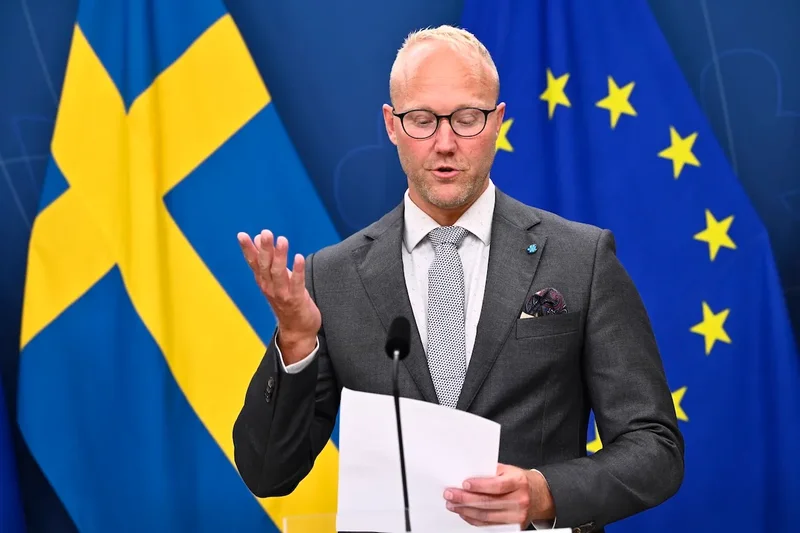
When The Local tells Sweden Democrat migration spokesman Ludvig Aspling that software workers and other highly skilled employees at some of Sweden’s top companies frequently tell us they are considering leaving Sweden because of the stricter citizenship rules and other migration reforms his party has driven through, he is unmoved.
“If the reason that you came here to work is because of the very, very relaxed rules for citizenship, then I don’t really want you to come here,” he tells The Local bluntly. "I want you to come here for the career or for the money, or to have a reasonable life with your kids. I don't want you to choose this country because we have no language test for citizenship – because then you're here for the wrong reason."
In the first of The Local’s election interviews with the migration spokespeople of Sweden’s parliamentary parties, Aspling claims the Sweden Democrats have achieved “exactly 80 percent” of the migration policies they set out to implement during this mandate period, defends the government’s most controversial reforms, and sets out his priorities if the right wins September’s election.
‘Why would skilled workers care about the citizenship rule?’
When it comes to highly skilled workers, Migration Minister Johan Forssell has long argued that his government aims to encourage more of them to come to Sweden, with the immigration crackdown squarely aimed at asylum seekers and low-skilled workers.
But employers in Sweden’s technology sector are increasingly warning that tighter migration and citizenship rules are in fact making the country less attractive to international talent.
Aspling is having none of this.
He argues it is "completely ridiculous" to suggest that a highly skilled senior programmer might be negatively affected by the decision to tighten citizenship rules without transitional arrangements, or indeed by any other of the government's reforms to work permits or residency.
"If you have that type of high-paying, very successful job, you're head of software development for a major corporation, why would you care about the citizenship rule?" he argues. "You can move to any country you want."
"I don't think it's true at all that the new citizenship law affects all migrants the same, especially if you consider, for example, the biggest change is the fact that you have to have your own income and you can't live on benefits," he says. "This chief software developer you're talking about is obviously not going to have a problem with this."
When The Local replies that the new rule increases the residency requirement for work permit holders from five to eight years, which is one year longer than for asylum seekers, he argues this is irrelevant.
"Why would that last year make such a huge difference? If you're planning to live here for seven years, and now you have to wait eight years. Why would that be such such a a big point of contention? I really don't see it."
He argues Sweden’s new citizenship rules merely bring it into line with competing countries.
From Japan to the Sweden Democrats
Aspling says living in Japan as an English teacher and care worker gave him first-hand experience of being a migrant.
He says it was not immigration but observing criminal court cases as a law student that first drew him to the Sweden Democrats, after seeing what he considered unduly lenient sentences.
"There was one guy. He was convicted of aggravated drunk driving for the fourth time and he got three months in jail, which was less than what he got the last time, which is just crazy."
The only party at that time pushing for stricter punishments, he discovered, was the Sweden Democrats.
Priorities for the next mandate period
After a four-year term in which the government enacted much of his party's immigration policy programme, you might think the party would have run out of things to do on immigration, but Aspling says there is no shortage of ideas.
"There's tons left. Oh my God, there's so much that need to be done."
One of the party's most controversial plans for the current mandate period – revoking the existing permanent residency permits held by well over 100,000 immigrants – was shelved after the courts and other agencies argued it would be enormously costly and overwhelm the legal system.
Aspling denied that the proposal, which is being "completed" in the Justice department, had been shelved.
“It is in the agreement, so it’s important, obviously,” he says. “It has not been kicked into the long grass. But I can see two or three other pretty big reforms that are as, or even more, important.”
These include return hubs in non-EU countries, a proposal to make immigrants' benefits payments contingent on fulfilling a language requirement, tackling what he sees as the abuse of the EU's Long Term Residence status by other EU countries, and a crackdown on unscrupulous construction firms' use of cheap, often illegal, non-EU labour.
**"You have decided to stand outside labour market" **
Depriving some immigrants of benefits, Aspling argues, could potentially achieve the goal of revoking existing permanent residencies by other means. "They won't want to live here anymore if they are unable to live off benefits," he says.
Because in Sweden, benefits claimants need to show they are actively applying for jobs, he claims that immigrants are deliberately failing to learn the language.
"There is a bit of a life hack here that if you just refuse to learn the language, then you can't really be expected to work. And then there is no pressure on you, and you can just live off of benefits forever," he says. "Is this reasonable? No, it's absolutely insane."
The Sweden Democrats, he says, plan to stop this by requiring anyone who has been living in Sweden for five years to show they have learned Swedish to an acceptable level in order to qualify for continued benefits.
"You have decided on your own volition to stand outside of the labour market – so no benefits for you," he says.
**Return hubs **
But while language requirements for benefits is important, Aspling says, setting up return hubs in non-EU countries for immigrants who have been refused residency in Sweden but whose home countries will not cooperate on deportations is his "number one favourite reform" for a coming mandate period. The EU's Returns Directive, passed in June, "opens up a lot of possibilities to have cooperation with third countries," he says.
He argues return hubs – facilities in non-EU countries where people can be held pending return to their home countries – would function mainly as a threat.
"We can say, 'we can't return you to Iran by force but you can't stay here, so we're gonna put you in this return hub. However if you would like to voluntarily move back to Iran then that will be totally fine. We'll pay for your ticket, and we're going this afternoon'. In that situation, 99 percent of these migrants will say, 'Okay, fine, I'm going back home,'" he says.
Once a few immigrants were sent to a facility and allowed to post on TikToks and Instagram about it, he argues, others will voluntarily return.
When The Local points out that many of these migrants might fear persecution and imprisonment in their home country – even if the Swedish authorities have judged they have no grounds, he dismisses this, claiming that many return of their own volition to the country they claim to have fled for holidays or to visit relatives.
Tighter rules on Long Term Residency
Aspling also believes that Greece, Italy and Spain are using the EU's Long Term Residency Permits to shunt on their unwanted migrants to other EU countries. He wants a new government to carry out a "very, very deep investigation" into long term residency permits issued by these counties.
"What I believe is happening is that Italy and Greece don't want these people in their country anymore, so they just issue these permits because they know that if they do, they will move away. This is a very easy solution if you want to get rid of people that you don't want in your country."
After the election
If the right-wing parties lose, Aspling is certain that the new government led by Social Democrat leader Magdalena Andersson will undo some of the stricter migration rules the Sweden Democrats have managed to pass.
"A lot of the stuff – and maybe some of the really good stuff – is going to be in the danger zone," he says.
Adding transitional provisions to the new stricter citizenship law – something the Fair Transition group has been pushing for, would he argues, be "an absurd thing to do".
"You're adding transitional rules to a package of legislation that will have already been in force for six months. That's never happened and it would be very strange. What happens if your application has already been revoked between June 6th and that point? We toughened up the rules for persons with criminal records who are applying for citizenship. Are convicted criminals going to have the opportunity to apply again?"
If the right-wing parties win, he has no great expectations of being appointed a minister, he says.
"If I'm on the team or not, I've no idea. It doesn't really matter. The only thing I care about is that we get the necessary reforms to put the country back on the right track."