Eisner Award Winning manga, Witch Hat Atelier, captured the minds of global fans—including American animators—long before its 2026 anime adaptation.
Praised for its inclusivity and fantastical take on standardized school systems, the spellbinding story appeals to those who value education and creativity. These elements are integral to Witch Hat Atelier, as author Kamome Shirahama explains her intent on crafting a purposeful world; one where a reader learns to recognize the signs of danger inside and outside of a fictional tale.
The story follows an aspiring witch, Coco, who finds herself in the center of an ideological conflict between two factions between the Pointed Hats and the Brimmed Caps witches. To control the dangerous unfettered use of magic, an oversight council established ground rules on what is considered forbidden magic and the knowledge of its existence. In the anime trailer, Qifrey tells Coco that the kind of spells that aren’t forbidden are the ones that bring happiness to all.
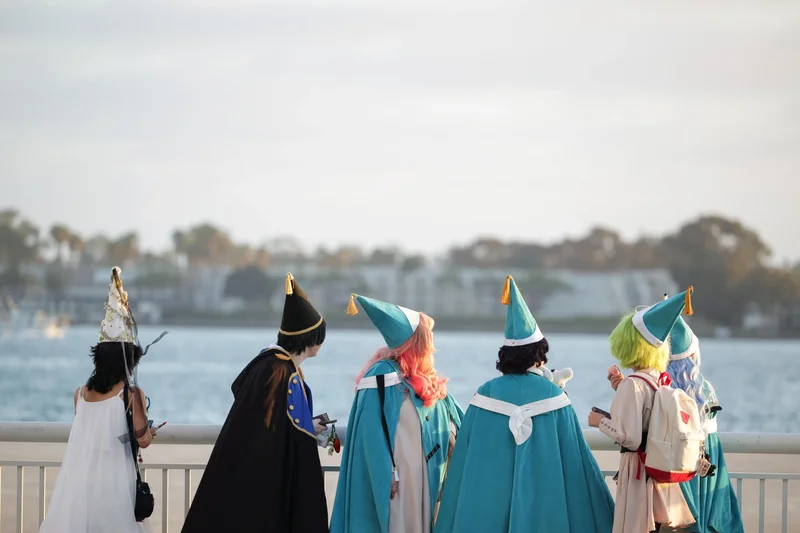
The series’ popularity continued to explode after the Bug Films anime adaptation and is seen through the enthusiasm of fans offline and online. Even with rising convention prices, Witch Hat Atelier’s Anime Expo panel was bursting at the seams with Pointed Cap Witches and their Brushbuddies. They could even be found in abundance at San Diego Comic Con, too. Since the main characters are all young apprentices, what makes the story so universal for both adults and children?
“Adults are just like children, and they still have the possibility for growth and development,” said Shirahama during an in-person interview. “Of course, in front of younger people or even children, adults may put on this front of being a good teacher. However, they're not perfect people. I think that's something we should always keep in mind and that's something fans can glean from a series.”
Interestingly, the manga is published in a seinen magazine called Morning Two, whose target audience is adult men. But Shirahama clarifies the medium of publication is a “catchall genre” where any story can be told. “In Japan, the seinen magazine is not intended for just men.”
Regarding Coco, she expressed her desire to craft a story that she’d be interested in reading. “I wanted to draw a story that I’d want to read. Of course, I, myself, am a woman, so I wanted to make a young girl the protagonist."
Considering the diversifying taste in anime, especially in the U.S., fans have praised the story for having a main female protagonist. Many online discussions lament how there aren’t enough leading women in anime. "I haven’t felt that there’s a lack of female protagonists in anime or manga, personally. There might just be some discrepancies between genres and where that tends to be the case.”
When it comes to disabilities, magic and the fantasy genre, the Witch Hat author sheds light on her approach and how that perspective is integrated into the series. She also conveys her utmost trust in Director Ayumu Watanabe and the Bug Films studio on their animated adaptation.
KALAI CHIK: You portray the teachers and adults in Witch Hat Atelier using magic as an aid for their disabilities. Did you do research on coming up with the practicalities and intuitive uses of magic for these disabilities, such as the seal chairs, Qifrey's glasses, etc.?
KAMOME SHIRAHAMA: It is a fantasy world. If I were to write about real world medicine, the amount of research and the number of checks that Witch Hat Atelier would have been submitted to would be more detailed. But I did read a lot of books on the matter. I also refer to the research that I did in university, which has to do with universal design.
KC: You mentioned in another interview that you talked to Witch Hat Atelier readers outside of Japan. You also directly engage with fans and their analysis, such as with Qifrey's injury. As an artist, what does this mean to you? How does that response help you grow?
KS: It’s through coming to live events like this that I've been able to engage with readers outside of Japan. It's being able to engage with them that really gives me the reason to look into, for example, the elements that you've mentioned or to give new perspective. It has engaged me in new ways and given me new experiences. I was thinking about how if I were to invite all these fans from around the world into my world—the one I've created—then it's kind of obvious that there should be diversity and inclusion. I think that's what shows through.
KC: What is your approach to fantasy? Do you approach fantasy with limits, or do you like to imagine fantasy without limits?
KS: I think I am the type of person who would write fantasy with limits, and this is because I believe fantasy functions to reflect reality. If there's something that is kind of fable-like or educational in it, it will help to have this facet where it doesn't feel like it's completely removed from reality. In fact, gives you an objective and a deeper look at reality.
KC: Healthy teaching leads to healthy learning is a message central to the series. Why is it important to show different children with different learning styles, including the adults' different teaching styles for them?
KS: I wanted people to know that there's a lot of options and many choices out there. Especially in a country like Japan, where learning can be quite rigid and everything is categorized or formatted. I wanted people to know that if this learning style doesn't work for you, it doesn't mean you have to give up on your future. There's lots of other options. That's what I was thinking of when I came up with this concept.
KC: Is there an educator in your life that led you to place a great importance on teaching in Witch Hat Atelier?
KS: There's no single individual or special person left to this, but I’m always thinking about the possibility of education, especially when it comes to inheriting knowledge or transmitting knowledge to others. Passing down knowledge has led to good progress in society. I wanted it to be viewed as the meaning behind my work. I think it's wonderful that even if you're not necessarily blessed with a very special adult or a teacher in your life, there's tons of ways to get knowledge and information, such as through books.
KC: How did you work with Director Watanabe to elevate the impact of the scene in episode 10, where Tartah discovers that he can use magic to accommodate his disability and even go beyond it?
KS: Honestly, Director Watanabe has such a deep understanding of the story, that it was unnecessary for me to proactively contribute anything. I just sort of put my trust in him and he did a great job.
KC: Although there are many parts of Witch Hat Atelier that can be left up to interpretation, the heavier topics and themes are presented straightforwardly. Why did you want to make sure these emotionally heavy topics, such as what happens with Euini in Episode 13, are shown with such directness?
KS: Because it is in a fantasy setting, I didn't want readers or watchers of Witch Hat Atelier to just separate the story in their head as, “This is fantasy, this couldn't happen to me.” I wanted to make sure that it felt relatable. I felt like it could be something that happened to the readers or the watchers. I really wanted to blur that border between reality and fiction when I was giving them this experience. By taking on these heavy themes with a straightforwardness, I hope that it has gone beyond the idea that it's ‘just a story,’ and it presents as a more realistic what-if situation.
Witch Hat Atelier is streaming on Crunchyroll.