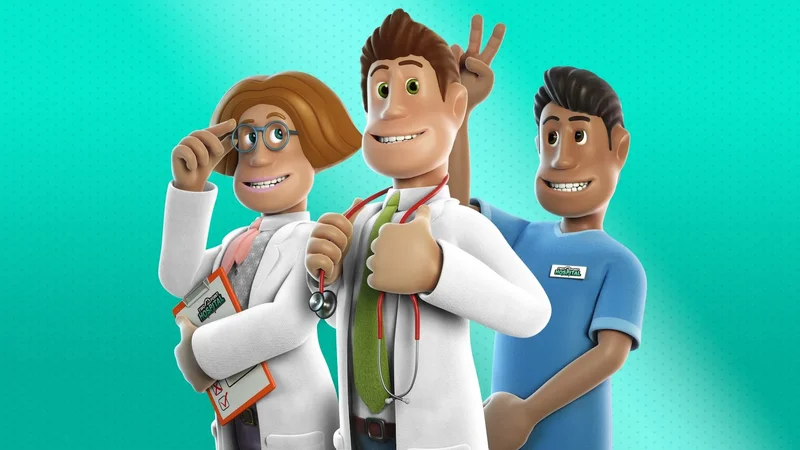
Two Point Studios, makers of Two Point Hospital and the excellent Two Point Museum, originally contracted with Sega for about 18 months in 2016. 10 years later, the studio is still going strong and remains one of Sega's most important first-party studios. Reaching 10 years is a big milestone for any studio. But it's becoming increasingly rare in a struggling games industry and even more so for smaller studios making niche games that aren't bite-sized indies or big-budget epics. Polygon spoke with Two Point founders Gary Carr and Ben Hymers and COO Jo Koehler about how the studio defied the odds — and the corporate smothering — to prove the value of staying small and having fun.
Two Point Studios officially opened its doors 10 years ago, but its origins stretch even further back, to the last years of Fable-maker Lionhead Studios. Carr was part of a prototype team with Ben Hymer, who helped found Two Point and is currently its technical director. The two had worked together on previous projects, including Lionhead's studio simulator The Movies and asked Hymer if he might be interested in starting something new with him unaffiliated with Lionhead.
"I was old and he was young," Carr said. "I basically wanted to harvest his youth and cling to it."
Carr jokes, but Hymers' youth was helpful. Hymers adored the Bullfrog Production games that Carr had worked on, like Theme Hospital, and kept asking Carr why they don't make games like that anymore. The answer was simple, or at least, it was simple for Xbox management responsible for greenlightning new games. Sims just weren't sexy enough.
"We pitched these games at Microsoft, and I remember at the time they were saying, 'We need billion-dollar franchises. We leave that kind of money on the table,'" Carr recalled. "And that was a saying that really irked me a bit."
Microsoft's insistence that sims don't sell "bashed" the idea out of Carr and fellow Two Point founder Mark Webley. But Hymers' insistence that the twin appeal of nostalgia and good management games had potential eventually convinced Carr that maybe Microsoft was wrong.
"I think we assumed [sim games] had probably had their day, if I'm honest," Carr said. "Ben definitely made me think twice about that assumption. When you're in the industry for so long, you kind of don't have a strong sense of public perception and what people want."
Hymers, Carr, and Webley figured if Microsoft was happy to leave that money on the table, then someone else would likely be just as happy to take it. They decided to pitch themselves "below AAA" and hoped for the chance to make the kind of game they enjoyed playing again. That game ended up being Two Point Hospital, a spiritual successor to Bullfrog's 1997 hit Theme Hospital.
Carr and Hymers said it seemed like everything just fell into place after that, and it's not hard to see why. Sega's Searchlight program — a bid to find smaller, independent studios that complemented the publisher's output of larger games — was in full swing at the time of Two Point's birth. In other words, they were looking for projects below AAA. As if that weren't serendipitous enough, Carr found out later that Sega decision-makers had been chatting amongst themselves just days before Two Point reached out, saying how nice it would be if they had a studio like Bullfrog in their portfolio. Now they just needed a team.
That, it turns out, was less challenging to assemble than expected. Microsoft closed Lionhead in 2016 as Hymers, Webley, and Carr were negotiating with Sega. The nascent Two Point now had a pool of developers who knew each other and who knew how to make sim games suddenly in need of work. Carr also hired Jo Koehler, an experienced producer who previously worked with EA and Playsport, the studio behind Motorsport Manager. Production started with six people, and by the time Hospital launched, that number grew to 14.
Making Two Point Hospital was comparatively easy as far as game development goes, the kind of smooth process that's only possible when a team of experienced creators familiar with each other can work together.
"It was a very strong shared vision of what we were making, which really sped up the process," Hymers recalled.
"We trusted in each other," Carr said. "Everybody was very experienced, so there was a free-form attitude to design, to our style, and everybody was involved. It was wonderful, almost like we'd gone back 20 years to early game development in the 80s and 90s, where there wasn't really that much documentation or process. It was just about energy."
With no perceived audience and no previous design documentation to tiptoe around, the Two Point team could make things up as they went along. Carr said the team allowed itself to "regress" to their earlier days of making charming, lighthearted games with Bullfrog and Lionhead, and it was a therapeutic process for them as much as it was a business endeavor — a last chance, so they thought, to do the thing they loved with people they respected.
Two Point Hospital launched in August 2018. Carr said he only expected Two Point to survive as long as Sega kept paying, which he estimated might be two years at most. Hospital's success changed everything. It reached the top-selling spot on Steam in more than 40 territories, despite facing steep competition. Also released that month were Madden NFL 19, Overcooked 2, and Monster Hunter World, among others.
"It completely blew us away," Koehler said. "I don't know what we expected, but it wasn't what happened."
"Our expected recoup time was about 18 months down the line, when we hoped we might have enough money to put behind the company," Carr said. "Instead, we repaid Sega's advances in two-and-a-half days. Which was nuts and a really emotional time. A lot of dev companies, they make a game and at the point they've released the game, they're at their most vulnerable because they're broke. They've spent all the development money, but thankfully and luckily, we were immediately in the black."
Two Point Hospital performed particularly well in China, Germany, the U.S., and the U.K., which surprised the team. Such games historically underperformed in China and Germany, and Theme Hospital's sales were notably less in the U.S. compared to the U.K. But people were thrilled, and the game's success surprised Sega just as much. Two Point quickly negotiated an amendment to its contract — the original agreement had no provisions for any work beyond the first game's initial launch — and spent the first few months after release fixing bugs and evaluating feedback, staying up late into the night answering player questions and requests, and deciding what should happen next.
"We were so happy," Koehler said. "We just wanted to make [Hospital] bigger, and we did."
Two Point Studios released multiple free updates and paid expansions for Hospital across the next four years and had already begun discussing ideas for what would become Two Point Campus with Sega. However, success also came with a few unexpected complications and pressures. The short-term nature of that initial contract and the team's measured expectations meant that no one at Sega or Two Point had thought about how to handle a second game.
"There was fear," Carr said. "We were a relatively unknown indie game studio, only founded two years before, and almost to the anniversary date of two years, we were number one on Steam. People can quite easily go on Company House and see you're an independent studio, and we had a lot of people swarming around, a lot of outside interest."
Sega wanted to keep Two Point in its portfolio, however, and the team felt a sense of loyalty to its backer. Sega had supported them without asking for much in return and without demanding ownership of whatever IP Two Point ended up making. It just gave them enough money to go make the game. So, Two Point batted away other offers and became a first-party studio under Sega.
Two Point Hospital was a final homage to a bygone era of games and development, but that era was less gone than anyone predicted. So with Two Point Campus, Two Point wanted to make its own mark and not just recreate the past. Webley had a philosophy that a good setting was anything people felt a connection to, whether it was grand or mundane. Everyone had experiences with education systems at some point, and hardly any developers used college as their setting. It was a natural fit.
It was also the perfect chance to implement lessons learned from working on Hospital at a larger scale. Koehler led efforts to collate feedback after Hospital's launch and identify smaller issues that tripped people up, but also to understand the audience more broadly and figure out the type of simulation player Two Point appealed to.
Whether by luck or virtue of reaching audiences other developers had neglected for years, the people who played Two Point Hospital were exactly the kinds of players Carr and the rest had made games for in the past. They wanted deep simulation without feeling overwhelmed and lighthearted charm without sacrificing complexity. There were few such middle-ground options at the time, and even 10 years later, Two Point's games remain largely uncontested in their niche. Unlike the old Bullfrog and Lionhead audiences, though, Two Point's audience had opinions about how to improve the game — and ways to share those opinions.
It was new territory for Carr.
"Prior to that, we were typical developers for the time, who didn't necessarily have a relationship with people that bought our games," Carr said. "Now we literally ask our community what they want. It's flipped my experience from being kind of in a bubble of development to actually spending time speaking to players. It isn't just about keeping people buying your games. It's about helping them, then helping you make a better game for the next time around."
For Campus and, later, Museum, many of those lessons required improved technical foundations. Two Point started developing for consoles while working on the PC version, improving interfaces and button placement, among other pain points from Hospital. But the team also made new systems, like some to help make all the little simulated people more interesting than just, as Carr called them, "fodder" for the simulation. Campus has a notification system that lets you mark favorite students and professors so you get updates about their performances, for example, or find out when a student makes a new friend. That turned into Two Point Museum's more complicated sets of staff traits, associated events, and even potential deaths if they meet with disaster while tracking down exhibits.
But listening to feedback also meant changing design philosophies and rebuilding parts of existing games, too, not just upcoming ones. Museum launched with a less balanced security system than it has now, partly a reflection of real-world heists that the team had heard about while making the game. But as the complaints rolled in, Koehler said they realized the problem. Museum might feel timely, but giving people creative freedom to design a museum, only to watch as it gets dismantled by thieves, wasn't exactly fair.
Scaling up to handle new systems and implementing post-launch changes posed a different kind of challenge, though: maintaining a reasonable studio size. Koehler and Two Point's founders share the philosophy that once a studio starts adding layers of management, everyone suffers. Koehler "managed the hell" out of the studio, Carr said, to keep that culture strong. Two Point Studios had 14 people when Hospital launched. Now, they employ 50 and contract carefully vetted support studios to help in areas Two Point may not have specializations in.
"A lot of us have been at companies that have grown really big really quickly and it just kind of destroys the culture at the studio," Hymers said. "And we didn't want that because we liked how we work."
"We're all developers," Carr added. "At bigger studios, you become managers. But the reason we got into games was to make games. So we all keep our hands on, and we stay small. Otherwise, we'd have to become managers again."