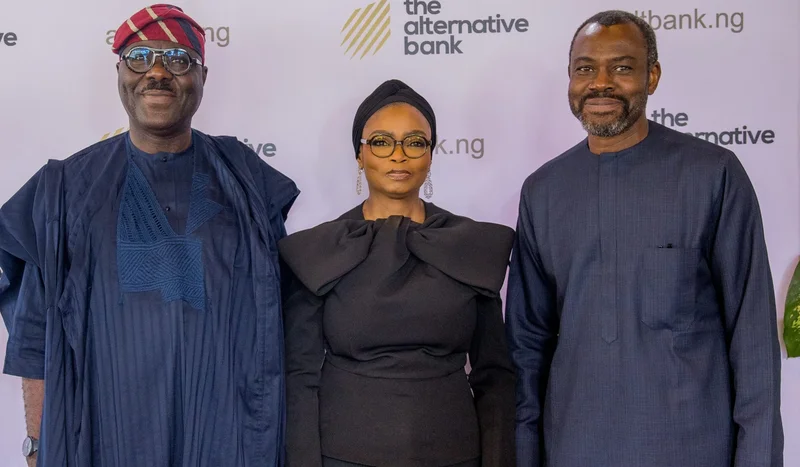
Lagos State Governor, Babajide Sanwo-Olu, and former Minister of Works and Housing, Babatunde Fashola, have called for greater adoption of non-interest finance to mobilise long-term capital to support Nigeria’s productive economy.
They spoke on Thursday at the ‘Beyond Interest’ private intelligence forum organised by The Alternative Bank in Victoria Island, Lagos.
The forum brought together investors, entrepreneurs, wealth creators, institutional decision-makers and public-sector leaders to examine the role of patient capital in driving sustainable economic growth.
Opening the forum, Chairman of The Alternative Bank, Muhtar Bakare, said Nigeria’s challenge was not a lack of capital but the absence of trust required for long-term investment.
| | |
|---|
“What we lack is not effort. We lack capital that stays long enough to turn effort into capacity, capacity into durable jobs and durable jobs into stability. That is why the distinction between extractive and productive capital matters,” Mr Bakare said.
Keynote address
Delivering the keynote address on behalf of Governor Sanwo-Olu, Lagos State Commissioner for Finance Abayomi Oluyomi said governments should serve as enablers of private investment rather than competitors.
“The future of finance is not only about the price of capital; it is increasingly about the quality of the economic activity that capital enables. Lagos is not only open for business; Lagos is prepared to do business,” Mr Sanwo-Olu said in the address.
The governor cited the Lagos infrastructure programme, the recent dual bond issuance and the Lekki corridor as examples of public investments that have improved the environment for private capital.
In his special remarks, Mr Fashola said capital anchored to real, productive assets and the public good delivers more enduring value than investments driven primarily by short-term returns.
He urged investors and institutions to consider the long-term social impact of their investments alongside financial returns.
Case for Ethical Capital
Speaking on “The Business Case for Ethical Capital,” Abubakar Suleiman, Promoter of Non-Interest Banking in Nigeria and Board Member of Sterling Financial Holdings Company Plc, said The Alternative Bank had demonstrated that non-interest banking could achieve commercial success while supporting economic development.
He noted that the bank, which started as Sterling Bank’s non-interest banking window in 2014, now holds assets approaching ₦500 billion and serves nearly one million customers.
“The Alternative Bank has shown that non-interest banking can grow, win customers, and generate profit. The business case for ethical capital already exists. Our task is to apply it with discipline,” Mr Suleiman said.
He cited WasteBanc, The Alternative Bank’s recycling initiative with the Lagos Waste Management Authority (LAWMA), and Nigeria’s sovereign Sukuk programme as examples of values-aligned finance connecting capital to productive assets while maintaining commercial standards.
Other speakers, including Stanley Jacob, Group Chief, Innovation and Technology at Meristem, and Ajibola Tobi-Osho, Executive Director of Tugrande Alliance Limited, argued that Africa’s financial challenge is increasingly one of infrastructure and capital allocation rather than liquidity.
Mr Jacob said the convergence of the Pan-African Payment and Settlement System (PAPSS) and the tokenisation of real-world assets could give Nigeria a first-mover advantage in continental capital markets.
Mr Tobi-Osho, meanwhile, said Nigeria’s challenge had shifted from inflation to capital allocation, noting that banks were parking record levels of liquidity with the Central Bank of Nigeria rather than lending to businesses capable of creating jobs and driving growth.
The forum attracted senior business executives, investors and public-sector leaders, including Sterling Bank Chairman Olatunji Mayaki, Managing Director of The Alternative Bank Hassan Yusuf and Aruwa Capital founder Adesuwa Okunbo Rhodes.
Others included Sahara Group co-founder Tonye Cole, Noor Takaful Vice-Chairman Aminu Tukur, and Africa Business Angel Network President Yemi Keri.