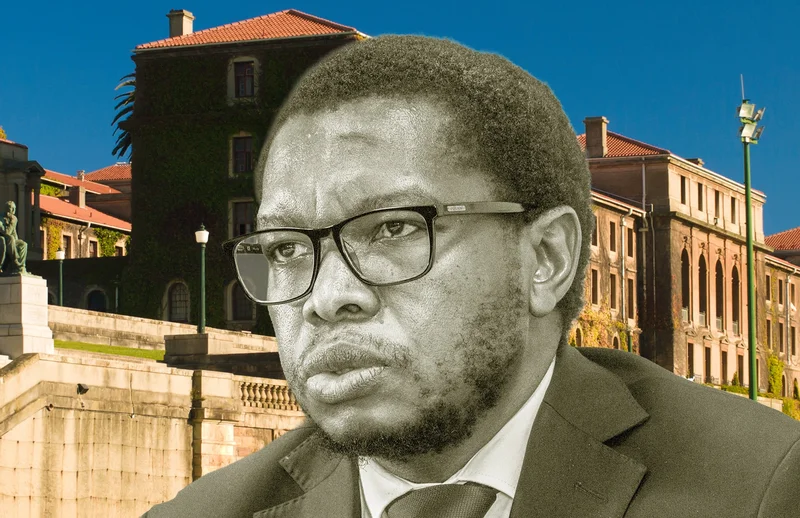
Less than four years after the University of Cape Town was plunged into a governance crisis over allegations concerning then vice-chancellor Mamokgethi Phakeng, Africaâs top university is facing fresh leadership turmoil involving her successor.
Court papers filed this week reveal that UCT Vice-Chancellor Professor Mosa Moshabela has taken the universityâs own council to the Western Cape High Court after an investigation into 34 complaints from UCT staff and students concerning his conduct.
The investigation ended with the UCT Council deciding that no disciplinary proceedings would follow. But the council simultaneously recorded that the investigatorsâ report had raised âcertain concernsâ about Moshabelaâs behaviour.
The current issue of particular concern to Moshabela, however, appears to be the fact that the council has ordered a further probe into a separate incident involving entry without prior permission into a female UCT academicâs home.
Daily Maverick sent detailed questions to UCT, in response to which spokesperson for the University (including the office of the vice-chancellor) Elijah Moholola gave the following statement: âThe University of Cape Town (UCT) confirms that legal proceedings have been initiated involving the Vice-Chancellor and the university's council. As this matter is now before the courts, it would not be appropriate to comment on the details or merits of the caseâ.
Complaints included sexual harassment
Moshabela took office in August 2024.
Court papers reveal that less than a year later, on 30 June 2025, UCT Council member Malcolm Campbell informed Moshabela that UCTâs Ombud Nashira Abrahams had received 21 complaints from staff relating to âyour interactions with themâ.
Campbell indicated at the time that an independent investigation commissioned by the council was a possibility.
By December 2025, the Ombud had recorded 39 staff and student âvisitorsâ concerning Moshabela, eight of which were marked âclosedâ and 31 âopenâ - referring to whether the matters remained active in the Ombudâs records, rather than whether the allegations had been proved or disproved.
The related court documents caution that the 39 recorded visits to the Ombud over the VC do not necessarily represent 39 separate people.
The Ombud records do not reveal the complainantsâ identities, but in the majority of cases the records indicate their race, gender, and whether they were students or staff members.
Almost 70% of the complaints regarding Moshabela were brought by women, with the majority of these recorded as African.
Two-thirds involved professional, administrative and support staff at UCT, six involved faculty members, and five involved students.
Most of the matters involving the VC were classified by the Ombud as âEvaluative Relationshipsâ, a broad category covering difficulties arising where one person exercises managerial, supervisory or other authority over another.
In simple terms, this category could cover issues ranging from allegations of abuse of power or bullying, to grievances over performance reviews.
But six of the open Ombud matters were categorised differently: three as sexual harassment, two as discrimination based on culture and one as discrimination based on gender.
For these six matters, the Ombud withheld even race, gender and staff-status details because she believed they could enable Moshabela to infer the complainantsâ identities.
Nothing in the court papers reveals the details of what conduct was alleged in those six cases.
A council subcommittee subsequently recommended that all 31 open complaints be formally investigated, with senior advocates Alex Freund SC and Tanya Golden SC appointed for this purpose in February 2026. Three further complainants emerged within a month, with the probeâs mandate accordingly expanded to encompass these.
The investigation was to be conducted confidentially, with complainantsâ identities protected unless they consented to disclosure.
But it was agreed that without this consent, complaints against Moshabela could not be pursued.
Only one complaint would ultimately be put to Moshabela for a substantive response, and the documents before court do not disclose the relevant allegations.
Nor do they explain what became of the other complaints, including those categorised as sexual harassment and discrimination.
Fairbridges Attorneys, the firm appointed by the UCT Council to assist the investigators, wrote in a 9 April 2026 letter to Moshabelaâs lawyers that the reduction in complaints ultimately put to the VC âsimply reflects the practical operation of a confidential investigation in which the consent of complainants, and the state of the evidence, are relevant considerationsâ.
No discipline, but behavioural concerns
Freund and Golden completed their investigation in late May 2026.
On 30 May, Council decided that no disciplinary proceedings should be instituted against Moshabela in respect of any of the 34 complaints.
But the council also found that the investigatorsâ report pointed to âcertain concernsâ about Moshabelaâs behaviour which should be discussed with him.
Council further directed Moshabela to undergo executive coaching and an annual review with feedback from staff. The same measures were merely âstrongly encouragedâ for other members of UCTâs senior leadership.
The fact that the VC was âdirectedâ to have coaching and subject himself to an annual review, while other members of the executive were only âencouragedâ to do the same, appears to be a sore point for Moshabela - who highlights the discrepancy more than once in his affidavit.
âA genuinely developmental programme does not single out one individual for compulsion on the strength of undisclosed âconcernsâ while inviting everyone else for coaching,â he argues.
What the behavioural concerns actually were remains unknown.
The court papers also reveal that the UCT Council had by this stage turned its scrutiny on the Ombud herself.
In March, Freund and Golden were instructed to investigate Abrahamsâ conduct during the events leading up to, and during, the Moshabela investigation.
The reason for that instruction, and the investigatorsâ conclusions about the Ombud, are also not disclosed.
The Forest Hill incident
The one matter which remains potentially alive is separate from the original 34 complaints.
During their investigation, Freund and Golden learned of an incident at UCTâs Forest Hill staff accommodation on 13 November 2025 involving Moshabela, a Campus Protection Services officer named Grant de Monk who also served as the VCâs driver, and a female UCT faculty member.
Daily Maverick is not naming the academic in question due to the sensitivity of the circumstances.
According to the investigators, De Monk entered the academicâs residence without her prior permission. He subsequently told them that he had done so while carrying out an instruction from Moshabela âto confidentially investigate [her] wellnessâ.
Moshabelaâs version appears to have been that the academicâs mother had contacted him because she was unable to reach her daughter and was worried. He says he was outside Cape Town and instructed De Monk only to check whether she was safe.
According to Moshabela, De Monk and another official entered using a master key and found the academic asleep in her bedroom.
Moshabela claims her mother subsequently thanked them for assisting, but appears to have produced no evidence to this effect.
The court papers do not reveal the source of this complaint.
The UCT council ordered Freund and Golden to conduct a further investigation into the incident. That investigation has since been placed in abeyance, rather than terminated, and could potentially produce further recommendations to Council.
Moshabelaâs court challenge argues that the UCT Council cannot formally act on concerns about his behaviour while refusing to tell him what those concerns are. He says he has never received the investigatorsâ report into the 31 complaints, was not given an opportunity to answer concerns before the council issued the coaching directive, and has effectively been subjected to compulsory remedial measures on the basis of findings he cannot see.
He is also challenging the Forest Hill investigation, including the decision to appoint the same investigators who had already learned about the incident and brought the matter to Councilâs attention.
Déjà vu at UCT
For UCT, these developments will be particularly concerning because of the echoes of what happened under Moshabelaâs predecessor.
In 2019, then Ombud Zetu Makamandela-Mguqulwa recorded that 37 people had approached her with concerns about former VC Phakengâs professional conduct, reporting that they felt âbullied, silenced, undermined, rebuked and/or treated unfairlyâ.
Daily Maverickâs October 2022 investigation subsequently documented allegations of bullying, intimidation and a culture of fear and secrecy at the university, alongside a remarkable turnover in UCTâs senior leadership.
The UCT councilâs attempts to address concerns about the functioning of Phakengâs executive included plans to create a more âpsychologically safeâ environment and providing Phakeng with leadership coaching.
Phakeng left the vice-chancellorship in March 2023 under an early-retirement agreement which saw her walk away with a total pay package worth over R12-million. An independent investigation subsequently found serious governance failures during her tenure.
The court papers now before the High Court do not establish that Moshabela has behaved in the same manner as his predecessor, but the parallels are difficult to ignore.
For the second consecutive UCT vice-chancellor, numerous concerns about the VCâs dealings with other members of the university community were brought to the Ombud; the UCT council commissioned external investigators to determine what was going on; the Ombudâs own conduct became embroiled in the affair; and the council turned to executive coaching as part of its response.
The UCT Council is scheduled to hold a special meeting on Saturday 8 August to consider the demands and objections raised by Moshabelaâs lawyers, with the Forest Hill investigation on hold pending that meeting. DM