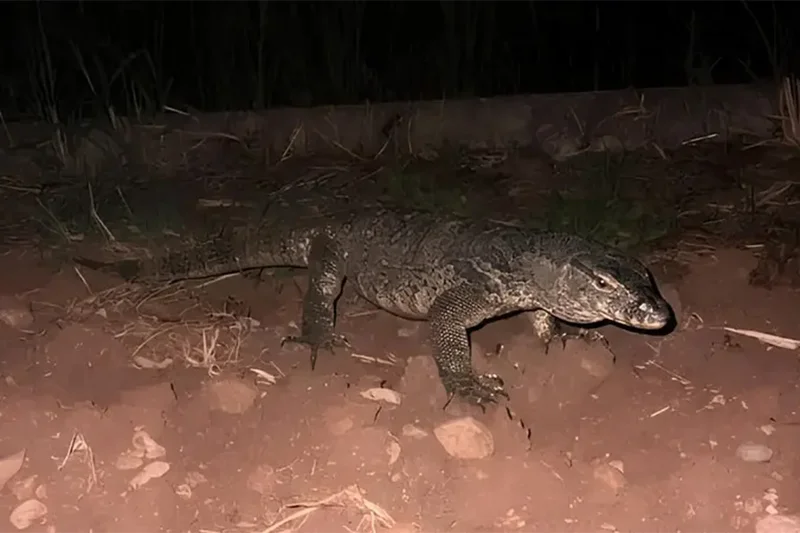
“For you, it's a joke, but for me it's not,” the frustrated mayor of a small town in northern Italy told reporters, leading a dramatic search operation like no other.
Caught in the bright flash of a local worker’s camera, a giant Papuan monitor lizard was spotted weeks ago around the Gasparina farmhouse near the town of Montichiari, in Italy’s Lombardian countryside.
First seen in early July, more than 13,000 kilometres from its native habitat of Papua New Guinea, the reptile quickly captured the country’s attention. Local authorities mobilised vast resources for the search and have banned pedestrians from walking in the area it was sighted.
But what started as a fascinating hunt for the elusive lizard, followed by a captivated social media audience, quickly turned into a headache for local authorities.
“I'm harassed all day by newspapers, media, and TV,” mayor Marco Togni told reporters according to Il Gorno Brescia. “Whoever abandoned him is an idiot, but this story must end: if it's true that he's dead, let us find him.”
Italian outlet La Sicilia said in late July there had been three sightings in just two weeks.
But in an appealing for more sightings, the mayor assured that if it is dead, whoever finds it will not be in trouble. It is illegal to either keep or kill - except in self-defence - any reptiles of the Varanidae family in Italy, including the Papuan monitor.
"If he's dead, I don't care whose fault it is, but I simply ask that he be placed on the side of a road clearly visible to everyone, so we can close this matter and leave the provincial police and forestry police free to devote themselves to other matters,” the mayor added, one fortnight after the photograph was taken.
It appears the reptile is still on the loose. The Independent has contacted the Montichiri council and Italian Cabanieri for an update but not yet received a response.
Bresciaoggi reported that authorities have used drones and cage traps in their search for the lizard. Television crews from broadcasters Rai and Mediaset have also attempted to locate the large animal.
According to The Times, thermal imagery and night vision is being used in the search for the 1.5-metre lizard. “The reptile is cold-blooded,” Togni told the outlet. “It warms itself in the sun, so we hope the thermal cameras will detect a difference in temperature.”
The Papuan monitor, also known as a crocodile monitor, is threatened by poaching and deforestation, and is protected by CITES, a multilateral treaty that protects endangered animals from the threat of international trade.
They typically have blunt, rounded heads with long, sharp teeth and curved claws, and can grow as big as 2.5 metres long. Living among the swamps and coastal rainforests in southeastern New Guinea, they feed on anything from small mammals, to birds, and even other smaller reptiles.
Encyclopedia Britannica lists them as the third most dangerous lizard in the world, known for being very aggressive when approached.
Togni told The Times that local authorities do not know how it ended up in northern Italy, and proposed it must have been kept illegally. “It either escaped or was abandoned.”
When he first saw the animal, he “didn’t initially believe it could be true”, but after authorities verified the image they have confirmed that it is “absolutely real”.
For the locals, the presence of the lizard in their local area presents a constant danger.
"Shortly after that famous sighting and photograph, we glimpsed the animal fleeing, let's say we saw a shadow," said the owner of the Gasparini farmhouse, where the lizard was first spotted, speaking to Bresciaoggi.
"We were afraid for our men who go out to irrigate at night, but we haven't seen it since. We don't know exactly how long it's been around or where it's hiding, but we certainly have an idea,” he added.
“Between Lonato and Calcinato, after a double bend, there are underground canals of the Medio Chiese River, disused but still with water; it could be hiding around there."