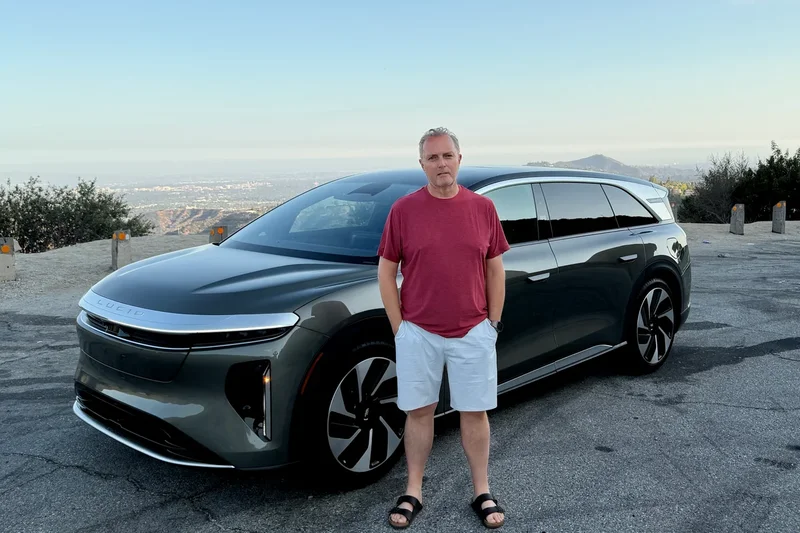
A brief drive around New York last year was enough to show that the Lucid Gravity had plenty of promise. However, ten days and 1,100 miles across the American West gave it nowhere to hide. I drove the Grand Touring around Los Angeles then to Las Vegas for a few days, on to Palm Springs and then down to San Diego, carrying three adults and a substantial amount of luggage through city traffic, fast highways and desert temperatures that reached 115 degrees Fahrenheit, or around 46C.
The result was a much more revealing test than a conventional launch route. The Gravity was fantastic. It drove brilliantly, remained comfortable over long days and delivered the space, refinement and luxury touches that impressed my passengers as much as they impressed me. The air conditioning had some serious work to do and did it without fuss, while the car itself did not miss a beat in some fairly extreme circumstances.
Some Lucid customers have reported quality problems, but there was no sign of them in my car. Nothing failed, no warning lights appeared and none of the technology threw a tantrum across the whole trip. One fault-free example cannot speak for every Gravity, but this one dealt with heat, mileage, people and luggage exactly as it should.
It also attracted plenty of attention. Hotel valet teams repeatedly made positive comments about it, which felt significant given that they spend their working lives getting into and out of more cars than even I do. The reaction was understandable. The Gravity offers the space of a large seven-seat SUV without looking like a bloated SUV. At 5,035mm long it is a big car, yet its low, sleek shape and clean surfaces disguise much of that bulk. It is a great-looking car with genuine presence, but it does not shout about it.
There is an interesting British connection, too. Lucid was set up and originally run by British former Tesla engineer Peter Rawlinson. His focus on powertrain efficiency shaped the Lucid Air, the company’s first model and the 2023 World Luxury Car winner – and it is central to the Gravity too. Lucid has also agreed to supply electric technology to Aston Martin for the British company’s future EVs.
The Gravity has now followed the Air by winning a World Car Awards title. I joined 95 other international jurors in voting it the 2026 World Luxury Car. Living with it for 1,100 miles has only enhanced my view that Lucid is doing something different and special. To almost borrow the phrase from an old American sitcom, I love Lucid.
How we tested
I spent ten days driving a Lucid Gravity Grand Touring 1,100 miles from Los Angeles to Las Vegas, Palm Springs and San Diego with three adults and plenty of luggage on board. In that time I could assess what Lucid ownership would be like from the sound system to the folding rear seats.
Independent rating: 9/10
- Pros:Exceptional space and comfort, impressive efficiency, seamless technology, superb performance, easy to manoeuvre, great roof
- Cons:Not available in the UK, inconsistent wireless phone charging, DreamDrive availability varies by freeway, tailgate edges need care
Lucid Gravity specs
- Price range:$94,900 (£70,800)
- Battery size:123kWh
- Maximum claimed range:450 miles
- Miles per kWh:More than 3 miles/kWh on test
- Maximum charging rate:400kW
Battery, range, charging, performance and drive
The Gravity Grand Touring uses a 123kWh battery and a 926-volt electrical platform, with two motors, all-wheel drive and 828bhp. Lucid claims a maximum EPA range of 450 miles for a five-seat car on the smallest 20-inch front and 21-inch rear wheels. A seven-seat model on those wheels is rated at 437 miles, while larger wheel combinations reduce the official figure further. The important point is that the headline range varies with the seating and wheel specification. I managed well over 320 miles in extreme conditions.
Over my trip the Gravity returned more than 3 miles/kWh. That was seriously impressive for a car of this size carrying three adults and plenty of luggage, particularly as much of the route was covered at speeds broadly comparable with UK motorway driving. The figure was not achieved by crawling around or treating the accelerator as if it were made of glass. It came from using the Gravity as a large, luxurious road-trip car.
Charging performance is equally strong on paper. The Grand Touring can accept up to 400kW from a compatible 1000-volt charger, and Lucid says as much as 200 miles can be added in under 11 minutes in the right conditions – the fastest speed I managed on a Electrify America charger was 340kW, which is still impressively fast.
The Gravity’s boost-charging technology also allows up to 225kW on lower-voltage 500-volt chargers, including compatible Tesla V3 Superchargers. Actual speed will depend on the charger, battery temperature and state of charge, but this hardware gives the Gravity an unusually broad rapid-charging capability.
Performance is startling for a seven-seat SUV. The official 0–60mph time is 3.4 seconds, and the Gravity feels every bit as quick as that suggests. The response is immediate, yet the accelerator is easy to modulate, so there is no need to make passengers regret accepting a lift. One-pedal driving is intuitive and makes town running smoother.
The greater achievement is the way the Gravity combines that speed with comfort and control. Its air suspension dealt well with poor surfaces in New York during my earlier drive and remained first rate across the longer test. It rides with the calm expected of a luxury car, without allowing the body to feel loose or cumbersome. The steering has useful weight and response, while the available active rear steering gives the big SUV a decently tight turning circle and makes it far easier to manoeuvre than its dimensions suggest.
That agility helps the Gravity avoid feeling like rival big SUVs. It is easy to place, stable at highway speeds and capable of covering long distances without tiring its occupants. The air conditioning coped with desert heat, the cabin stayed quiet and the overall sense was of a car developed as a complete package, rather than a huge battery and a lot of power wrapped in an SUV body.
Interior, practicality and boot space
Space is one of the Gravity’s defining qualities. It can be configured with five or seven seats, and the three-row car gives adults useful room in every row. The flat floor helps, particularly in the second row, where the powered seats slide to balance legroom between passengers. Access to the third row is made easier by long, wide-opening rear doors and middle-row seats that move forward at the touch of a lever. Other back row seats fold more easily into the floor, though.
My passengers were consistently impressed by the room, comfort and luxury touches. The middle row can feel limousine-like when pushed back, while fold-out tables on the front seatbacks provide a proper surface for a laptop rather than forcing somebody to balance one on their knees. The third row has usable headroom and legroom, so it is more than a pair of occasional seats reserved for children.
The glass roof is one of my favourite parts of the car. It blends into a windscreen that stretches back over the front occupants, creating a wide, uninterrupted view and making an already spacious cabin feel even airier. It gave a spectacular view of the New York skyline on my first drive. In 115-degree Fahrenheit desert heat, however, we made very good use of the pop-in sunshades. The view is wonderful, but reducing the solar load was sensible when the temperature climbed.
Material quality and design support the sense of luxury. Lucid offers sustainable wood and vegan leather, and the latter looks and feels much like the real thing. The cabin is tasteful rather than showy, the seats remained comfortable over long days and the build quality of the test car stayed solid throughout. The squared-off steering wheel sits low enough to leave a clear view of the display and is really good to use. There are also conventional stalks for the indicators, wipers and gear selection – a welcome point of difference from recent Teslas.
Luggage space is substantial. Lucid quotes 594 litres with all seven seats in use and 3,143 litres of total carrying capacity when the five rear seats are folded flat. What that meant in practice is that four super-sized suitcases, plus associated small bags all fitted in the boot with room to spare.
There is also a large storage area under the bonnet, with an added party trick. Its floor can be turned into a padded perch, making the frunk somewhere to sit as well as somewhere to store charging cables or bags. We did it to enjoy the view from the Griffith Observatory overlooking LA.
There is one practical warning around the rear. The powered boot lid has pointed lips at either side, and a taller person approaching the luggage space from the side could bring their head uncomfortably close to one. I had a couple of near misses during the trip. It’s a minor inconvenience rather than a verdict-changing flaw, but owners will quickly learn to approach the open boot with a little care.
Technology, stereo and infotainment
The Gravity’s technology is extensive, but the most impressive part is how naturally it fits into the car. It feels a little like a Tesla, but designed with the benefit of hindsight: software-led and modern, yet with lessons learned about the value of familiar controls and straightforward operation. Across ten days, the technology rarely demanded attention for its own sake.
The main display is a curved 34-inch 6K OLED screen that appears to float above the dashboard and combines the driver’s instruments with touchscreen functions. A second touchscreen sits lower down, just above the centre console, with quick access to ventilation settings. That arrangement keeps regular controls within easier reach and helps the large upper screen remain useful rather than overwhelming.
An augmented-reality head-up display projects information into the driver’s line of sight, including navigation guidance. Wireless Apple CarPlay is included, while the car’s own Lucid UX software can be updated over the air. The controls responded cleanly during the trip and the overall integration was seamless.
The exception was the wireless phone-charging pad. It did not seem to get on with my iPhone and would not always charge it. That was irritating on long days when navigation, music and photography all placed demands on the phone, although it remained a small issue in an otherwise convincing cabin.
Lucid calls its driver-assistance package DreamDrive. It uses radar, lidar and cameras, shows surrounding traffic and other road users on the display, keeps the car in lane and can change lanes to overtake when it decides that’s needed. In the right conditions it worked well and took some of the strain out of long freeway sections. Full hands-free ‘dream driving’ only appeared to be available on some freeways, though, rather than every road where it might have been useful.
The in-house Surreal Sound Pro system was another highlight. It uses 22 speakers and supports Dolby Atmos, giving music a convincing sense of height and space. Listening through Tidal, the clarity and scale were first rate and the system became an important part of the road trip rather than a specification-sheet extra. The same was true of the climate control: in extreme heat it worked hard, quietly and effectively.
Prices and running costs
The 2026 Lucid Gravity Grand Touring tested was priced from $94,900 in the US, excluding taxes, registration, options and destination charges. The Touring version was announced at $79,900, bringing a lower entry price with a smaller battery and reduced performance. There is still no UK price because Lucid does not sell right-hand-drive cars and has no plans to offer the super-sized Gravity over here.
Lucid has previously said it is interested in right-hand-drive production but has other priorities. That leaves British buyers watching from the sidelines and waiting for smaller Lucids to arrive, even though the Gravity’s mix of space, comfort, performance and efficiency would place it naturally among premium electric SUVs sold here. European left-hand-drive sales have begun, but that does not change the position for the UK.
The Grand Touring’s 450-mile maximum EPA range applies to the most efficient five-seat configuration, so buyers need to check the rating attached to their chosen seating layout and wheels. Even so, achieving more than 3 miles/kWh during a 1,100-mile trip with three adults and luggage suggests that its efficiency is not confined to a laboratory figure.
Lucid provides an eight-year or 100,000-mile battery warranty, with the battery expected to retain at least 70 per cent of its original capacity during that period. The test car’s fault-free performance across a demanding ten days was reassuring, although reported quality concerns from some owners remain relevant when assessing a young manufacturer.
Value is difficult to translate directly into pounds without a UK car or official UK pricing. In America, however, the combination of seven-seat space, 828bhp performance, long range, rapid charging and a high-quality cabin gives the Gravity a broad set of abilities for its price. My extended drive strengthened the impression formed by World Car Awards jurors: this is a luxury EV doing things differently.
The verdict: Lucid Gravity
The Lucid Gravity is a very different and very special luxury, seven-seat, all-electric SUV. It’s fast, efficient, quick-charging, super-spacious, comfortable and beautifully resolved. My 1,100-mile road trip only strengthened the case for 2026’s World Luxury Car of the Year.
Lucid Gravity rivals
FAQs
**How long does it take to charge? **
Lucid says the Gravity Grand Touring can add as much as 200 miles in under 11 minutes when connected to a compatible charger capable of delivering more than 400kW. Peak charging is up to 400kW on suitable 1000-volt equipment and up to 225kW on compatible 500-volt chargers. We saw speeds up too 360kW, which in searing heat was seriously impressive
**How much does it cost - is it worth it? **
The 2026 Gravity Grand Touring tested was priced from $94,900 in the US, with the Touring announced at $79,900. There is no UK price because Lucid does not currently offer a right-hand-drive Gravity
**Does Lucid replace batteries for free? **
oes Lucid replace batteries for free? Lucid’s battery warranty lasts for eight years or 100,000 miles. It covers defects and guarantees that the battery will retain at least 70 per cent of its original capacity during that period, subject to the warranty terms.
Why trust us
Our team of motoring experts have decades of experience driving, reviewing and reporting on the latest EV cars, and our verdicts are reached with every kind of driver in mind. We thoroughly test drive every car we recommend, so you can be sure our verdicts are honest, unbiased and authentic.