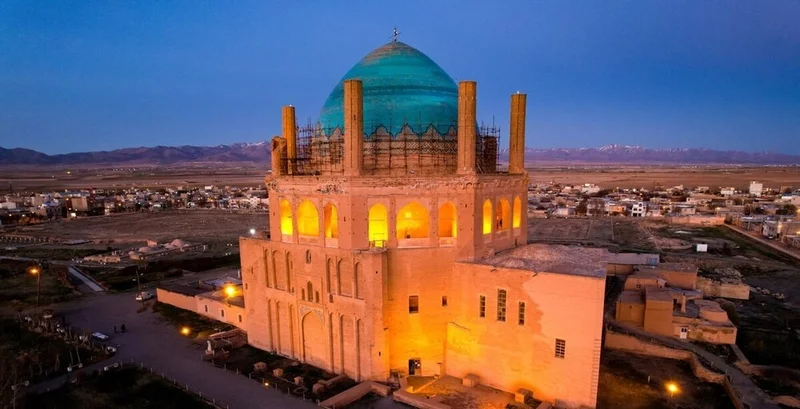
UNESCO-listed Soltaniyeh to undergo restoration
TEHRAN – Restoration work on the interior of the UNESCO-listed Soltaniyeh dome in northwestern Iran will begin soon after a contractor is selected in the coming days, a provincial cultural heritage official said.
On Friday, Seyyed Mikaeil Mousavi, director general of Cultural Heritage, Tourism and Handicrafts for Zanjan province, said on Friday that the next phase of conservation will include restoration of the eastern and western sections of the monument, installation of a new wooden entrance door, tilework in the eastern section, and organization of the archaeological excavation area.
The project will also focus on restoring the monument's inscriptions and interior decorations, Mousavi said, adding that completion of this phase would allow the removal of the scaffolding that has filled much of the interior during years of conservation work, a priority emphasized by Iran's minister of cultural heritage.
He said the subsequent phase of the project will address damaged tiles and other parts of the monument requiring conservation.
Located about 40 kilometers southeast of the city of Zanjan, the Soltaniyeh dome, also known as the Mausoleum of Oljaytu, was built between 1302 and 1312 when [the city of] Soltaniyeh served as the capital of the Ilkhanid dynasty, a branch of the Mongol Empire. Commissioned by Sultan Mohammad Khodabandeh (Oljaytu), it is the only surviving structure of the former royal citadel.
Inscribed on the UNESCO World Heritage List in 2005, the mausoleum is regarded as one of the finest achievements of Persian architecture and a landmark in the evolution of Islamic architecture in Central and Western Asia.
The 14th-century monument is renowned for its turquoise-tiled, double-shelled brick dome, which rises about 50 meters above its base. It is widely recognized as the world's largest brick dome and one of the most significant mausoleum structures of the Islamic period.
AM