WASHINGTON — Italian startup ORiS has raised 5 million euros ($5.7 million) to help it develop wireless power-beaming technology for satellites using lasers.
The company, based in Turin, Italy, announced July 21 that it raised 4.5 million euros in a pre-seed funding round led by Earlybird and co-led by Pitchdrive, with participation from Galaxia, Vento and Piemonte Next Fund. The company also received a grant worth 500,000 euros from an Italian regional program for startups.
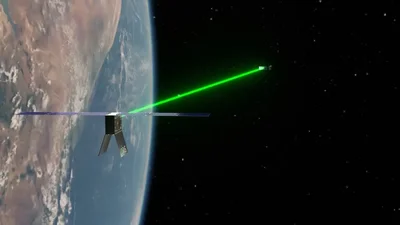
ORiS is developing technology that uses lasers to transmit power to satellites. The company has tested the technology on the ground, using it to transmit power to drones hovering 100 meters from the transmitter.
In space, one spacecraft equipped with a laser would transmit power to another spacecraft, which would be able to receive the power using its solar arrays without modifications.
“We worked on a laser system with a combination of multiple lasers that can allow us to be compatible with existing satellites and with every kind of solar panel out there,” said Andrea Villa, co-founder and chief executive of ORiS, in an interview.
The funding will allow the 15-person company to test the technology in space next year. On one mission in the first quarter of 2027, ORiS will work with Dcubed to demonstrate laser power transmission over a distance of 10 meters. Villa said the company plans a second demonstration mission next year with an undisclosed partner.
“With these two launches, we will demonstrate the building blocks,” he said. “We will then be ready to launch a third mission with one of our first clients we already have, and the aim will be to demonstrate the feasibility of the service.” He declined to identify the customer beyond saying it is one that operates satellites to host payloads for others.
Wireless power beaming has attracted interest as a way to provide more power to satellites and allow them to operate with smaller solar arrays and batteries. Star Catcher Industries, a Florida company working on power-beaming technology, raised $65 million in a Series A round in May.
The Defense Innovation Unit recently issued a solicitation for commercial power-beaming technologies with a goal of having an operational capability for military applications by the end of the decade.
Villa said there are several differences between what ORiS is pursuing and what Star Catcher is planning. While ORiS intends to use lasers to transmit power, Star Catcher will instead focus sunlight onto the solar panels of customers’ satellites.
“With lasers, you can have a much more compact system instead of the big lenses like Star Catcher is using,” he said. “But it may be much cheaper to launch lenses and mirrors like they are using compared to a laser system. So, it’s always a tradeoff.”
A bigger difference between the two companies, he argued, is positioning. While Star Catcher has highlighted the use of its technology for orbital data centers, he said ORiS is focused on supporting a larger number of smaller spacecraft using a network of tens to hundreds of its satellites.
“Both approaches are extremely valuable, for different reasons,” he concluded.
The ground-based testing using lasers to power drones has become its own line of business for the company. That terrestrial system, called LOONA, has received support from NATO’s Defence Innovation Accelerator for the North Atlantic, or DIANA, program.
“We started looking at this concept as a step to demonstrate technological feasibility,” he said of those tests. “Eventually we received a lot of interest from institutional and private entities.”
“Right now, we’d like to continue with that line of business, and we can enter the market by the end of this year,” he said. “We don’t want to lose this opportunity.”
That terrestrial business was also attractive to investors. “ORiS’ dual-use roadmap combines near-term validation with an ambitious vision for the future,” Koen Christiaens, managing partner at Pitchdrive, said in a statement. “LOONA gives the company a faster path to validating its core wireless power technology and building commercial momentum, while supporting its broader vision of making energy more accessible in space.”
ORiS also has ambitions to use that laser power-beaming technology on the moon to support exploration missions there. Such a system could help missions handle issues like the 14-day lunar night, when solar power is not available.
“It’s something very long term in the future, but it’s quite in synergy with what we are building,” Villa said. “So it’s a seed that we are planting today, and hopefully in the future, we will see some development.”