‘A long winter for house prices’: Melbourne market’s steepest drop in four years
Save
You have reached your maximum number of saved items.
Remove items from your saved list to add more.
AAA
Melbourne house prices slumped 3.1 per cent – or about $30,000 – in the past quarter, and further falls are expected as rate rises and tax changes chill the property market.
The median price for a house in Melbourne in the June quarter was $1,041,205, the latest Domain House Price Report, released on Thursday, revealed. The median unit price stayed relatively steady at $587,137, down just 0.05 per cent over the same period.
“It is the steepest drop in almost four years for house prices … For houses and units, this is two consecutive quarters of decline,” Domain’s chief residential economist, Nicola Powell, said. “And this is just the start, really.”
Only Sydney’s house prices have fallen more in the past quarter – at 3.3 per cent – but both are declining from a December peak.
Powell pointed to negative consumer sentiment, fuelled by three consecutive rate rises this year and an overall increase in the cost of living, as helping to drive prices down in the past three months.
“People take their time to make their decisions, [and] they second guess themselves,” she said.
She thought a further rate rise this financial year was unlikely, but believed “the damage had been done”, exacerbated by the changes to negative gearing and the capital gains tax discount announced in the May budget – midway through the June quarter.
“We cannot point the finger at any one reason,” she said, but thought there was “no doubt” the tax changes would have caused investors to hold back from buying, which could flow on to first home buyers cautious about buying in a falling market.
The impact was felt particularly in more price-sensitive areas. Houses in the inner city, inner east and inner south recorded the biggest falls, while more traditionally affordable areas such as the north-east and north-west grew in the past quarter.
Melbourne’s median house price is cheaper than Sydney, Brisbane, Perth and Adelaide as the mid-sized capitals continue to rise in value.
Westpac senior economist Matthew Hassan was not so optimistic this year’s rate rises were over – the bank is anticipating increases in both August and September, and its consumer sentiment surveys suggest most Australians are already factoring them in.
He agreed it was difficult to disentangle the impact of rate increases from the Albanese government’s tax changes in terms of what was driving down prices.
“I suspect it was probably about 50-50 for the June quarter,” he said. However, he thought the tax changes were more likely to be felt in the next quarter.
“There’s a degree of paralysis that’s emerged – uncertainty around tax policy changes is just leading both buyers and sellers to hold off … It could be a long winter for housing markets in Australia,” he said.
Both Powell and Hassan said buyers might also be holding off in fear of buying before the market hits its true bottom – especially while affordability gains from lower house prices are offset by higher interest rates.
“[They think], ‘If I wait another couple of months, I might actually be able to afford to be in the street that I want to, or afford to buy that extra bedroom,’” Powell said.
While it might not yet be the bottom of the market, first home buyer Emmet Mulcahy found himself able to afford more than he expected when it came time to buy.
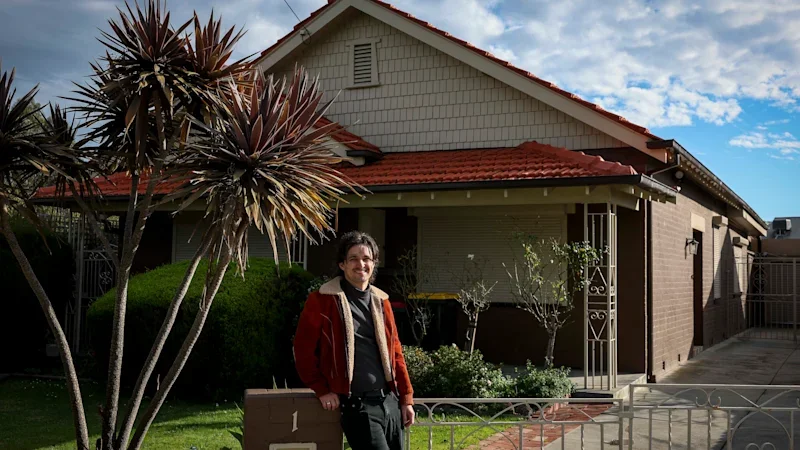
Emmet Mulcahy found he and his wife, Sophie, were able to buy in a suburb they thought they had been priced out of thanks to falling house prices.Eddie Jim
The 30-year-old university lecturer and his wife, Sophie, bought a three-bedroom house in Coburg North in late June for $905,000, after discovering houses in areas they had previously considered out of the question had become more affordable.
“The absolute dream was always having a proper, fairly large house with a nice outside area,” he said. “Anything in Coburg or Coburg North, we had written off as out of our price range.”
With a baby on the way, securing a larger first home, closer to the city than the couple were expecting, has been a blessing.
The pair bought using the federal government’s Help to Buy scheme, which allows lower-income buyers to buy with a minimum 2 per cent deposit, with the federal government contributing to up 30 per cent of the purchase price for established properties – 40 per cent for new builds – for a share of the property’s equity.
“We were never going to be able to buy a property without [it],” Mulcahy said.
The couple’s agent, Nelson Alexander Brunswick’s Mark Verrocchi, thought it was clear first home buyers’ purchasing power had increased.
“I think that the ones that are taking the advantage currently and are having a go at an auction are being rewarded,” he said.
He also thought the impact of rate rises – and potential for missing out on a lower price – would only be felt for so long.
“If you want to actually live there for the next 10-odd years … I think it doesn’t really matter as much,” he said.
Save
You have reached your maximum number of saved items.
Remove items from your saved list to add more.