I boarded Europe’s new bus with business class-style seats for a 12-hour trip
Andrea Sachs
July 23, 2026 — 5:00am
Save
You have reached your maximum number of saved items.
Remove items from your saved list to add more.
AAA
The two drivers of a bus in Barcelona bound for Switzerland climbed the stairs of the Twiliner double-decker and stopped by each passenger’s seat for a predeparture briefing. Before setting off into the night, they needed to show the travellers how to sleep.
Sleeping horizontally is common on overnight trains where the seats or benches convert into beds. Fully unfurling your body on a bus is rarer. Riders can usually recline a few inches, but stretching out on your back? Only in your dreams.
Twiliner aims to be a more affordable and environmentally friendly alternative to flying.Getty Images
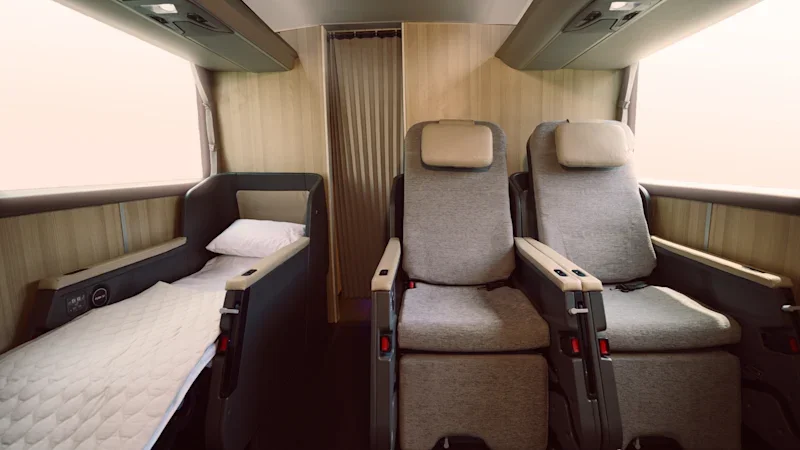
Twiliner, which launched in November, is hoping to revolutionise coach travel as Europe’s only provider of night buses with fully reclinable seats. Its 21 lie-flat seats resemble the cushy convertible pods that economy passengers pass en route to their cramped seats in the back of the plane.
“We initially started from scratch. How do we get people from A to B in the most comfortable way?” said Joël Béla Bernauer-Bourgeois, a Swiss industrial designer and co-founder of Twiliner, which holds full intellectual property rights on its seat design. “The inspiration was the business-class seat in aviation.”
Though budget travellers can often fly within Europe for cheap, Bernauer-Bourgeois touts the overnight bus as a less expensive and more environmentally-friendly alternative to flying, especially when paired with a hotel. According to Swiss government calculations, the coaches emit up to 85 per cent fewer carbon emissions per passenger-kilometre than a flight on a similar route. Environmental agencies and organisations regularly cite the short-haul flight as one of the biggest polluters in the industry and urge travellers to opt for greener modes of transportation, such as trains or buses.
Sign up for the Traveller newsletter
The latest travel news, tips and inspiration delivered to your inbox. Sign up now.
The Twiliner’s 21 lie-flat seats resemble the cushy convertible pods you’d find in business class on a plane.
Over the years, I have attempted sleepovers on long-distance buses and trains in North America and Europe, and discovered that, even in a supine position, restorative rest can be elusive. The swaying or jerky motion combined with the cacophony of sounds – rattling and rustling, honks and whistles, snores and snorts – can turn even the most exhausted traveller into a wired insomniac.
But I wasn’t giving up. Perhaps the Twiliner could lull me to sleep?
“You enter the coach, and grab your cup of tea. You have big windows so you can watch your surroundings, but then you pull down the curtains, put your seat in the bed position and brush your teeth downstairs,” said Bernauer-Bourgeois, setting the dreamy scene. “You go to sleep and awake, hopefully refreshed, in the city center of your destination.”
Booking passage on an overnight bus
Several times a week, Twiliner buses travel between Zurich and Amsterdam and Zurich and Barcelona. Passengers can ride to the end point or disembark at an intermediary stop, such as Brussels, Rotterdam, Luxembourg or the Swiss city of Basel on the Amsterdam line or Girona, Spain or Bern, Switzerland, on the Barcelona route.
The forward section of the upper deck contains the bulk of seating – four rows with three seats each.Getty Images
For my midweek journey in early July, I purchased a one-way ticket from Barcelona to Bern, the penultimate stop before Zurich. Without traffic or other delays, the roughly 941-kilometre journey should take about 12½ hours. My €170 ($276) fare included a full set of linens, bottled water and unlimited tea and coffee from the self-serve shared kitchenette. By comparison, a one-way flight, which would take about two hours, plus hotel would have cost more than twice as much.
Booking online was a cinch. After choosing my route, I selected a seat, which, as a light sleeper who values her personal space, required the strategic skills of a wedding planner or four-star general.
The forward section of the upper deck contains the bulk of seating – four rows with three seats each, with an aisle separating the pair and the single. There are also two rows aft of the stairs plus a row on the lower level, wedged between the drivers’ cab and the bathroom, changing room and kitchen area.
Great views on the upper deck.Getty Images
Though a front seat up high would have been the most panoramic – at least before the squished bugs smudged the views – I worried about feeling pinned in by other passengers beside and behind me. The seats on the first floor were too close to the lavatory and the drivers, who would rotate shifts during the night. The back of the bus appeared empty, so I reserved a solo seat, hoping the squares on seating chart remained empty.
With only eight people on the journey, they did.
Boarding and settling in
The Twiliner bus was scheduled to depart Barcelona Nord Station at 7.30pm. I waited by the bay, in the sweltering heat, with several other passengers, including Lisa Conzelmann, a Swiss teacher returning home after a year in Madrid.
“The train was too expensive, and I didn’t want to fly,” said Conzelmann, who was trying to minimise her expenses and carbon emissions. “I spent three hours researching FlixBus, but you have to sit up.”
The on-board bathroom.
Conzelmann had planned to leave two nights earlier, but the company cancelled her trip due to “technical problems.”
The bus pulled up a few minutes late, and Rene Aquino and Martin Fulo, our chirpy and cheerful drivers, hopped out. They checked off our names and stored the larger pieces of luggage. With no overhead bins or racks, the smart packers among us had filled a smaller bag with sleepover essentials.
My accommodations were as tidy as a hotel room. On the seat, I found a short stack of clean, folded bedding, including a sheet, a light quilted blanket and a case for a pillow tucked inside a purple tote.
Aquino and Fulo dropped by to demonstrate the removable tray table and seat settings, which ranged from ramrod straight to slouchy lounger to full prostration. They also explained a safety feature called a “restraint bag” that would prevent me from sliding forward and slipping under the lap belt in the event of a crash. It resembled a large fisherman’s net that I couldn’t squirm out of.
Aquino warned me against placing my bag by my feet. Pointing at an unoccupied seat, he explained how, on an earlier trip, the footrest had collided with a traveller’s luggage. It was one of four seats stuck in daytime mode.
Before sleep
With so few passengers, we had room to move – literally. The drivers told us we could spread out or relocate. This was not the case the night before, they said, when all 21 seats were occupied.
While we still had natural light streaming through the tall windows, I explored the bus.
I started in the kitchen, which was stocked with chilled drinks (juice, soda, water) and snacks (pretzels, paprika potato chips, protein bars) available for purchase by QR code. A hot beverage station offered assorted teas, a jar of instant coffee and coffee pods, but no brewing machine.
Up the steps and toward the front, I met two Swiss friends returning from a yoga vacation in Barcelona. They had just finished their takeout dinner and were contemplating their next activity: Remove their contact lenses? Change into their pajamas? Put on their shoes?
“I once got upgraded to first class, and this really feels like that, so I’m excited,” said Lea Whitcher, an actor and comedian based in Zurich. “But I don’t know how well we will sleep. We didn’t sleep well at the yoga retreat, because it was too hot.”
Unlike many European lodgings, the bus was frostily air-conditioned, which was perfect for me.
The pair had booked round-trip tickets, but Twiliner nixed the southern leg because of, once again, “technical issues.” (According to the company, it had to cancel or rebook a number of trips on a third bus deemed inoperable because of “permanent technical issues.“) Though they had wanted to do right by Mother Earth, under such short notice, their only other option was to fly.
While we were chatting, we heard a loud thud. A swallow had flown into the bus. Strike two against Mother Earth.
Around midnight, we stopped for gas in Montpellier, France. Inside the mini-mart, I loaded up on soaps, herbs and scented sachets from Provence while Aquino filled his tank with hot chocolate.
Back on the road, smelling like a lavender field, I prepared for bed.
In the changing room, I slipped on sleepwear appropriate for public display and brushed my teeth. The sink water was not potable; it was also dangerously hot. I used the water in my flask to rinse and wash my face.
The restroom, heavy on the signage, was spotless. We were advised to use the toilet paper sparingly, to fill the toilet bowl with water (a simple press of a button) and to sit down regardless of gender.
Making up my bed
Step 1: Press the “bed” button on the armrest and watch with awe as the seat wriggles and kicks, transforming into a full-fledged bed.
The seat in lie-flat mode.Getty Images
Step 2: Place the sheet over the bed, remove the safety netting from its compartment and clip it in. Plop down the pillow.
Step 3: Lie down, stick legs straight out in the restraint bag, secure the seat belt and cover body with the blanket.
Step 4: Sit up, itchy.
Step 5: Swaddle body in the blanket so the scratchy restraint bag does not touch bare skin.
Step 6: Wait for sleep to come.
Sleeping - kind of
I have never been tied to a gurney, but I suspected the Twiliner’s setup was similar to a medical transport. I could barely move my legs, which meant the restrainer bag was working.
“For safety reasons, please remain lying on your back for the entire duration of the trip,” the instructions read.
After a futile attempt at curling up on my side, I dozed. But I also woke up a lot. On two occasions, I peered out the window and noticed that we were parked, once for a shift change and again when, as Fulo later told me, the cab door wouldn’t properly shut. I bolted awake for a traffic jam at the Swiss border crossing. As soon as I started seeing sunflower fields, shimmery blue lakes and snowcapped Mont Blanc, I knew I was up for good.
The Twiliner’s beds were a comfortable cocoon.Getty Images
Twelve hours later, we arrived in Bern. The drivers had saved time by skipping Girona, but a detour in Avignon, France, had set us back 45 minutes.
Honestly, 8 a.m. suited me just fine. Any earlier and I would have just wanted to crawl back into bed, even one on a bus.
The takeaway
The Twiliner’s beds were a comfortable cocoon. Once I adapted to the limitations on my limbs, I slept-ish. Fortunately, occupation was low, so I had privacy and relative quiet.
Sleep, of course, was not the primary purpose of the trip, nor was speed: Flying would have been much faster, even when I factored in travel to the airport and security. I was seeking an adventure, and the Twiliner delivered. Though I did drag a little during my day in Bern, I could also blame the heat for my sluggishness.
So, would I take the Twiliner again? Absolutely. Would I ride the Twiliner if I needed to be well-rested the following day? Possibly, but only if I had a real bed at my final destination, preferably with an early check-in so I could catch up on any missing zzzs.
The Washington Post
Save
You have reached your maximum number of saved items.
Remove items from your saved list to add more.