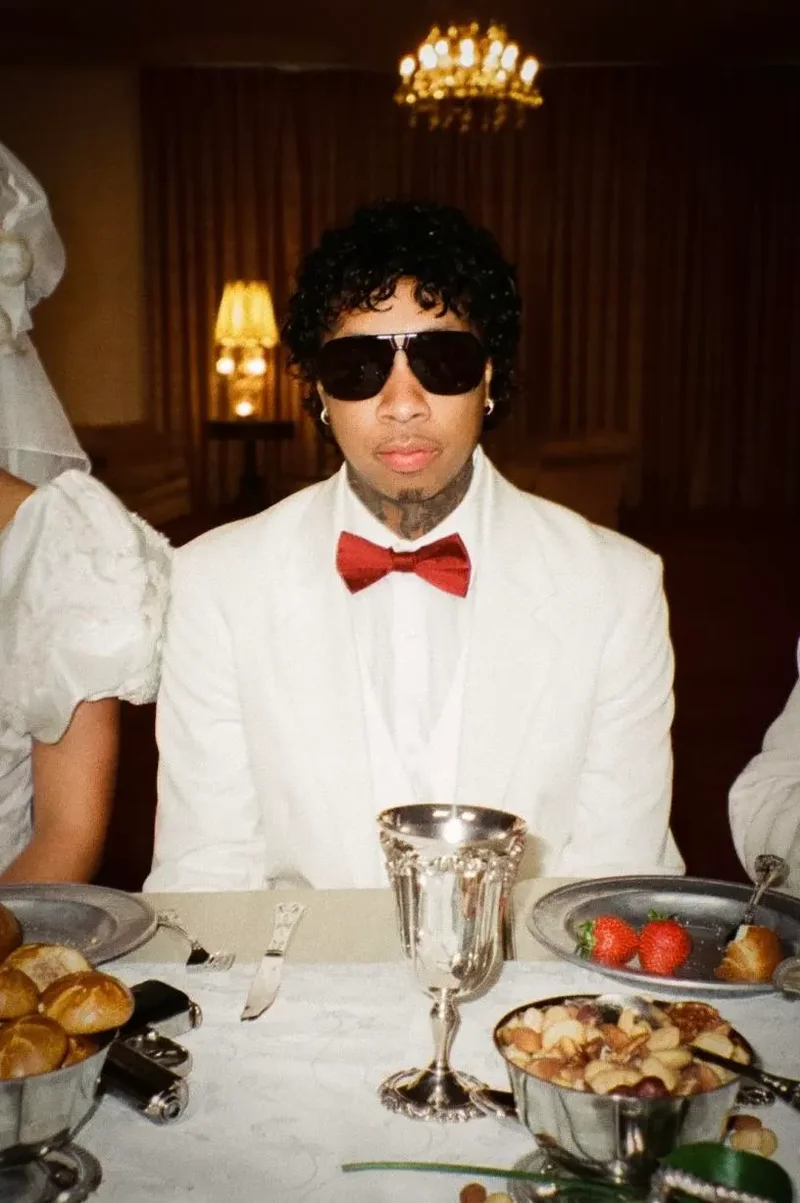
There was a time when music didn’t just live in headphones—it lived beneath neon marquees, echoed through movie theaters, and soundtracked midnight drives down palm-lined boulevards. It was an era when artists became larger than life, building entire worlds through sound, style, and storytelling. Fifteen years after “Rack City” catapulted Tyga into hip-hop’s cultural lexicon, the Los Angeles artist is returning to that same philosophy—not by recreating the past, but by stepping inside it. With $TARFACE, released July 31, 2026, Tyga trades familiarity for mythology, introducing an alter ego that blurs the line between creator and character.
For a visionary whose career has already stretched across nearly two decades, the project feels less like a reinvention and more like an evolution. At a time when moments disappear as quickly as they arrive, Tyga created something designed to breathe—to unfold scene by scene, melody by melody. The result is not just an album, but a cinematic journey through a world only Tyga could imagine—and $TARFACE could inhabit.
Act I: Enter $TARFACE
Every cinematic universe begins with a single scene. For $TARFACE, that scene wasn’t born in a recording studio—it flickered from the silver screen.
The inspiration behind the project begins with Scarface—but not in the way most would expect. While the 1983 classic became synonymous with Tony Montana’s relentless rise, Tyga found himself drawn to the quieter story unfolding beneath the chaos: the romance between Tony and Elvira. The relationship, often overshadowed by themes of ambition and destruction, became the emotional blueprint for everything that followed.
“What if they did a soundtrack just for the love story of Scarface and Elvira?” Tyga recalls. “And that’s what I wanted $TARFACE to be.”
Rather than revisiting Tony Montana’s empire, the album explores the emotions surrounding it through songs like “AFFECTION.” It unfolds like a lost film reel, beginning with ambition before giving way to intimacy, vulnerability, and romance—less a retelling of Scarface than a reimagining of the story hidden beneath its surface.
The idea had been taking shape for years. While bringing the upcoming Baby, You’re a Star to life—a coming-of-age musical drama set in the 1980s that marks Tyga’s feature film debut, with the artist starring, producing, and co-writing the project alongside Curtis Bryant—he became immersed in the decade’s unmistakable rhythm and larger-than-life creativity.
Somewhere between building that world on screen and shaping music in the studio, Tyga realized he had found a creative space beyond the identity audiences already knew. “I really was just heavily immersed in the '80s stuff. I just felt like this would give me the creative freedom to explore outside of the Tyga brand,” he says.
The solution was not to reinvent Tyga—it was to create someone who could exist alongside him. “I wanted to do an alter ego and create something that can live in its own world, its own space... completely separate than what I do.”
That idea shaped every corner of the album. From the stylized dollar sign and all-capital lettering to the visuals and fashion, every detail adds another layer to the mythology surrounding the character. “Everything is intentional... the whole aesthetic, the world building... $TARFACE is its own character.” For Tyga, the project is more than an alter ego—it is a story unfolding beyond the music itself.
Act II: Before $TARFACE, Before The Lights Went Neon
When Tyga looks back at the artist who released “Rack City” compared to where he stands today, he sees someone who has learned how to navigate the ever-changing landscape of music. “I’ve learned way more about the politics in the music industry and how to do things,” he says.
The world surrounding his early career moved differently. “It was more fun because of the freedom to put out music. You could record something and just upload it, put music out directly to fans.” That era rewarded discovery. Fans found music because they were searching for something new—not because an algorithm placed it in front of them.
Now, Tyga believes the way music is created and consumed has shifted. “People weren’t really focusing on trying to go viral. They were just making a product. I think now people focus on trying to create conversation or trying to go viral to promote something.”
That shift is part of what pushed Tyga toward something more immersive. In a world built around the next thirty seconds, he wanted to create something that could exist beyond the moment. Something with a beginning, middle, and end. Not just a release. A story. One that could keep playing long after the credits rolled.
Act IV: $TARFACE After Dark — Miami Nights & Crisp Suits
The world of $TARFACE is painted in the colors of a very specific moment in history. For Tyga, “’83, ’84, ’85 was... the peak time of the ’80s”—a period when music, fashion, and pop culture collided in a way that felt limitless.
It was the era of Thriller, Purple Rain, Madonna, and larger-than-life personalities who transformed themselves into cultural events. For Tyga, the magic of that period wasn’t only in the sound—it was in the confidence. Artists weren’t simply releasing music; they were creating identities, aesthetics, and entire worlds audiences wanted to step inside. “It was a party. It was fun...”
That same spirit carried into the music itself. The songwriting of the era became another source of inspiration, particularly its directness and simplicity. Tyga was drawn to the way artists of that period could communicate emotion without overcomplicating the message. “It was very direct, like a conversation.”
That approach became a creative compass for the album, where Tyga focused less on trying to prove something and more on creating moments that felt natural. "I'm not trying to overly say something cool... As long as the melodies are catchy.”
The visual language followed that same philosophy. Drawing inspiration from Miami Vice, Tyga wanted to capture the energy of the decade without turning it into a costume. The goal was not to recreate the past—it was to create a character who felt like he belonged there. “I wanted to keep it functional... to where it wasn’t too costume-y.”
That attention to authenticity extends into every detail, including one of the most talked-about elements of the aesthetic: the hair. When asked whether the unmistakable hairstyle was a wig or his own, Tyga offered little explanation, leaving the question exactly where it belongs: unanswered. “I don’t know. That’s his own thing,” he says mischievously, allowing the moment itself to become another layer of $tarface’s persona.
Much like the character itself, the look exists somewhere between reality and performance—a visual signature that keeps people wondering. The result is a style that feels like it could have stepped out of a nightclub in 1985 and still command attention today.
Act V: The Artist Behind The Alter Ego
Behind the designer sunglasses and cinematic imagery is the same instinct that has defined Tyga’s career: a deep connection to the creative process.
Throughout his catalog, Tyga has maintained a hands-on role in shaping his music, writing his own records and approaching each project with the mindset of a producer—even when he isn’t the person physically creating the beat. “I’ve always been like that. From day one, any music that I've ever released, it was always... written by me.”
For him, making music has never been about simply stepping into a finished product. He approaches each record like someone building from the ground up, understanding how every element contributes to the final picture. “I kind of look at it more from a producer mindset.”
That instinct has followed him since the beginning. Whether reworking a song’s structure, reshaping a beat, or combining different sounds into one cohesive piece—as heard on tracks like “GAVE U RACKS”—Tyga says he has always known exactly how he wants a record to feel. “I know exactly how I wanted to hear the music. I know exactly how the chord progression should change here. I always knew exactly how I wanted it to sound.”
That same attention to detail carried into this project. Rather than approaching the album as a series of individual songs, Tyga treated it as a complete vision—one where every sound, visual, and creative decision served a purpose. “I get a beat, get the files, I break it down, and I put something from a whole other producer in this beat and then chop it up...”
To describe his approach, Tyga returns to a familiar image: an artist standing in front of a blank canvas, slowly transforming an idea into something complete. “It’s like painting. You get a blank canvas, and then you just... paint. And then at the end you’re like, ‘Damn, that sounds good.’”
Act VI: As The Credits Roll, Tyga’s $TARFACE Lives On
For artists with careers measured in decades rather than album cycles, legacy is not built in release weeks—it is built in return visits. Tyga understands that this project may not be something every listener immediately understands, and he seems comfortable with that possibility. “I think people are just going to go back to it. You don’t have to immediately understand something or appreciate it right away—you can sit with it, live with it, and come back to it.”
Rather than chasing instant consensus, Tyga views the album as something designed to evolve alongside its audience. In his mind, it is still growing—not musically, but culturally.
“I’m still world-building. I’m about to do the first two $tarface shows. People are still seeing the process... and some people will feel like they're building with me too.”
That philosophy feels increasingly rare in an industry driven by opening-week numbers and viral moments. “The people who take risks are the ones who actually get rewarded down the line. People eventually look back and say, ‘You know what? I appreciate that.’”
Having already built a catalog filled with defining moments, Tyga no longer feels obligated to recreate what audiences already know. Instead, he is chasing curiosity. “Once I put it out in the universe, I feel good about it. And now I can move on to the next one.” Because for Tyga, this was never just about creating a moment—it was about creating something that could live beyond one.
In a world moving faster than ever, he is choosing to slow the camera down. The lights are dimming. The synths are rising. And as the credits begin to roll, Tyga and $TARFACE aren’t leaving the frame—they’re preparing for the next scene.